Earlier quoted context omitted.
Exactly, and all on an embedded system with quite restrictive settings and no overclocked Intel lastest generation combined with NVIDIA's 10k graphic cards.
Embedded systems can make network calls to powerful, GPU equipped servers.
OpenCV 5 Is Here: The Biggest Leap in Years for Computer Vision
61–70 of 160 posts
Re: OpenCV 5 Is Here: The Biggest Leap in Years for Computer Vision
#62> One practical detail is worth knowing. The new engine is CPU-only at the moment, so if you select a non-CPU backend and target (for example CUDA or OpenVINO through setPreferableBackend and setPreferableTarget), you will want the classic engine. So there's room for even better performance!
No one uses ONNXRuntime (nor the new engine in OpenCV 5) in production. For anything performance-sensitive, one would run models under TensorRT, as an example.
Re: OpenCV 5 Is Here: The Biggest Leap in Years for Computer Vision
#63AI written release post and it shows...
The diagrams definitely look like LLM output as well
I personally don't mind AI generated content when it's properly reviewed, but unfortunately more often than not the author just glances at the result and decides it's good enough.
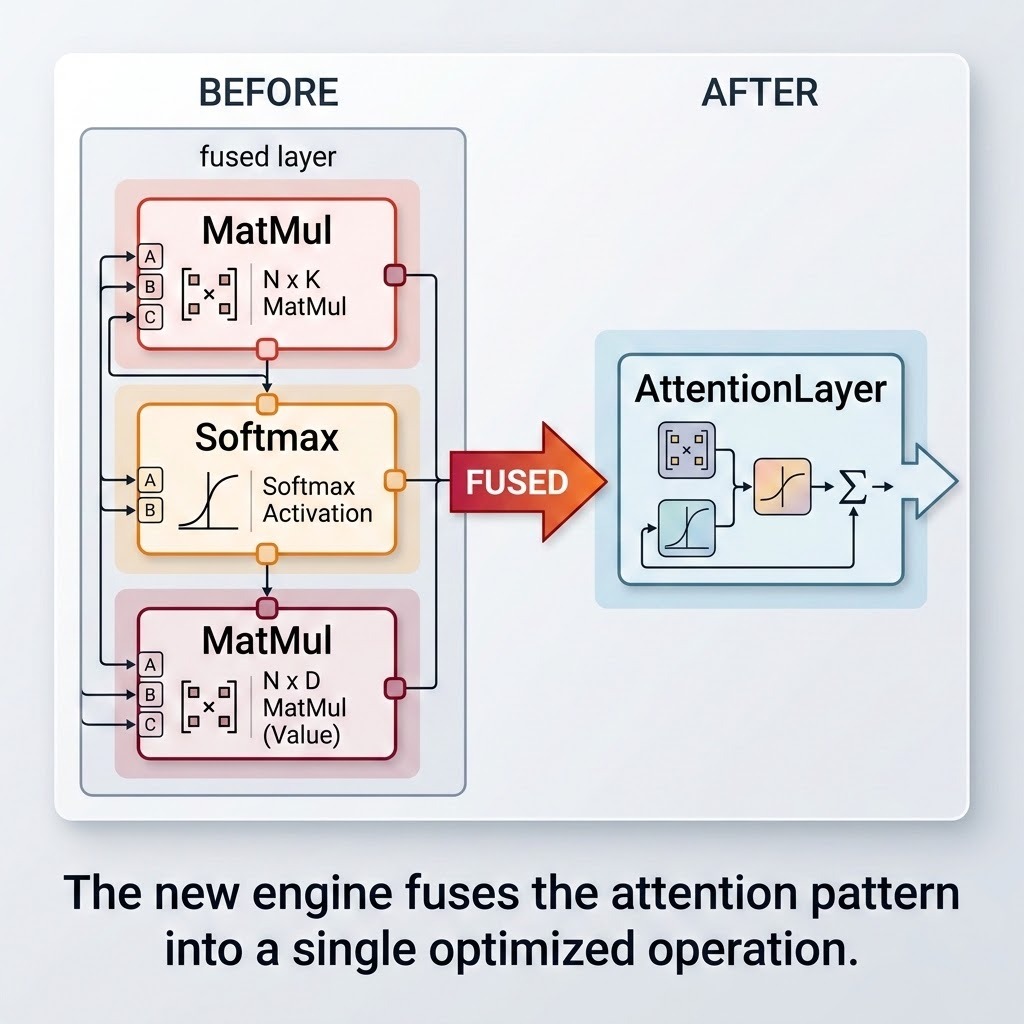
Example: https://opencv.org/wp-content/uploads/2026/06/image-1.jpeg
I'm not knowledgable enough to determine whether this diagram is 100% accurate, but some things look off - the arrows in the bottom left seem superficial, some arrows are connected in weird ways, the mini diagram in AttentionLayer block doesn't look right (it has two Softmax icons and one MatMul icon, while the "before" diagram is the opposite).
Re: OpenCV 5 Is Here: The Biggest Leap in Years for Computer Vision
#64> LLMs and VLMs, Running Inside OpenCV…Qwen 2.5, Gemma 3, PaliGemma, and the GPT-2 / GPT-4 family Why these specific models / versions?
Re: OpenCV 5 Is Here: The Biggest Leap in Years for Computer Vision
#65AI written release post and it shows...
Re: OpenCV 5 Is Here: The Biggest Leap in Years for Computer Vision
#66Can it detect the speed of the car without any hand-made measurement ?
Re: OpenCV 5 Is Here: The Biggest Leap in Years for Computer Vision
#67Re: OpenCV 5 Is Here: The Biggest Leap in Years for Computer Vision
#68Re: OpenCV 5 Is Here: The Biggest Leap in Years for Computer Vision
#69Re: OpenCV 5 Is Here: The Biggest Leap in Years for Computer Vision
#70The thing I love about OpenCV is that it remains hands down the best library for simply loading images and video. I've never even used any of its fancy computer vision features, but if I need to load a video file and look at the pixels - which I did need to do recently for an art project - OpenCV does it in about four lines of code.
However, it has a few issues:
1. Patented algorithms that are effectively impossible to license in a commercial setting.
2. Permuted API that change how identically named functions behave over versions.
3. Hardware CUDA version coupling deprecating support every major release.
4. Inconsistent and contradictory documentation in the constant subtle permutations. Downstream projects tend to version lock the lib for really practical reasons.
5. A shift away from core C libraries like ImageMagick & V4l, and into C++ abstractions with legacy Swig wrapper libraries in Java or Python.
6. Perpetual-Beta culture means the library will unlikely ever really fully stabilize.
It is a fun library, until people actually try to deploy something serious. As users will often simply suggest using an old version release if there is a bug.
Everything from Build flags to the API documentation has never fully stabilized. ymmv =3