Live data from Hacker News

Minnesota becomes first state to ban prediction markets

npr.org

111–120 of 256 posts

Re: Minnesota becomes first state to ban prediction markets

#111
post #86
post #50

Earlier quoted context omitted.

They also place their own bets within their own market. They don't just make money on trading fees.

Kalshi does not trade against its users.

Kalshi definitely does this

They just don't make any money off it.

Re: Minnesota becomes first state to ban prediction markets

#112
post #96
post #50

Earlier quoted context omitted.

They also place their own bets within their own market. They don't just make money on trading fees.

A different entity provides liquidity. There’s no house like in sportsbooks.

And there is no house in pool betting, poker or backgammon either. We still count all of them including betting exchanges (what has now been rebranded as prediction markets) are still normally regulated as gambling.

Re: Minnesota becomes first state to ban prediction markets

#114

Earlier quoted context omitted.

I think sports betting is a lot less harmful than prediction markets. With sports betting if someone throws a game to get a pay day, for instance, the only real consequence is on the reputation of the sport. In prediction markets, people can do all sorts of awful things to make money as insiders..

First, over 90% of the wagers on Polymarket and Kalshi are already on sports (quoting John Oliver's Last Week Tonight on that one). Despite the headlines, Kalshi and Polymarket are mainly just sportsbooks. Second, while yes, some of the markets available on prediction markets can push people to do awful things, there are plenty that are harmless. I'm cherry picking to make an extreme point, but I would so much rather…

Technically they are betting exchanges. But they also probably have contracts with some of the big sportsbooks to provide liquidity too making them also kinda a sportsbook. I used to work at a betting exchange and we did have liquidity partners that made sure to increase the liquidity on our exchange.

Re: Minnesota becomes first state to ban prediction markets

#115
post #22

Earlier quoted context omitted.

There’s no “house” or “book” aspect to Kalshi. They are nothing more than contracts that are bought and sold between individuals.

Lots of types of contracts bought and sold between individuals are prohibited by law.

They problem is the federal government considers these particular contracts are generally legal, and the states have no authority.

Re: Minnesota becomes first state to ban prediction markets

#116
post #7

as the article notes, prediction markets are regulated by the CFTC as a commodities futures contract, so I'm not sure how any state law survives a federal pre-emption challenge. On the other hand, it's a little unusual to see a federal agency suing to protect its turf. Would've expected a class action by a Minnesota user of the service to bring the challenge instead.

I'm curious to see how this works out, because sports betting is _not_ in the CFTC's remit, and Kalshi etc's argument that states can't regulate them because they're not technically sports betting is contrary to the spirit of the law

What if CFTC would start to claim they are allowed to regulate online casinos or online poker? I feel that would be about as non-sensical.

Re: Minnesota becomes first state to ban prediction markets

#118

Earlier quoted context omitted.

> Sure, but that's not really an argument to ban prediction markets, it's an argument to regulate what the public can or cannot bet on. I wasn't making any argument above in either way. But the reality is that sports betting is not legal in much of the US. DraftKings is only legal in about half of US states. Minnesota does not permit DraftKings to operate in their state. They don't permit any kind of online gambling…

I totally agree with your response to my first point. I have another comment in this thread that might be at the top right now, but I basically say that I think the fact that Minnesota, a state that has a complete ban on online sports betting, is bringing this case actually gives them an advantage over previous states who've brought cases because the entire argument can just be "if it walks like a duck and talks like…

> as opposed to trying to explain why betting on the Super Bowl on Kalshi is somehow different than making the same bet on DraftKings.

I think the answer to that is also the same: if they're the same thing, and both are gambling, then Kalshi should have to be subject to gaming regulations and inspections the same as DraftKings is. Gaming is highly regulated even where it is legal.

Personally I don't have an issue with gambling, and I also don't have an issue with states that decide to ban it.

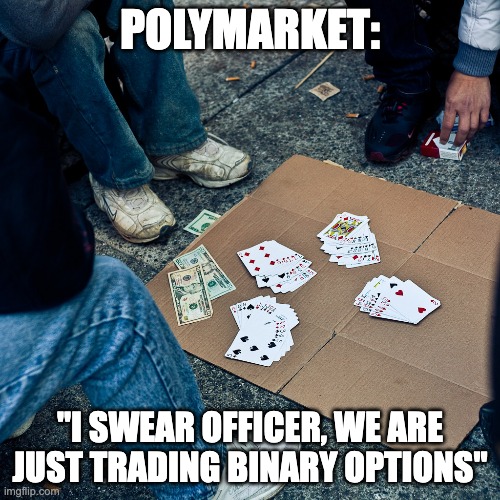
But I do have an issue with Polymarket, Kalshi, etc, using bullshit language to pretend they're not doing what they are obviously doing. They are obviously booking wagers. And as such, they are subject to the laws that states have outlined regarding those that take wagers.

https://i.imgflip.com/as8d2j.jpg
Re: Minnesota becomes first state to ban prediction markets

#119

It’s hard to pretend this isn’t at least gambling-adjacent when most people are simply betting on outcomes.

Given that exactly the same thing has been regulated as gambling in Europe under the name "betting exchange" for 25 years the case for it being gambling is quite strong.

Re: Minnesota becomes first state to ban prediction markets

#120

Earlier quoted context omitted.

I'm curious to see how this works out, because sports betting is _not_ in the CFTC's remit, and Kalshi etc's argument that states can't regulate them because they're not technically sports betting is contrary to the spirit of the law

> because sports betting is _not_ in the CFTC's remit Traditionally it has not been, but the current CFTC says that 'prediction bets on sports' ARE under their purview. This has not been fully challenged in court, though.

If Congress intended for the CFTC to regulate sports betting, it would have had that language in the act that originated the agency. It's telling that only recently the CFTC has discovered such authority. No previous leadership of the CFTC read the act to mean what the current leadership thinks it means.
Post reply on HN