Live data from Hacker News

Screenshots of Old Desktop OSes

typewritten.org

261–270 of 407 posts

Re: Screenshots of Old Desktop OSes

#261

Earlier quoted context omitted.

If that's a problem for you, you have much to gain with better window management shortcuts. On KDE I have the Windows key + left click set to drag a window from anywhere , and win + right click to resize depending on the quadrant the cursor is on. It's incredibly satisfying not having to hunt titlebar empty spaces or thin edges.

But do you see that title bar buttons are bad explicitly because you have to hunt for title bar edges? That you were more or less forced to adopt these KDE shortcuts so that you could work around the fact that they had cannibalized the title bar for a purpose it was not designed for. You were forced to change your workflow and everybody else is having to be forced to adapt because they changed a metaphor that has rem…

The arguments in this thread-- amounting to "it's a good general practice because I happen to like it" (rather than "it is a sane / discoverable / usable default") are precisely demonstrating why these issues exist.

UX design is treated as a subjective matter, as if it is equally valid to clearly label UI elements as it is to have magic, nondescript UI pixels that serve as vital control surfaces.

Go watch videos of the research Xerox did on UI/UX and HCI in general, and weep for what we have lost...
Re: Screenshots of Old Desktop OSes

#263

Earlier quoted context omitted.

> Too many developers nowadays don't know this. Guess they've never been on the phone with an elderly relative in tears because she can't figure out basic tasks on an iPad anymore after years of learning how. That's when you realize you, as a highly-skilled technical person, can't either, because they've moved, hidden, or otherwise obfuscated them. Yesterday I learned there are two icons in the Files app called "..."…

Even with screen sharing, I've said "click the three dots" and then "no, not those, not that one, wait there's another one, no that's the wrong one ..."

But if we didn’t use ••• menus everywhere then some parts of the UI might be cLuTtErEd!!! The worst sin of computing.

To think that we used to trust mere mortals - without even a signing certificate or developer membership - with the power to customize every toolbar in a Microsoft application, and to set every font and color for the whole UI of the system. People made their computer environments ugly in some cases. And it was fine, because they owned those freaking computers, so who the heck has any business telling them not to?

Sorry, clearly it bugs me a lot how much we’ve lost.

Re: Screenshots of Old Desktop OSes

#265
post #259

Earlier quoted context omitted.

> This sort of worked when the opinionated manager was Steve Jobs. Steve indirectly had a hand in this, by emphasizing the humanities. That, unfortunately, backfired as a sort of positive feedback loop. Someone hired a few underemployed artists onto the team, and the artists invited all their friends and soon took over the department. People that in an alternate timeline would be smoking weed whilst sculpting wood in…

You are so very spot on with this. All of it. Literally nothing is better in the UI world in the past 20 years. Zero. We already had multitouch scrolling on laptops back then. I don’t think it’s a stretch to say that most of the problem can be traced back to the transition to Mobile first design. The motivations were arguably pretty innocent in general. If there were no downsides, it’s nice that there isn’t a separat…

> And because of fashion...

That's basically the curse. Fucking fashion. If that human concept wouldn't exist, UIs today would be way way better. But no, we have to keep changing it forever and with each iteration worse and worse. UI enshittification at its pinnacle.

Re: Screenshots of Old Desktop OSes

#266

Earlier quoted context omitted.

You want Linux. Hardware features are contained in the kernel. GUI has nothing to do with them. GUI frameworks provide features for applications to draw their UI. A selection of numerous windows managers and desktop environments allows you to choose the best GUI shell to work in. It is somewhat of a bazaar, with different components sometimes not fitting perfectly into each other and there's a constant migration to a…

No thanks, I do not want Linux. I use Linux for my home servers and at work, and I'd like to keep it that way, at arm's length. I don't know why people suggest Linux for desktop use at the first swoop. I dislike it. I dislike how janky its various GUI desktop managers are, I dislike how edge cases that are handled straightforwardly on Windows just aren't on Linux. Things like high pixel density, different audio setup…

> I dislike how it is 'developers first' and not 'users first',

There are user-centric and dev-centric Linux distros. Windows is "Microsoft cloud onboarding" centric, and the experience has been dramatically degrading for years.

If that were not the case, why would senior executives at Microsoft say things like "we've heard you" and "we intend to reverse the suck in the coming year"? Even their management knows users hate the Win11 experience, and have placed it on their backlog....

> I dislike how janky its various GUI desktop managers are...igh pixel density, different audio setups, multi-touch trackpad support

These things are objectively better on a modern KDE linux. Out of the box I can output youtube videos to a dual-Sonos / Airpod setup by... clicking the sound icon, which pulls up an interface reminescent of "Windows 7, when the mixer wasn't terrible".

The reasons not to use KDE these days are because you need Windows software (usually: edge, teams, Office), or especially because LibreOffice is terrible. The core desktop experience, however, is notably and demonstrably less jank than the mess that is Windows 11.

Re: Screenshots of Old Desktop OSes

#268
post #49

I can't help thinking about how much we have lost. Just finding the scrollbar nowadays can be a challenge. Not to mention if you want to resize a pane - in some applications they seem to have taken extra steps to make it difficult to find the line to grab.

Operating systems of that era were designed based on UX research to help people use the unfamiliar operating system. Subsequent ones were designed by UI designers, and opinionated senior managers, who already knew how to use them, and took out usability features to make them "look nicer". This sort of worked when the opinionated manager was Steve Jobs. Most managers are not Steve Jobs. > in some applications they see…

> based on UX research to help people use the unfamiliar operating system.

It's worthwhile to note that this was not just research in a vacuum, but a lot of user studies where they literally watched and studied people using the software and how they were confused, found or didn't find functionality, etc. Lots of interviews, talking to people, boiling things down to how actual people struggled with the software.

Re: Screenshots of Old Desktop OSes

#269
post #267

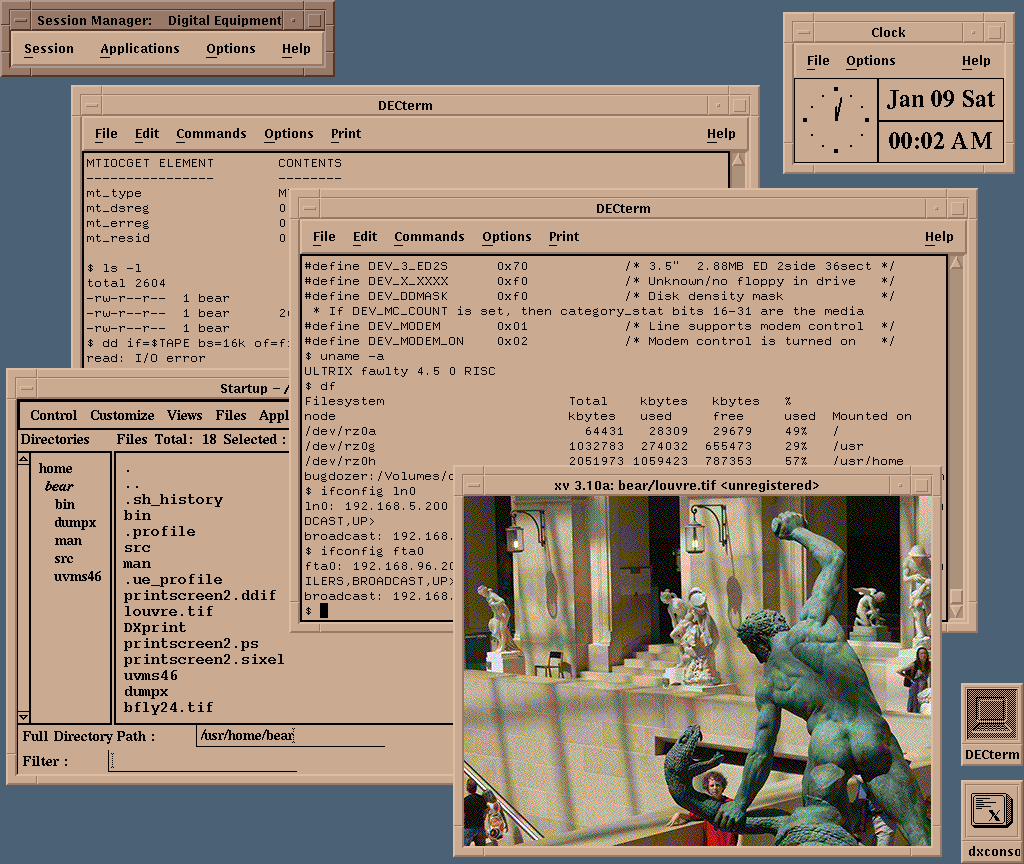
That page does not include VMS DECwindows Motif, so here is a link: https://www.xanthos.se/~joachim/OpenVMS.html VMS DECwindows Motif 1.0 was released in August 1991; it is difficult for me to comprehend that was 35(!) years ago. I still have a mouse pad from the release party.

There is the very similar Ultrix version:

http://www.typewritten.org/Media/Images/decwindows-ultrix4.5...

Re: Screenshots of Old Desktop OSes

#270

There's a lot of nostalgia in the comments here. I wonder if any reader under say 25 is willing to comment; do you think OS's today are a regression? do those look better? To me they look unwieldy, heavy and overwhelming and I can't help but think the love for them is just the love for youth or whatever

Hi! I'm slightly under that so I feel like I'm qualified :)

I wholeheartedly agree, they're quite a regression.... although I don't think this is a popular opinion around here.

When people say "something used to be better" they usually don't mean literally, they mean that for the circumstances, it was better. Of course, more modern systems support more hardware, more features, etc., but if you made those same modern technical improvements on top of an older designs, you'd get much better results.

To me it looks like software design has been massively overtaken by "form over function", everyone just wants a unique "brand" but the actual UX is complete dogshit. Borderless buttons, zero indication what's clickable, no visual delimiters for different areas of programs, no good shortcut / altkey menu support, etc....

This has somehow infected even Linux to such a crazy extent...

Post reply on HN