Live data from Hacker News

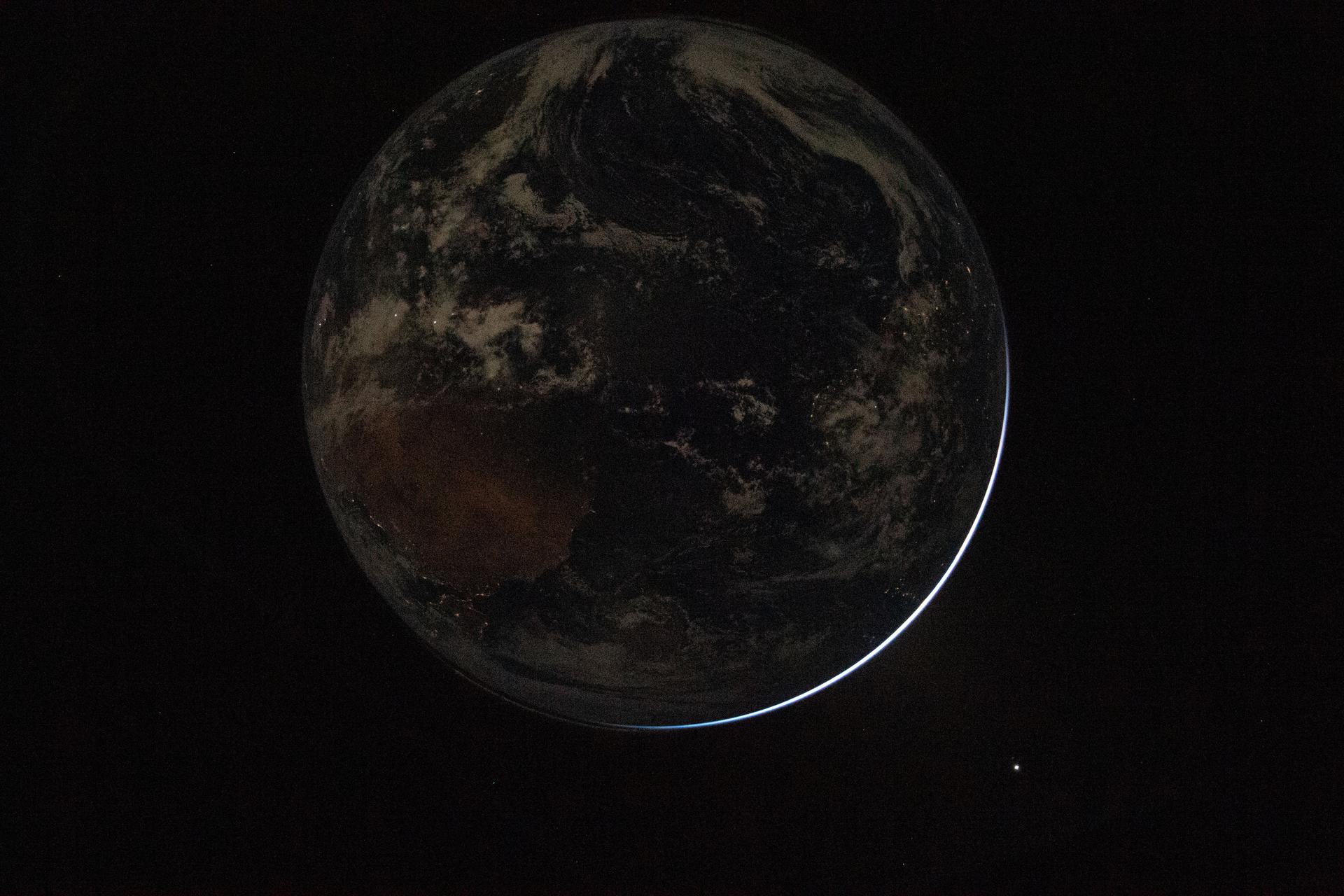
Artemis II crew take “spectacular” image of Earth

bbc.com

81–90 of 419 posts

Re: Artemis II crew take “spectacular” image of Earth

#81

Looking at the EXIF (with exiftool) for the image uploaded by NASA ( https://www.nasa.gov/wp-content/uploads/2026/04/art002e00019... ), apparently this was taken by a Nikon D5 with an AF-S Zoom-Nikkor 14-24mm f/2.8G ED and developed with Lightroom. It also seems like very little was done in Lightroom. Amazing... I dumped the whole EXIF here: https://gist.github.com/umgefahren/a6f555e6588a98adb74eed79d...

While the D5 is a great camera it's ~10 years old. Wonder why they didn't go for the Z9 which is its modern mirrorless equivalent.
Re: Artemis II crew take “spectacular” image of Earth

#82
It really is crazy when you think about it, we're capable of taking a picture of the planet we live on from outer space. We take it for granted, that we know what it all looks like. I often find myself wondering how ancient peoples before us would react to something like this

Re: Artemis II crew take “spectacular” image of Earth

#83

Looking at the EXIF (with exiftool) for the image uploaded by NASA ( https://www.nasa.gov/wp-content/uploads/2026/04/art002e00019... ), apparently this was taken by a Nikon D5 with an AF-S Zoom-Nikkor 14-24mm f/2.8G ED and developed with Lightroom. It also seems like very little was done in Lightroom. Amazing... I dumped the whole EXIF here: https://gist.github.com/umgefahren/a6f555e6588a98adb74eed79d...

Before Lightroom it might have looked closer to this: https://images-assets.nasa.gov/image/art002e000193/art002e00...

Re: Artemis II crew take “spectacular” image of Earth

#84
post #81

Looking at the EXIF (with exiftool) for the image uploaded by NASA ( https://www.nasa.gov/wp-content/uploads/2026/04/art002e00019... ), apparently this was taken by a Nikon D5 with an AF-S Zoom-Nikkor 14-24mm f/2.8G ED and developed with Lightroom. It also seems like very little was done in Lightroom. Amazing... I dumped the whole EXIF here: https://gist.github.com/umgefahren/a6f555e6588a98adb74eed79d...

While the D5 is a great camera it's ~10 years old. Wonder why they didn't go for the Z9 which is its modern mirrorless equivalent.

Government budgets man…

Re: Artemis II crew take “spectacular” image of Earth

#88
post #81

Looking at the EXIF (with exiftool) for the image uploaded by NASA ( https://www.nasa.gov/wp-content/uploads/2026/04/art002e00019... ), apparently this was taken by a Nikon D5 with an AF-S Zoom-Nikkor 14-24mm f/2.8G ED and developed with Lightroom. It also seems like very little was done in Lightroom. Amazing... I dumped the whole EXIF here: https://gist.github.com/umgefahren/a6f555e6588a98adb74eed79d...

While the D5 is a great camera it's ~10 years old. Wonder why they didn't go for the Z9 which is its modern mirrorless equivalent.

> Wonder why they didn't go for the Z9 which is its modern mirrorless equivalent.

From [0], "The D5 was chosen for its radiation resistance, extreme ISO range (up to 3,280,000), and proven reliability in space." (

[0] https://www.photoworkout.com/artemis-ii-nikon-d5-moon/

Re: Artemis II crew take “spectacular” image of Earth

#89
post #81

Looking at the EXIF (with exiftool) for the image uploaded by NASA ( https://www.nasa.gov/wp-content/uploads/2026/04/art002e00019... ), apparently this was taken by a Nikon D5 with an AF-S Zoom-Nikkor 14-24mm f/2.8G ED and developed with Lightroom. It also seems like very little was done in Lightroom. Amazing... I dumped the whole EXIF here: https://gist.github.com/umgefahren/a6f555e6588a98adb74eed79d...

While the D5 is a great camera it's ~10 years old. Wonder why they didn't go for the Z9 which is its modern mirrorless equivalent.

Zero point in measuring camera sizes (or other sizes haha) when JWST is floating there.

Re: Artemis II crew take “spectacular” image of Earth

#90
post #53
post #36

Earlier quoted context omitted.

South America is visible on the right, and it looks to me like part of North America might also be pictured close to the horizon. Higher-resolution image: https://www.nasa.gov/wp-content/uploads/2026/04/art002e00019...

Oh, good point. I missed South America under the cloud cover. I guess the Eastern edge of the US would indeed be visible as a highly distorted smudge on the edge of the visible surface. For a view of roughly the same half of Earth, but with less clouds, if you rotate the image clockwise by 150 degrees you get roughly this viewpoint of the earth: https://earth.google.com/web/@3.63731074,-23.1618975,-2690.7...

Thanks!

There's a heading control to include rotation in link: https://earth.google.com/web/@3.63731074,-23.1618975,-2690.7...

Post reply on HN