Live data from Hacker News

Artemis II crew take “spectacular” image of Earth

bbc.com

31–40 of 419 posts

Re: Artemis II crew take “spectacular” image of Earth

#31
post #30
post #26

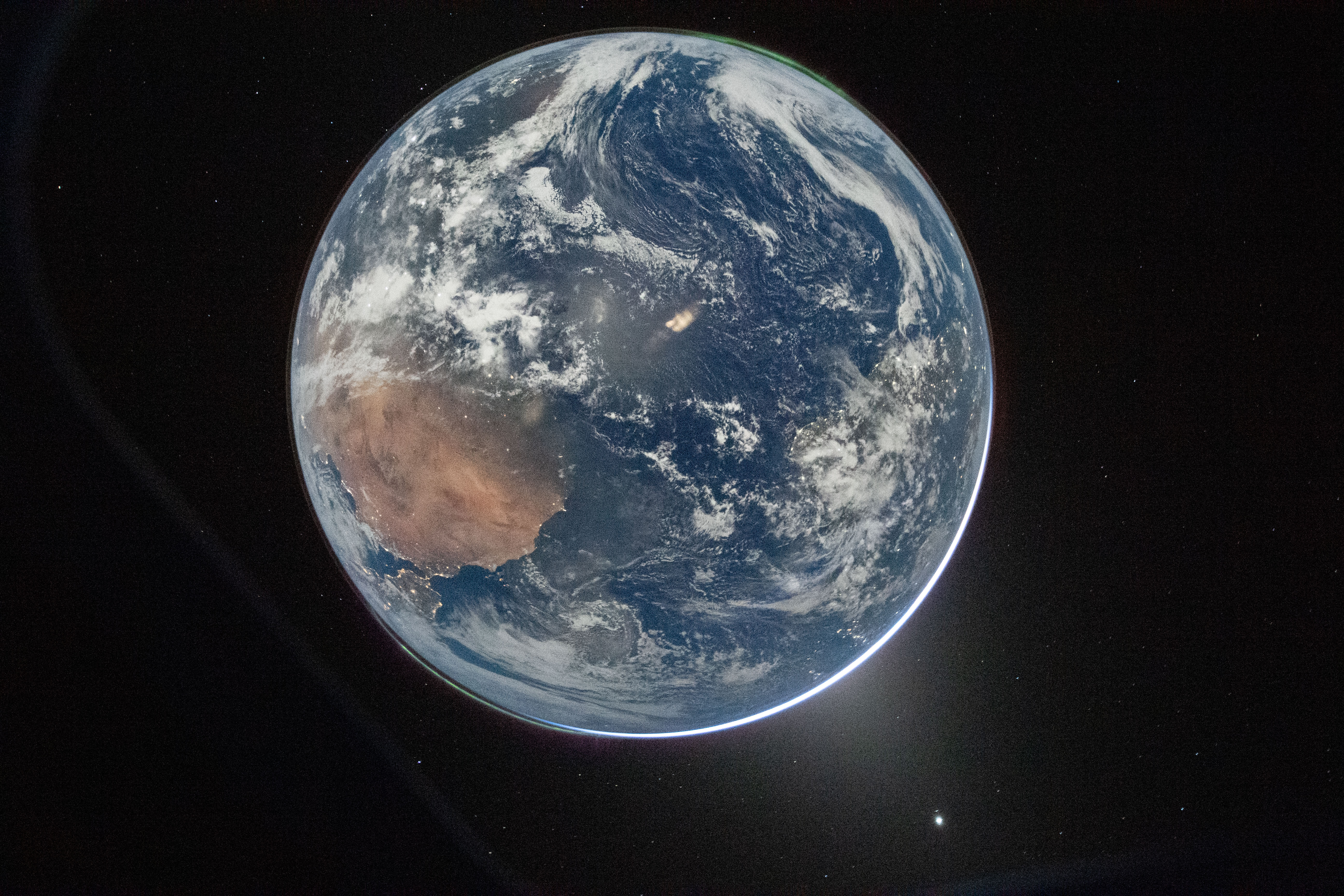
How come the pictures have such bad quality ? Is it a bandwidth issue ? Or there are really constraints that are not so obvious ? Because fundamentally it is a large object illuminated by sunlight.

It's the night-side Earth, taken at a high ISO value to keep shutter speed fast to prevent blur.

Ok thank you, makes more sense, I thought it was the day-side
Re: Artemis II crew take “spectacular” image of Earth

#32
post #10

Earlier quoted context omitted.

They're here: https://www.nasa.gov/gallery/journey-to-the-moon/ Direct link to this image: https://www.nasa.gov/wp-content/uploads/2026/04/art002e00019...

That version is ~~brightened significantly~~ (edit) a longer exposure; I like the darker one better. https://www.nasa.gov/image-detail/amf-art002e000193/

They're two separate photos, just taken at different exposure settings.

Re: Artemis II crew take “spectacular” image of Earth

#33
post #15
post #11

I was confused when I first saw this photo, as I don't think I've ever before seen a nightside, moonlit Earth, exposed so that it looks like the dayside at a first glance. I wonder how many casual viewers actually realize it's the night side. A nice demonstration of how moonlight is pretty much exactly like sunlight, just much much dimmer. In particular it has the same color, even though moonlight is often thought of…

It explains why the image is so grainy. At first I was confused what that stripe to the left and the bottom was. But it’s just the window edge, and the noise isn’t stars.

Well one of them is obviously Venus. How did you determine the others weren't stars?

Re: Artemis II crew take “spectacular” image of Earth

#34
post #31
post #30

Earlier quoted context omitted.

It's the night-side Earth, taken at a high ISO value to keep shutter speed fast to prevent blur.

Ok thank you, makes more sense, I thought it was the day-side

Yes, I was also confused when I first saw it – how could the aurora be visible?! The bright sliver of atmosphere in the lower right is, of course, backlit by the sun which is itself eclipsed by Earth. It's the near-full moon that provides most of the illumination here. Besides both auroral rings you can also see airglow, city lights, and lightning flashes, it's a marvellous photo.

Re: Artemis II crew take “spectacular” image of Earth

#35
post #28
post #15

Earlier quoted context omitted.

It explains why the image is so grainy. At first I was confused what that stripe to the left and the bottom was. But it’s just the window edge, and the noise isn’t stars.

(To be clear, the bright dots are stars [except the brightest one, in the lower right, is Venus I think], which makes this photo also a great demonstration that of course you can capture stars in space, you just have to expose properly!)

How do you know that they're stars? I believe they probably are stars as well (by visual comparison with a star chart, suitably rotated), but I've found no source for either claim.

I did find multiple sources, including TFA, for the brightest being Venus.

Re: Artemis II crew take “spectacular” image of Earth

#36
post #25

I object to being included in this image without a model release and demand that pixel be removed.

Your comment history suggests you're in the US, so you should be pleased to learn that you weren't included. The visible landmass is northern Africa, with a smidge of the Iberian Peninsula visible.

South America is visible on the right, and it looks to me like part of North America might also be pictured close to the horizon.

Higher-resolution image: https://www.nasa.gov/wp-content/uploads/2026/04/art002e00019...

Re: Artemis II crew take “spectacular” image of Earth

#37

Come on flat-earthers. I know you are out there. Lets hear your crazy rant about how this is a fisheye lens on a weather balloon or a webcam atop the eiffel tower. Why can't we see the poles? And is that an ice wall on poking up in the lower-right quadrant of the disk?

My guess is the answer is: We didn’t really launch Artemis. This is all CG.

> This is all CG.

Reminds me of the classic - It is true that Spielberg filmed the moon landings, but he was such a perfectionist that he wanted to shoot on location.

Re: Artemis II crew take “spectacular” image of Earth

#38
post #28
post #15

Earlier quoted context omitted.

It explains why the image is so grainy. At first I was confused what that stripe to the left and the bottom was. But it’s just the window edge, and the noise isn’t stars.

(To be clear, the bright dots are stars [except the brightest one, in the lower right, is Venus I think], which makes this photo also a great demonstration that of course you can capture stars in space, you just have to expose properly!)

Just answered my own question to my satisfaction; they are stars.

The same specs, which match star charts, show up in two images taken a few moments apart at different exposures (links were given down-thread).

Re: Artemis II crew take “spectacular” image of Earth

#39

Come on flat-earthers. I know you are out there. Lets hear your crazy rant about how this is a fisheye lens on a weather balloon or a webcam atop the eiffel tower. Why can't we see the poles? And is that an ice wall on poking up in the lower-right quadrant of the disk?

Flat Earth is a distraction or a way to ridicule any counter-narrative to anything scientific. When a cosmologist says that a planet nobody can see exists and is made of x% helium and is y light years away etc etc with absolute certainty despite nobody being able to go there and witness any of it (look how wrong they were about Pluto’s appearance), then you can always just say “what are you a Flat Earther” and easily…

Do you believe in Antarctica?

Re: Artemis II crew take “spectacular” image of Earth

#40
post #11

I was confused when I first saw this photo, as I don't think I've ever before seen a nightside, moonlit Earth, exposed so that it looks like the dayside at a first glance. I wonder how many casual viewers actually realize it's the night side. A nice demonstration of how moonlight is pretty much exactly like sunlight, just much much dimmer. In particular it has the same color, even though moonlight is often thought of…

It’s a remarkable photo. You can see the aurora Australis at the top right of the image (it’s upside down, if there is such a thing - that’s the straits of Gibraltar at the lower left, and the Sahara above it - and the skein of atmosphere wrapping the entire planet. Those look like noctilucent clouds in the north, or possibly more aurora.

It really is gorgeous. You can see both auroral rings, then there's airglow, and city lights around Gibraltar and on the South American coast, and lightning flashes in the storm clouds over the tropics.
Post reply on HN