Live data from Hacker News

Artemis II is not safe to fly

idlewords.com

531–540 of 667 posts

Re: Artemis II is not safe to fly

#531

Earlier quoted context omitted.

> The sealant and O-rings did not succeed in keeping the hot gasses inside (evidence: Challenger). They were not adequate No. The whole assembly --joint, sealant and O-rings, -- failed. "They were not adequate" - yet, after the redesign, they kept those same O-rings and declared that boosters are safe to fly, in manifest contradiction to your assertion. So your reasoning is clearly flawed.

> "They were not adequate" - yet, after the redesign, they kept those same O-rings presumably "redesign" means some stuff changed. why is it not possible that the O-rings were inadequate for the old design, but adequate for the new design?

>why is it not possible that the O-rings were inadequate for the old design, but adequate for the new design?

Boneheads getting lucky, happens to the worst of them more often than lots of people want to admit :\

I came from Florida and am not a fan of cold weather.

That morning of course nobody knew about defective engineering at NASA contractors when it comes to o-rings. I got in to work, and the office people had turned on the seldom-used little black & white TV in the office manager's room so they could watch the Challenger launch. That was about the only time anybody watched TV at work, except for baseball playoffs when they occasionally occur in the afternoon.

It was 19 Fahrenheit at the launch site so I never thought for a minute that they would go through with it. It was simple common sense. You don't even try anything "normal" during the one day per decade when it gets that cold, and that would be in north Florida. You wait years for it to get below freezing at 32 F, especially on the central Florida Atlantic coast. And no matter what, you never have to wait long for it to get above freezing. I just naturally couldn't imagine anyone not fully on board with living to wear shorts another day. I was thinking about the rubber seals that must be there to keep the crew hatches airtight, for one thing, but aware there were countless other variables which I didn't have a clue about that could also be cold sensitive, like electronics.

I went into the back where my lab office was, thinking they were surely going to delay the launch, at least to later in the day. I didn't get back to the front office until a little after liftoff time, where I expected to find out how much of a delay or reschedule there was. It was very quiet. I asked what happened and they said "it blew up!" I actually thought they were kidding me because I missed the liftoff. Then I saw the tragic replay that was enough to make anybody sick.

Eventually, the o-rings were pointed to, and publicly disclosed and it was stupidly worse than I imagined.

A few years earlier I had experienced a dramatic o-ring blowout on some high-pressure apparatus that one of our engineers had designed at a previous employer. That was an engineering lab, and I'm no engineer but it turned out they needed more help than just chemistry lessons for experiment design. Since I was the one who had taken a reading within the blast zone minutes before I went back to my desk, I took over the redesign of the heavy-walled high-pressure custom cylinders, going over every little thing from alloy properties, dimensional characteristics, reinforced thread strength, etc. It was helpful that I had worked in a machine shop before, but I was the only one there who had any full time experience at metal fabrication. Well constant overtime really. When I got to the critical o-ring design parameters, that alone required more engineering effort than the rest of the project. Each standard o-ring has its own precision design parameters, highly dependent on the durometer hardness of the rubber among many other things.

Without considering durometer, here's a very simplified chart of some key parameters (primarily US inch units):

https://d2t1xqejof9utc.cloudfront.net/pictures/files/186532/...

There's way more data than this and most of it was gathered over decades of serious destructive testing & analysis.

And here's a pretty good article about the Challenger fiasco:

https://clearthinking.co/the-teleconference-before-the-chall...

Plus a color diagram that may be a little clearer:

https://onlineethics.org/sites/onlineethics/files/Challenger...
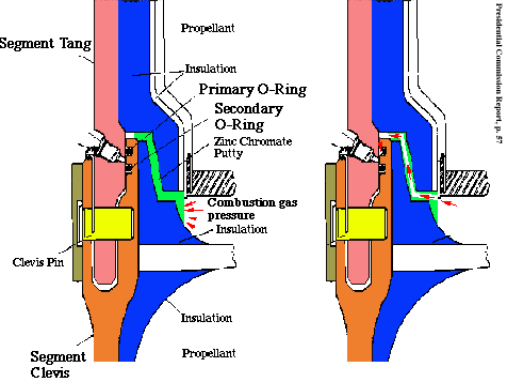
Never did look into the Challenger o-rings this much until now, all I knew was that defective o-ring design is more likely than not, and you would be a fool to use any o-ring that was not standard size without the equivalent of decades of destructive testing yourself.

All I needed to know was these o-rings circled the entire booster, so that alone was a no-no since it was nowhere near standard. Now in the clearthinking article I see the nominal measurements, 38 feet in circumference but only 1/4 inch thick. Yikes, what were they thinking? No wonder they used two o-rings, it was plain to see that one would never be enough :\

Look back at the d2t1xqejof9utc.cloudfront chart. Notice that a 1/4 inch thick o-ring is not expected to have nominal reliability outside the tolerances listed.

Notice the Groove depth and the gland depth are two different things but actually need to be as close as you can get in practice, within 3 thousandths of an inch altogether across the entire (38 foot!) diameter, or half of that when measured at any one point on the arc. This requires some precision machining and quite rigid metal substrates or it will never come true. This is precise enough that large temperature swings would always be a factor, but more so the greater the diameter of the substrate. And the maximum eccentricity of the groove relative to its substrate must be within 0.005 inch. The widest tolerance on this little chart is the "squeeze" of the rubber to be between 0.040 and 0.055 which is not for the machine shop but depends on the o-ring thickness being within its own design specifications. Not surprised to find out they were Viton rubber which is widely known to be some of the most chemically resistant for a non-teflon compound. Probably would have been better if Thiokol also was aware how "good" Viton is for its intended purpose, strong resilience at temperatures 200 F and above, below which it doesn't seal as well as ordinary rubber. Viton is just too hard and non-tacky at room temperature by comparison.

After all these decades, now I'm even more convinced it was always an accident waiting to happen :(

Re: Artemis II is not safe to fly

#532

It's not actually Avcoat. It was changed by LM. Thw honeycomb was removed. Imagine a beehive with no honeycomb and a slop of honey is what you have. Crystallized/solid honey, but honey never the less.

It is still Avcoat, that's just the name for the epoxy+silica 'honey.' But yeah they got rid of the honeycomb structure due to labour to manually fill the cells costing too much. Seems like kind of a dumb place to draw a line with the budget considering all the overruns it already has, means that now the Avcoat is being used in a design it wasn't originally meant for

Re: Artemis II is not safe to fly

#533

This is a more balanced take, in my opinion: https://arstechnica.com/space/2026/01/nasa-chief-reviews-ori... Camarda is an outlier. The engineers at NASA believe it is safe. The astronauts believe it is safe. Former astronaut Danny Olivas was initially skeptical of the heat shield but came around. And note that the OP believes it is likely (maybe very likely) that the heat shield will work fine. It's hard for me to r…

They have analyzed the problem with 1D non-coupled models that are so poorly matched to reality they would receive an F in a high school science class. They are YOLOing it. It is insulting that clowns like yourself continue to cover for them. NASA lowers its standards every time an accident happens. When they designed Shuttle, they intended for a failure rate of 1 in 10,000 or thereabouts. Remember, it was meant to f…

You seem to have ignored an important statement in your reply. Will you be willing to put $20,000 on a bet whether or not the Artemis will have a catastrophic failure? Or willing to record a statement and release it on all of your social media if the Artemis does not have a catastrophic failure? It is extremely easy to sit on the sidelines at home and say to delay everything because something may go wrong, and you will actually be right, because eventually something always goes wrong occasionally. But the people who actually get work done have to make decisions.

Re: Artemis II is not safe to fly

#534

Earlier quoted context omitted.

We have 4 kids. Before we had our 3rd, we needed to buy a new vehicle solely because we couldn't fit 3 car seats into the back of our old car. And when traveling with kids, carrying 4 gigantic car seats plus your other luggage is not exactly as easy as you might think! It essentially rules out solo parent travel with all 4 kids. Transferring car seats between two cars, or installing car seats in a taxi, is a serious…

I don’t think your analysis is fair, but pointing out details I disagree with misses the forest for the trees. Look at what lengths you went to in order to justify and defend what is, by your own arguments, the demonstrably less safe option.

Do you think that car seat mandates (up to age 12 in my state) are good policy if the net effect is:

- a small reduction in minor injuries,

- worse childhoods and parenting experiences (difficult to quantify, but real),

- and a few hundred thousand fewer children being born in the first place,

- very few, if any, lives saved?

If yes, then cool - but I strongly disagree.

If no - then I think the evidence and details very much matter, and that's why I was happy to invest my time in them.

Re: Artemis II is not safe to fly

#535

Earlier quoted context omitted.

It's kind of sad that we've become so risk averse. Risks should be fully disclosed but let the adventurers adventure. Would Columbus' ship ever have been allowed to sail in the modern day? Proximity wingsuit flying and free-climbing is legal and people choose to do it even though the probability of death is extremely high. Spaceflight is significantly safer and far more beneficial to humanity, yet we block it. No one…

I wish I could downvote this comment more than once. It's incredibly ghoulish to use the perfectly-sensible argument that modern culture is too risk-averse to handwave away known critical safety problems . Those two things are completely orthogonal. Yes, astronauts should be willing to accept that there are "unknown unknowns" and that they will be facing some amount of unquantifiable risk, and they should be celebrat…

>Camarda is an outlier. The engineers at NASA believe it is safe. The astronauts believe it is safe. Former astronaut Danny Olivas was initially skeptical of the heat shield but came around.

How do you explain so many people believing it is safe?

The problem is risks are far too easy to brainstorm, anyone can come up with endless risks that it takes endless time to mitigate.

If I were the manager for challenger, I would have run the o-ring experiment as soon as it was brought up as a concern. Put the fuel pumps in a freezer, test if they leak. Feynman famously demonstrated it with a glass of icewater. Experiment is what separates made up risks from real risks, I would have definitely told the engineers to take a hike and would have hit launch if they couldn't provide experimental evidence of o-ring failure in cold temps. (Spoiler alert: in that case they easily could have)

Re: Artemis II is not safe to fly

#536
post #292

I'm literally guest lecturing at a Harvard class tomorrow on systemic failures in decision making, using the Columbia and Challenger disasters as case studies, and changed my slides last night to include Artemis II because it could literally happen again. This broken safety culture has been around since the beginning of the Shuttle program. In 1980, Gregg Easterbrook published "Goodbye, Columbia" in The Washington Mo…

May as well link the full report too. IMO, this is a bit easier to read.

https://ehss.energy.gov/deprep/archive/documents/0308_caib_r...

Re: Artemis II is not safe to fly

#537

Earlier quoted context omitted.

Easier to manufacture usually means easier to reproduce. With something like this, you don't want variance.

Yeah that's the second part. So do they intend manufacture these en masse? If not, why not bite the bullet and manufacture it to spec, since it seems like the honeycomb is integral to the performance? Even if they do, what are we going to do with some number of deeply flawed craft?

Just manufacturing enough to cover a single craft is something you want keep as consistent as possible. Either way, I don't think the second real-world test ever should be with a crew, given the results of the first.

Re: Artemis II is not safe to fly

#538

Earlier quoted context omitted.

I wish I could downvote this comment more than once. It's incredibly ghoulish to use the perfectly-sensible argument that modern culture is too risk-averse to handwave away known critical safety problems . Those two things are completely orthogonal. Yes, astronauts should be willing to accept that there are "unknown unknowns" and that they will be facing some amount of unquantifiable risk, and they should be celebrat…

>Camarda is an outlier. The engineers at NASA believe it is safe. The astronauts believe it is safe. Former astronaut Danny Olivas was initially skeptical of the heat shield but came around. How do you explain so many people believing it is safe? The problem is risks are far too easy to brainstorm, anyone can come up with endless risks that it takes endless time to mitigate. If I were the manager for challenger, I wo…

> How do you explain so many people believing it is safe?

The article itself answers this question: institutional incentives leading to heavy social pressure to agree with the groupthink and declare something is safe when it is not. And we know that the scenario it lays out is highly possible, because it has already destroyed two Space Shuttles. Now that this has happened twice, the burden of proof is on the people saying it's not happening again, especially when the OIG's report directly contradicted what NASA had been saying about the heat shield up to that point (indicating they were lying and had to hastily retcon their story).

Re: Artemis II is not safe to fly

#539

Earlier quoted context omitted.

You still haven't explained how so many died and why the program ended.

I didn't and don't intend to. I was just addressing your incorrect figures.

How can your model be correct when it doesn’t explain the world ?

Re: Artemis II is not safe to fly

#540
post #501

Earlier quoted context omitted.

> The trip is far more awesome than anything I have planned for the rest of my life. If you would give your live for a single awsome trip (and you would still have multiple years to live), then you are likely suicidal. Even if it is rational because your live sucks so hard, I would still have to classify you as suicidal.

Is jumping on a grenade to save another person suicidal? Or is it just a matter of you not agreeing with the rational?

No. You save another person. An awsome trip isn't the same.
Post reply on HN