Live data from Hacker News

TurboQuant: Redefining AI efficiency with extreme compression

research.google

141–150 of 202 posts

Re: TurboQuant: Redefining AI efficiency with extreme compression

#141

Can someone ELI5 these two concepts please, which make no sense to me: > "TurboQuant starts by randomly rotating the data vectors. This clever step simplifies the data's geometry" I don't understand how taking a series of data and applying a random rotation could mathemetically lead every time to "simpler" geometry. If I throw a bunch of shapes on the ground, tightly packed and touching each other, then rotate all of…

> I don't understand how taking a series of data and applying a random rotation could mathemetically lead every time to "simpler" geometry.

Let's pick a simpler compression problem where changing the frame of reference improves packing.

There's a neat trick in the context of floating point numbers.

The values do not always compress when they are stored exactly as given.

[0.1, 0.2, 0.3, 0.4, 0.5]

Maybe I can encode them in 15 bytes instead of 20 as float32.

Up the frame of reference to be decibels instead of bels and we can encode them as sequential values without storing exponent or sign again.

Changing the frame of reference, makes the numbers "more alike" than they were originally.

But how do you pick a good frame of reference is all heuristics and optimization gradients.
Re: TurboQuant: Redefining AI efficiency with extreme compression

#142
This blog post sucks. It does not make me want to read the papers.

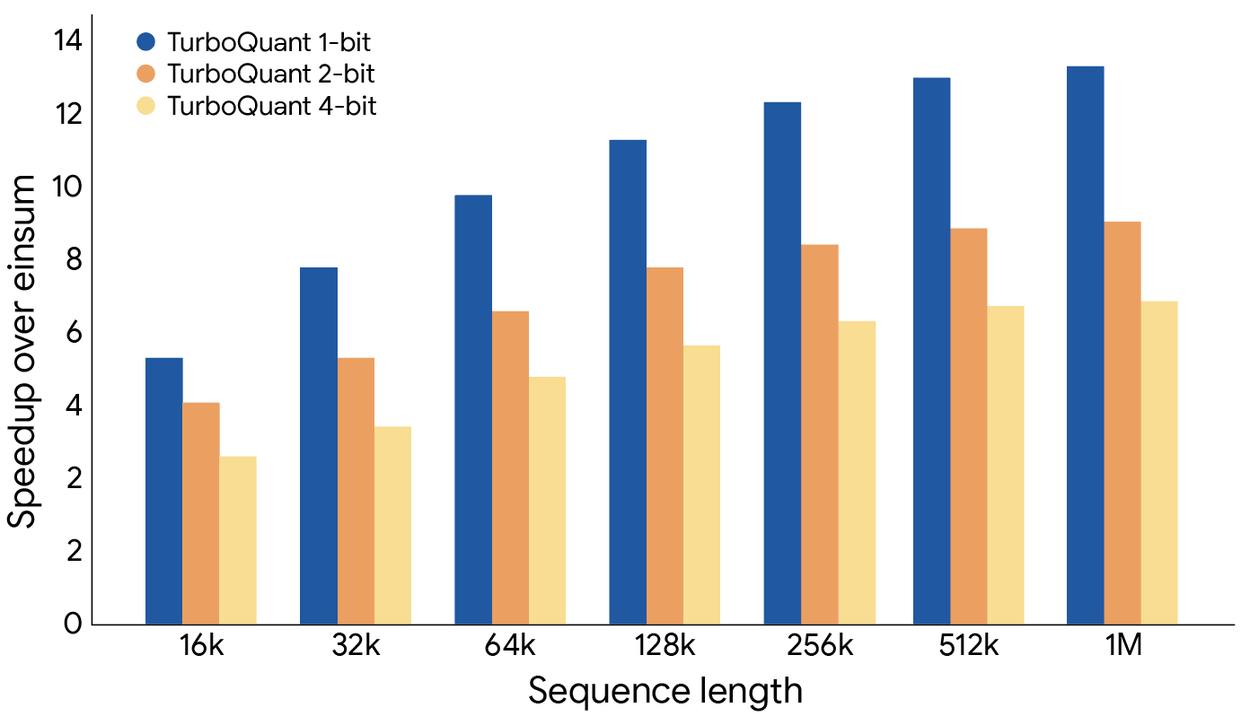
Look at this figure: https://storage.googleapis.com/gweb-research2023-media/image...

The speedup labels on the vertical axis are 0, 2, 2, 4, 6, 8... Why is 2 repeated? Did they just have nano-banana make them some charts? Can they not be bothered to use matplotlib or bokeh and directly render a graph? I don't know, maybe there is some legitimate reason that I don't know about for making a single value occur multiple times on a graph axes, but if that is the case, then they probably need to explain it in the figure caption. So it's either a "GenAI special" or it's poor communication about how to read the graph...

Look at this video visualization: https://storage.googleapis.com/gweb-research2023-media/media...

Do you have literally any clue what Polar Quantization is? Would this make me think, "I kind of have a high level understanding of that, let me go get the details from the paper."

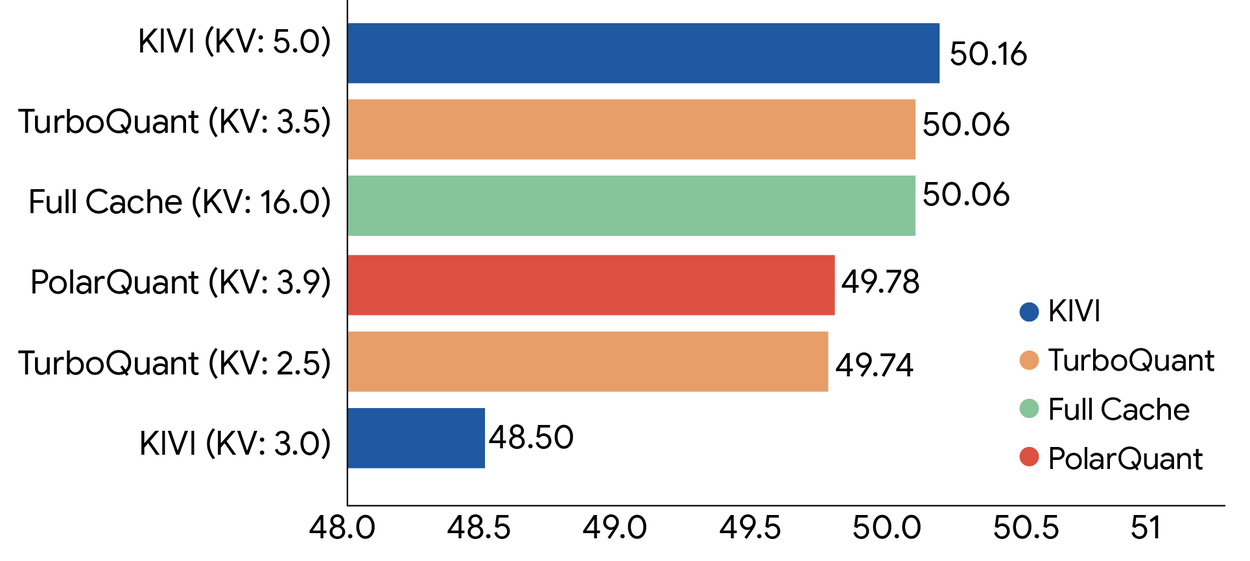
Look at this figure: https://storage.googleapis.com/gweb-research2023-media/image...

The left hand side of the graph, which is normally assumed to start at 0, starts at 48. Those MASSIVE differences you see in the figure? Only a few percent. And that's a deception but only if the figure is even accurate, because we saw earlier they can't even get figure axes correct.

Re: TurboQuant: Redefining AI efficiency with extreme compression

#143
Here's my attempt at a undergrad-level summary (corrections welcome!):

The core idea is to quantize KV cache, but do so in a way that destroys minimal information. In this case, it's similarly scores between vectors. The simplest way to do this is to change all the elements from 16bit of precision to, say, 4 bits (Scalar Quant.). These papers improve on it by realizing: almost all the energy (concentration of measure) is towards the equator of the hypersphere (normally distributed as 1/d; d=vector dimensionality). (The curse/blessing of hyper dimensionality strikes again.) So when we quantize the elements (think "latitudes", e.g. to the nearest degree) we destroy a lot of information because basically all the vectors were around the equator (so some latitudes have a lot of vectors and some have very few). The idea is to rotate the vectors away from the equator so they're more consistently distributed (to better preserve the entropy during quantization, which I guess was amitport's DRIVE idea). PolarQuant does a hyperpolar coordinate transform which superficially seems neat for preserving entropy because of this equator/polar framing (and ultimately unnecessary as shown by TurboQuant). They also realized there's a bias to the resulting vectors during similarity, so they wrote the QJL paper to fix the bias. And then the TurboQuant paper took PolarQuant + QJL, removed the hyperpolar coords, and added in some gross / highly-pragmatic extra bits for important channels (c.f. elements of the vectors) which is sort of a pathology of LLMs these days but it is what it is. Et voila, highly compressed KV Cache. If you're curious why you can randomly rotate the input, it's because all the vectors are rotated the same, so similarity works out. You could always un-rotate to get the original, but there's no need because the similarity on rotated/unrotated is the same if you compare apples to apples (with the QJL debiasing). Why was PolarQuant even published? Insu Han is solely on that paper and demanded/deserved credit/promotion, would be my guess. The blog post is chock-full of errors and confusions.

Re: TurboQuant: Redefining AI efficiency with extreme compression

#146
post #143

Here's my attempt at a undergrad-level summary (corrections welcome!): The core idea is to quantize KV cache, but do so in a way that destroys minimal information. In this case, it's similarly scores between vectors. The simplest way to do this is to change all the elements from 16bit of precision to, say, 4 bits (Scalar Quant.). These papers improve on it by realizing: almost all the energy (concentration of measure…

Some corrections: the vectors are un-rotated in practice for future query vectors. This could be removed with a slightly different LLM arch.

PolarQuant does live on in TurboQuant's codebooks for quantization which borrows from the hyperpolar coords

Re: TurboQuant: Redefining AI efficiency with extreme compression

#148

This is a great development for KV cache compression. I did notice a missing citation in the related works regarding the core mathematical mechanism, though. The foundational technique of applying a geometric rotation prior to extreme quantization, specifically for managing the high-dimensional geometry and enabling proper bias correction, was introduced in our NeurIPS 2021 paper, "DRIVE" ( https://proceedings.neurip…

LOL. This is a classical technique, Johnson-Linderstrauss etc. In this context, rediscovered every few years (recently months), e.g. here's 2017: https://proceedings.mlr.press/v70/suresh17a

Re: TurboQuant: Redefining AI efficiency with extreme compression

#150

This is a great development for KV cache compression. I did notice a missing citation in the related works regarding the core mathematical mechanism, though. The foundational technique of applying a geometric rotation prior to extreme quantization, specifically for managing the high-dimensional geometry and enabling proper bias correction, was introduced in our NeurIPS 2021 paper, "DRIVE" ( https://proceedings.neurip…

[dead]
Post reply on HN