Live data from Hacker News

VitruvianOS – Desktop Linux Inspired by the BeOS

v-os.dev

51–60 of 234 posts

Re: VitruvianOS – Desktop Linux Inspired by the BeOS

#51

Earlier quoted context omitted.

Presumably there's a lot more modern software written for Linux which you'd end up running through a compatibility layer from Haiku? The better option seems relative. I could be misremembering how Linux programmes are handled on Haiku though.

But Vitruvian is running its own graphics stack so no X11 or wayland applications will run afaict.

With xlibe they should.

Re: VitruvianOS – Desktop Linux Inspired by the BeOS

#52
post #14

If you like BeOS, take a look at Haiku https://www.haiku-os.org/ , it's very nice and very usable system based directly on BeOS.

I've been a fan of Beos philosophy since the Personal Edition but never had the occasion to run it on steel as I was too poor to have two machines back in the days, and now I miss login/password prompt at boot on Haiku. But i'm following it closely and I hope i'll be able to install it on my X220 for a web/mail machine !

Re: VitruvianOS – Desktop Linux Inspired by the BeOS

#53
It's been a pain to try to get ruby to work on Haiku, so I expect that this will be like linux - but worse, in that barely anything works. I like the design choices made by BeOS, but we have 2026 now. Linux kind of showed that practical considerations beat theoretical superiority (except for the desktop segment, where Linux keeps on failing hard; see GTK5 not supporting xorg, it is now the all corporate-dictated wayland era).

Re: VitruvianOS – Desktop Linux Inspired by the BeOS

#54
I bought an Amiga in the early 90's and enjoyed it immensely. Commodore went under and Amiga died.

I bought BeOS in the late 90's and enjoyed it immensely like a breath of fresh air in a sewage pipe. BeOS died.

With my track record I really, really should've bought Windows. Twice, to make sure.

Re: VitruvianOS – Desktop Linux Inspired by the BeOS

#55
post #20
post #14

If you like BeOS, take a look at Haiku https://www.haiku-os.org/ , it's very nice and very usable system based directly on BeOS.

And much better option, running the real deal, instead of some compatibility layer.

And things such as ruby don't work on it. Well, what shall I say? The "best" ideas get beaten when in practically already works very well - aka Linux. People need to compare to Linux and if there are failure points, they need to fix it. Haiku keeps on failing at core considerations. If you look at guides, they recommend to "run in qemu". Well, that is a fever dream. They need to focus on real hardware. And they need to support programming languages just as Linux does. And modern hardware too. Would be great if Haiku could shape up but the development is way too slow. I've been looking at it for many years - they are simply unable to leave the dream era. ReactOS is even worse in this regard. At some point those projects gave up on the real world. I think qemu, while great, kind of made this problem worse, since people no longer focus on real hardware; the mantra is "if it works in a virtual EM, it is perfect". Until one notices that it doesn't work quite as well on real hardware. Case in point how ruby does not work on Haiku. Ruby works well on BSD (for the most part), linux (no surprise) and also windows (a bit annoying, but it does work there too and surprisingly well, for about 99% of the use cases, though it is annoyingly slower in startup time compared to linux).

Re: VitruvianOS – Desktop Linux Inspired by the BeOS

#56
> It’s very easy to use. It features an intuitive desktop

> and adopts KISS principles. Anyone can rapidly feel at

>home and use V\OS. User experience, workflow and comfort

> is key.

What is more intuitive than a button to close a window without a X, in order to make people from every other OSes feel at home https://v-os.dev/img/photogrid.png

-- When words have no meaning

Re: VitruvianOS – Desktop Linux Inspired by the BeOS

#57
post #25

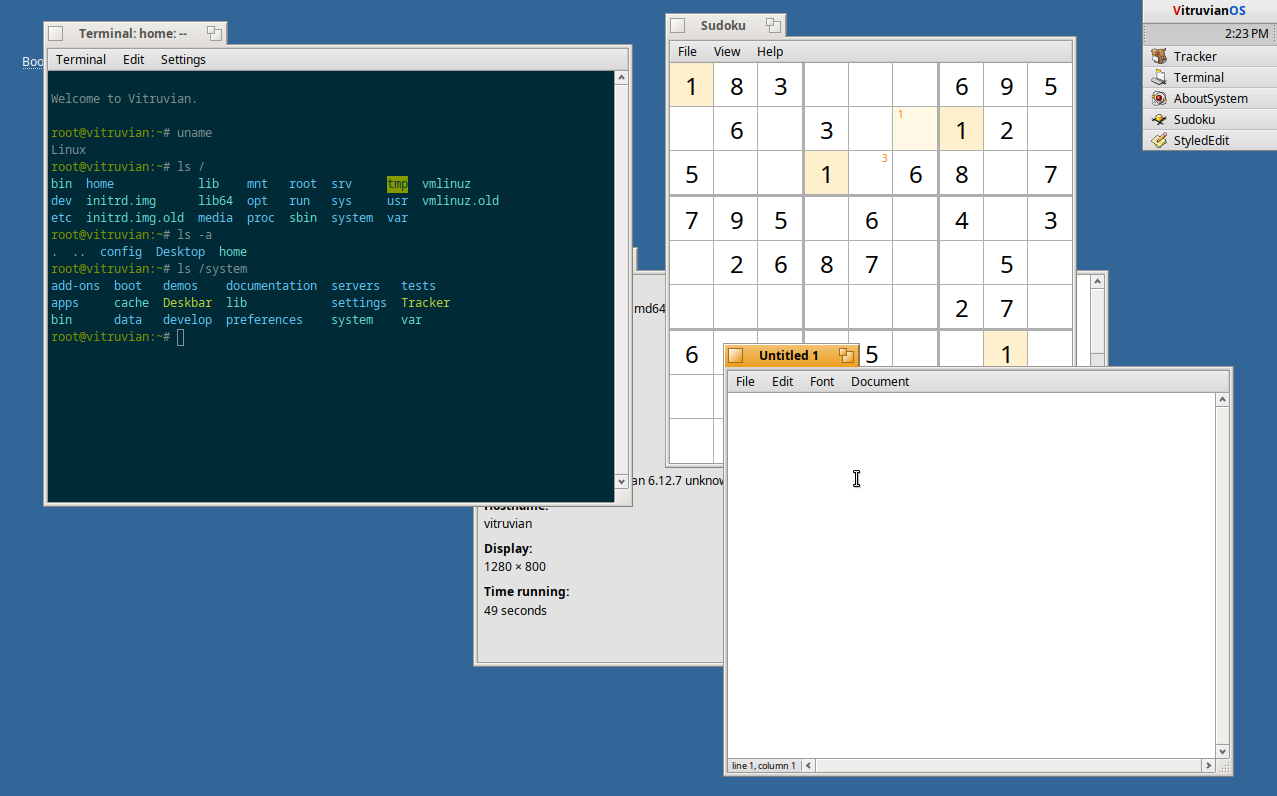
UI elements that have depth look so mouth-wateringly good now. So over the minimalism and bouncing back hard.

It fitted right these times when everything had that pseudo-3D gray outlook but yet was unique with these small yellow title bars (which you could move), diagonal icons and taskbar that could be placed in both corners and edges of the screen. Now compare that last thing to what MS did to Windows 11 taskbar, and only in last days announced it'll gladly restore previous behavior.

Haiku retained all of this and bring something new like combining various windows into single tabbed one - not sure if any other system has such feature. Or... toolbar in file manager - which is something I really missed back then in BeOS.

Back then BeOS was much more stable and faster than my daily Win98SE, even working in that image file on FAT32 partition.

Kinda makes you wonder, how things would go if Apple would pick BeOS as their OS instead of Jobs' NeXT. Would it still looks same or it would go thru all stages we've seen - with glass, transparency and then flatness and darkpatterns producing minimalism.
Re: VitruvianOS – Desktop Linux Inspired by the BeOS

#58
post #17

The important question becomes can you stack the window decoration "tabs" of different apps into a single stack of tabs like in BeOS? Demonstrated here (animated): https://www.haiku-os.org/docs/userguide/en/images/gui-images...

I used to run fluxbox in the early 2000s. I greatly miss tabbing any windows like that.

Re: VitruvianOS – Desktop Linux Inspired by the BeOS

#59
post #20

Earlier quoted context omitted.

And much better option, running the real deal, instead of some compatibility layer.

And things such as ruby don't work on it. Well, what shall I say? The "best" ideas get beaten when in practically already works very well - aka Linux. People need to compare to Linux and if there are failure points, they need to fix it. Haiku keeps on failing at core considerations. If you look at guides, they recommend to "run in qemu". Well, that is a fever dream. They need to focus on real hardware. And they need…

People aren't really running servers on Haiku, which is basically the only relevance to use Ruby in 2026, Rails powered web applications.

Then again, there is a golden opportunity to become a Ruby contributor, road to fame on Ruby contribution list.

Re: VitruvianOS – Desktop Linux Inspired by the BeOS

#60
post #15

"Real-time patched Linux kernel for low-latency desktop use" - does this really make sense? I think there have been various efforts like this over the decades but as far as I remember none of them really made a huge difference for the end user.

[flagged]
Post reply on HN