"When you measure, include the measurer" - MC Hammer
When you are MC Hammer, everything is an MC nail.
11–20 of 63 posts
"When you measure, include the measurer" - MC Hammer
The real meat from the article: https://dev.to/dkechag/how-geekbench-6-multicore-is-broken-b... First plot really says it all.
GeekBench probably made the right choice to optimize for more realistic real-world workloads than for the more specific workloads that benefit from really high core counts. GeekBench is supposed to be a proxy for common use case performance. High core count CPUs are only useful for specific workloads and should not be purchased as general purpose fast CPUs. Unless you’re doing specific tasks that scale by core count,…
If Geekbench 6 multicore is primarily a proxy for “common use case performance” rather than for workloads that actually use lots of cores, then it shouldn’t be treated as a general multicore CPU benchmark, and it definitely shouldn’t be the basis for sweeping 18-core vs 96-core conclusions.
That may be a perfectly valid design choice. But then the honest takeaway is: GB6 multicore measures a particular class of lightly/moderately threaded shared-task workloads, not broad multicore capability.
The criticism isn’t “every workload should scale linearly to 96 cores.” It’s that a benchmark labeled “multicore” is being used as if it were a general multicore proxy when some of its workloads stop scaling very early, including ones that sound naturally parallelizable.
The real meat from the article: https://dev.to/dkechag/how-geekbench-6-multicore-is-broken-b... First plot really says it all.
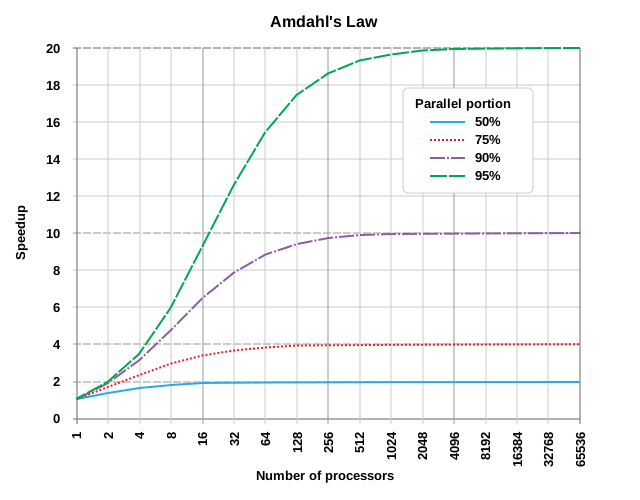
Compare to https://upload.wikimedia.org/wikipedia/commons/e/ea/AmdahlsL...
[flagged]
Phoronix is terrible in terms of clickbait and deliberate ragebait, and its comment section is a toxic cesspool, but its benchmarks generally seem sound. What issues have you observed with their benchmark suite?
You're seriously posting to HN a link to your Slashdot post linking to your year-old blog post complaining about Geekbench 6's multi-threaded test without ever mentioning Amdahl's Law? Pretending that everything a CPU does is an embarrassingly parallel problem is heinous benchmarking malpractice. Yes, Geekbench 6 has its flaws, and limitations. All benchmarks do. Geekbench 6 has valid uses, and its limitations are de…
It explains why a workload with a large serial/contended fraction won’t scale.
It does not prove that the workload’s serial fraction is representative of the category it claims to stand in for.
So when a benchmark’s “text processing” test over ~190 files barely gets past ~1.3x on 8 cores, that’s not some profound demonstration that CPUs can’t parallelize text work. It’s mostly a demonstration that this benchmark’s implementation has a very large serial bottleneck.
That would be fine if people treated GB6 multicore as a narrow benchmark of specific shared-task client workloads. The problem is that it is labelled as a general multicore CPU metric, and is used as such, including for 18-core vs 96-core comparisons. That’s the misuse being criticized.
TL;DR: Amdahl’s Law explains the ceiling; it does not justify treating an avoidably low ceiling as a general measure of multicore CPU capability.
EDIT: Also, submitter, I'm not sure why parent is upset that you submitted. Thanks for sharing. I've been wondering for years why GeekBench was obviously broken on multicore. (comes up a lot in Apple discussions, as you know)
GeekBench probably made the right choice to optimize for more realistic real-world workloads than for the more specific workloads that benefit from really high core counts. GeekBench is supposed to be a proxy for common use case performance. High core count CPUs are only useful for specific workloads and should not be purchased as general purpose fast CPUs. Unless you’re doing specific tasks that scale by core count,…
I think this actually concedes the main criticism. If Geekbench 6 multicore is primarily a proxy for “common use case performance” rather than for workloads that actually use lots of cores, then it shouldn’t be treated as a general multicore CPU benchmark, and it definitely shouldn’t be the basis for sweeping 18-core vs 96-core conclusions. That may be a perfectly valid design choice. But then the honest takeaway is:…
> Geekbench 6 is a cross-platform benchmark that measures your system's performance with the press of a button. How will your mobile device or desktop computer perform when push comes to crunch? How will it compare to the newest devices on the market? Find out today with Geekbench 6.
And further down,
> Includes updated CPU workloads and new Compute workloads that model real-world tasks and applications. Geekbench is a benchmark that reflects what actual users face on their mobile devices and personal computers.
GeekBench probably made the right choice to optimize for more realistic real-world workloads than for the more specific workloads that benefit from really high core counts. GeekBench is supposed to be a proxy for common use case performance. High core count CPUs are only useful for specific workloads and should not be purchased as general purpose fast CPUs. Unless you’re doing specific tasks that scale by core count,…
To justify the investment you need to have tasks that scale out, or loads of heterogeneous tasks to support concurrently.
Earlier quoted context omitted.
I think this actually concedes the main criticism. If Geekbench 6 multicore is primarily a proxy for “common use case performance” rather than for workloads that actually use lots of cores, then it shouldn’t be treated as a general multicore CPU benchmark, and it definitely shouldn’t be the basis for sweeping 18-core vs 96-core conclusions. That may be a perfectly valid design choice. But then the honest takeaway is:…
Geekbench 6 isn't really marketed as a one-size-fits-all benchmark. It's specifically aimed at consumer hardware. The first paragraph on geekbench.com reads: > Geekbench 6 is a cross-platform benchmark that measures your system's performance with the press of a button. How will your mobile device or desktop computer perform when push comes to crunch? How will it compare to the newest devices on the market? Find out t…