Earlier quoted context omitted.
You've got it exactly the wrong way around. And that with such great confidence! There was always a confusion about whether a kilobyte was 1000 or 1024 bytes. Early diskettes always used 1000, only when the 8 bit home computer era started was the 1024 convention firmly established. Before that it made no sense to talk about kilo as 1024. Earlier computers measured space in records and words, and I guess you can see h…
It was earlier than the 90s, and came with popular 8-bit CPUs in the 80s. The Z-80 microprocessor could address 64kb (which was 65,536 bytes) on its 16-bit address bus. Similarly, the 4104 chip was a "4kb x 1 bit" RAM chip and stored 4096 bits. You'd see this in the whole 41xx series, and beyond.
1 kilobyte is precisely 1000 bytes?
61–70 of 430 posts
Re: 1 kilobyte is precisely 1000 bytes?
#62Earlier quoted context omitted.
No it’s not. KiB is an abbreviation for kibibyte Eg https://en.wikipedia.org/wiki/Kilobyte
Those silly words only come up in discussions like this. I have never heard them uttered in real life. I don't think my experience is bizarre here - actual usage is what matters in my book.
Re: 1 kilobyte is precisely 1000 bytes?
#63A metric kilobyte is 1000 bytes. An imperial kilobyte, on the other hand, is 5280 bytes.
Re: 1 kilobyte is precisely 1000 bytes?
#64Earlier quoted context omitted.
. . . it seems weird that these are reported with a lowercase 'k' but 'M' and so on remain uppercase. For SI units, the abbreviations are defined, so a lowercase k for kilo and uppercase M for mega is correct. Lower case m is milli, c is centi, d is deci. Uppercase G is giga, T is tera and so on. https://en.wikipedia.org/wiki/International_System_of_Units#...
Of course! I was being silly and just thinking of "k" for the smaller one and "K" for the bigger one.
Re: 1 kilobyte is precisely 1000 bytes?
#65Earlier quoted context omitted.
You've got it exactly the wrong way around. And that with such great confidence! There was always a confusion about whether a kilobyte was 1000 or 1024 bytes. Early diskettes always used 1000, only when the 8 bit home computer era started was the 1024 convention firmly established. Before that it made no sense to talk about kilo as 1024. Earlier computers measured space in records and words, and I guess you can see h…
It was earlier than the 90s, and came with popular 8-bit CPUs in the 80s. The Z-80 microprocessor could address 64kb (which was 65,536 bytes) on its 16-bit address bus. Similarly, the 4104 chip was a "4kb x 1 bit" RAM chip and stored 4096 bits. You'd see this in the whole 41xx series, and beyond.
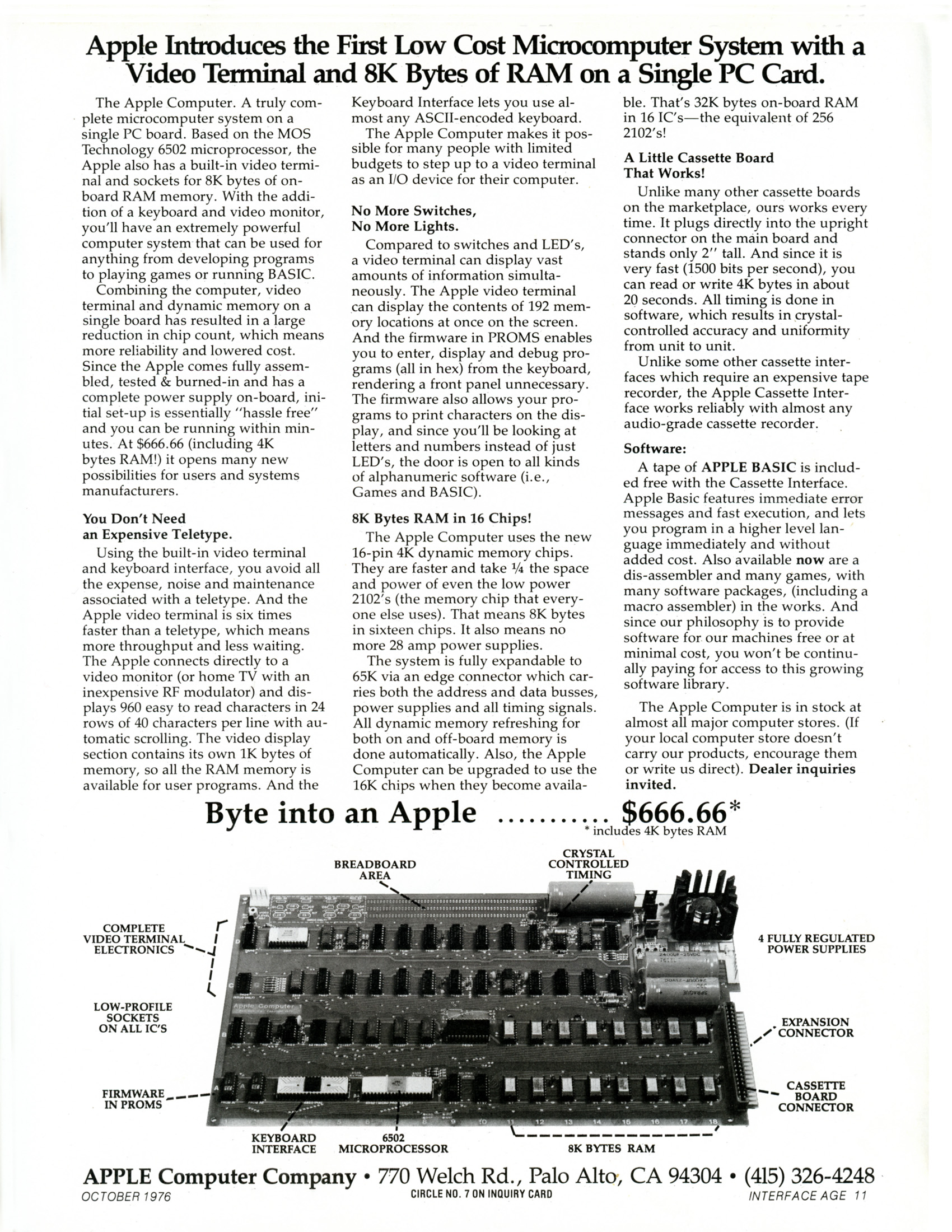
I was going to say that what it could address and what they called what it could address is an important distinction, but found this fun ad from 1976[1].
"16K Bytes of RAM Memory, expandable to 60K Bytes", "4K Bytes of ROM/RAM Monitor software", seems pretty unambiguous that you're correct.
Interestingly wikipedia at least implies the IBM System 360 popularized the base-2 prefixes[2], citing their 1964 documentation, but I can't find any use of it in there for the main core storage docs they cite[3]. Amusingly the only use of "kb" I can find in the pdf is for data rate off magnetic tape, which is explicitly defined as "kb = thousands of bytes per second", and the only reference to "kilo-" is for "kilobaud", which would have again been base-10. If we give them the benefit of the doubt on this, presumably it was from later System 360 publications where they would have had enough storage to need prefixes to describe it.
[1] https://commons.wikimedia.org/wiki/File:Zilog_Z-80_Microproc...
[2] https://en.wikipedia.org/wiki/Byte#Units_based_on_powers_of_...
[3] http://www.bitsavers.org/pdf/ibm/360/systemSummary/A22-6810-...
Re: 1 kilobyte is precisely 1000 bytes?
#66Re: 1 kilobyte is precisely 1000 bytes?
#67Earlier quoted context omitted.
No it’s not. KiB is an abbreviation for kibibyte Eg https://en.wikipedia.org/wiki/Kilobyte
Those silly words only come up in discussions like this. I have never heard them uttered in real life. I don't think my experience is bizarre here - actual usage is what matters in my book.
What the hell is a "kibibyte"? Sounds like a brand of dog food.
Re: 1 kilobyte is precisely 1000 bytes?
#68Earlier quoted context omitted.
You've got it exactly the wrong way around. And that with such great confidence! There was always a confusion about whether a kilobyte was 1000 or 1024 bytes. Early diskettes always used 1000, only when the 8 bit home computer era started was the 1024 convention firmly established. Before that it made no sense to talk about kilo as 1024. Earlier computers measured space in records and words, and I guess you can see h…
> Early diskettes always used 1000 Even worse, the 3.5" HD floppy disk format used a confusing combination of the two. Its true capacity (when formatted as FAT12) is 1,474,560 bytes. Divide that by 1024 and you get 1440KB; divide that by 1000 and you get the oft-quoted (and often printed on the disk itself) "1.44MB", which is inaccurate no matter how you look at it.
I wonder if there's a wikipedia article listing these...
Re: 1 kilobyte is precisely 1000 bytes?
#69Earlier quoted context omitted.
> The wish is for "kilobyte" to have one meaning. Which is the reality. "kilobyte" means "1000 bytes". There's no possible discussion over this fact. Many people have been using it wrong for decades, but its literal value did not change.
The line between "literal" and "colloquial" becomes blurred when a word consisting of strongly-defined parts ("kilo") gets used in official, standardized contexts with a different meaning. In fact, this is the only case I can think of where that has ever happened.
Re: 1 kilobyte is precisely 1000 bytes?
#70I agree in principle, but does anyone else feel super awkward saying "mebibyte" and "gibibyte"?
"I will not sacrifice my dignity. We've made too many compromises already; too many retreats. They invade our space and we fall back. They assimilate entire worlds with awkward pronunciations. Not again. The line must be drawn here! This far, no further! And I will make them pay for what they've done to the kilobyte!"