From the Waymo blog... > the pedestrian suddenly entered the roadway from behind a tall SUV, moving directly into our vehicle's path. Our technology immediately detected the individual as soon as they began to emerge from behind the stopped vehicle. The Waymo Driver braked hard, reducing speed from approximately 17 mph to under 6 mph before contact was made. > Following contact, the pedestrian stood up immediately, w…
I suspect the robotaxi may have done better than a human.
Human reaction times are terrible, and lots of kids get seriously injured, or killed, when they run out from between cars.
> But if there are a bunch of children milling about an elementary school in a chaotic situation with lots of double parking, 17 mph is too fast Hey, I'd agree with this-- and it's worth noting that 17^2 - 5^2 > 16^2, so even 1MPH slower would likely have resulted in no contact in this scenario. But, I'd say the majority of the time it's OK to pass an elementary school at 20-25MPH. Anything carries a certain level of…
> Hey, I'd agree with this-- and it's worth noting that 17^2 - 5^2 > 16^2, so even 1MPH slower would likely have resulted in no contact in this scenario. Only with instant reaction time and linear deceleration. Neither of those are the case. It takes time for even a Waymo to recognize a dangerous situation and apply the brake and deceleration of vehicles is not actually linear.
Yup. And to add > Waymo said in its blog post that its “peer-reviewed model” shows a “fully attentive human driver in this same situation would have made contact with the pedestrian at approximately 14 mph.” It's likely that a fully-attentive human driver would have done worse. With a distracted driver (a huge portion of human drivers) it could've been catastrophic.
If you drive in Sweden you will occasionally come up to a form of speed reduction strategy that may seem counterintuitive. They all add to make driving harder and feel more dangerous in order to force attention and lower speed. One is to merge opposite directional roads into a single lane, forcing drivers to cooperate and take turn to pass it, one car at a time. For a combined car and pedestrian road (max speed of 7k…
In Bulgaria we have a similar speed reduction strategy but we are a bit ahead of Sweden:
We use medium-radius but very deep potholes. If you lose attention for even a split second, you are forced to a full stop to change a tire.
Near schools it gets more "advanced": they put parked cars on both sides of the road, and the holes positioned so you can't bypass them. For example, two tire-sized holes on both sides of the road right next to the parked cars. You have to come to a complete stop, then slowly descend into the hole with the front wheels, climb back out, and repeat the process for the rear wheels. Occasionally, even though we (technically) have sidewalks, they are covered in mud or grass or bushes, so pedestrians are forced to walk in the middle of the road. This further reduces driving speed to walking pace and increases safety in our cities. Road markings are missing almost everywhere and they put contradicting road signs so drivers are not only forced to cooperate but also to read each other minds.
If you should slow down relative to the posted speed limit why not change the speed limit to reflect that directly?
Usually the reason is the "slow down" portion is very small, and it's confusing to shift down the actual speed limit for a 200 foot stretch of road then increase it again.
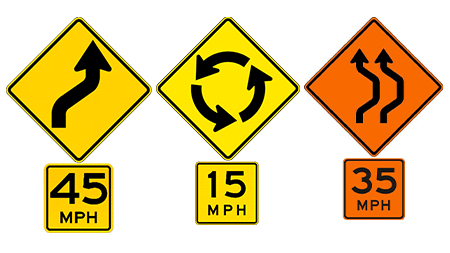
Much better to be specific than a vague "slow down". There's a road near me with two tight turns a couple blocks apart. One advises 25mph and the other advises 10mph.
So the waymo was speeding! All the dumbasses on here defending waymo when it was going 17 > 15. Oh also, that video says "kid ran out from a double parked suv". Can you imagine being dumb enough to drive over the speed limit around a double parked SUV in a school zone?
> Can you imagine being dumb enough to drive over the speed limit around a double parked SUV in a school zone? Can you imagine being dumb enough to think that exceeding a one size fits all number on a sign by As if 2mph would have fundamentally changed this. Pfft. A double parked car, in an area with chock full street parking (hence the double park) and "something" that's a magnet for pedestrians, and probably a bunc…
That was my point. The Waymo should have been going much slower than 15 around the double-parked car. Potential speeding makes it worse.
The fact that it’s hard to turn this into a formula is exactly why robot drivers are bad.
Yup. And to add > Waymo said in its blog post that its “peer-reviewed model” shows a “fully attentive human driver in this same situation would have made contact with the pedestrian at approximately 14 mph.” It's likely that a fully-attentive human driver would have done worse. With a distracted driver (a huge portion of human drivers) it could've been catastrophic.
If you drive in Sweden you will occasionally come up to a form of speed reduction strategy that may seem counterintuitive. They all add to make driving harder and feel more dangerous in order to force attention and lower speed. One is to merge opposite directional roads into a single lane, forcing drivers to cooperate and take turn to pass it, one car at a time. For a combined car and pedestrian road (max speed of 7k…
Does it actually work though?
Many roads in London have parked cars on either side so only one can get through - instead of people cooperating you have people fighting, speeding as fast as they can to get through before someone else appears, or race on-coming cars to a gap in the parked cars etc. So when they should be doing 30mph, they are more likely doing 40-45. Especially with EVs you have near-instant power to quickly accelerate to get to a gap first etc.
And putting obstacles in the road so you cant see if someone is there? That sounds really dangerous and exactly the sort of thing that caused the accident in the story here.
People's standards for when they're willing to cede control over their lives both as the passenger and the pedestrian in the situation to a machine are higher than a human. And for not totally irrational reasons like machine follows programming and does not fear death, or with 100% certainty machine has bugs which will eventually end up killing someone for a really stupid reason—and nobody wants that to be them. Then…
>People's standards for when they're willing to cede control over their lives both as the passenger and the pedestrian in the situation to a machine are higher than a human. Are they? It is now clear that Tesla FSD is much worse than a human driver and yet there has been basically no attempt by anyone in government to stop them.
Do you have data to back this claim up, specifically with HW4 (most recent hardware) and FSD software releases?
>they're safer because they're less safe Roundabouts are safer. They're safer because they prevent everybody from speeding through the intersection. And, even in case of an accident, no head-on collisions happen in a roundabout.
They're safer specifically for vehicles, as they convert many conflicts that would be t-bones (worst for passengers) into getting rear-ended (maximum crumple zone on both vehicles). Roundabouts are worse for land use though, which impacts walkability, and the safety story for pedestrians and bike users with them is decidedly not great as well.
>Roundabouts are worse for land use though, which impacts walkability, and the safety story for pedestrians and bike users with them is decidedly not great as well.
They're much safer for pedestrians than intersections. You're only crossing and dealing with traffic coming from one direction, stopping at a median, and then crossing further over.
Unlike trying to navigate a crosswalk where you have to play guessing games as to which direction some vehicle is going to come at you from while ignoring the lights (people do the stupidest things, and roundabouts are a physical barrier that prevents a bunch of that)
how about 10-15 mph if directly adjacent to a school, especially during the bands before and after school stars or ends. route away from schools whenever feasible.