Live data from Hacker News

Classical statues were not painted horribly

worksinprogress.co

201–210 of 351 posts

Re: Classical statues were not painted horribly

#201
post #120

Earlier quoted context omitted.

Sure, but medieval European art generally sucked. (Call this a hypothesis if that helps.) Compare the damn cave paintings of buffalo to most medieval European art. Some of the 10k-year-old stuff is much better observed. Europeans between about 500 and 1300 mostly couldn't paint. I'm sorry about that. It's just not always taste. Sometimes it's taste. Sometimes people are bad at making art.

I think that the medieval art article is making a different point. The art there had a style that was dictated by its purpose and the beliefs of the artists. For example, most of the examples given in that article are illustrations from manuscripts. This was something (as far as I know) that was new in the western world. The idea that books should be illustrated. And being before the printing press was introduced, ea…

Sure, but for me the standard isn't whether it's visually realistic. Plenty of good stuff isn't particularly realistic. Traditional Chinese landscapes aren't realistic, but a lot of them are great. David Hockney has a lot of good work that isn't realistic and uses primitive-looking technique. The standard is not realism or which style was used. The standard, for me, is whether the artist was any good at art. Hockney is. (Usually.)

I'm not particularly basing my opinion on the examples in this article. It's easy to see that a lot of surviving European medieval art sucks. Maybe "surviving" is the problem. Maybe the good stuff got all smokey from being displayed and only the leftovers and student paintings, in storage, have survived.

On illustrations, everybody can see the difference between Durer and most medieval stuff. It's not simply style or taste.
Re: Classical statues were not painted horribly

#202
post #115
post #72

Earlier quoted context omitted.

The archaeologists know that and say as much in TFA: "The paints used in the reconstructions are chemically similar to the trace pigments found on parts of the surface of the originals. However, those pigments formed the underlayer of a finished work to which they bear a very conjectural relationship. Imagine a modern historian trying to reconstruct the Mona Lisa on the basis of a few residual pigments here and there…

> that these are not exact copies, that we can never know exactly how they looked Meaning that these "reconstructions" are a pretty pointless and have no real purpose.

I totally agree with. This is not a reconstruction because the shading, detail and subtler colors are completely left off. It's just a reconstruction of the statue as it would have been in an incomplete state!

Re: Classical statues were not painted horribly

#203
post #2

I've literally never heard anyone say that classical statues were painted "horribly", and unless I missed it, there's no sources in this article that say that, either (just several links to the same New Yorker article talking about whiteness). What I've always heard is that classical statues were painted "brightly". So, is this something that's so well known in the study of antiquities that no source was required, or…

I personally noticed this when shown these reconstructions. I remember being puzzled at the ugliness when going to a museum. This article actually makes a lot of sense.

Re: Classical statues were not painted horribly

#204
post #28

I will die on this hill, because I'm right. Painters put on the first layer in saturated colors like this, then add detail, highlight and shadow. The base layer stuck to the statues, and the rest was washed away. This whole thing just won't go away because many people are operating outside their area of expertise on this subject. Painters layer paint, starting with a saturated base color. These archaeologists are sim…

Yes, this is what tfa says, and it's a good point. But tfa also points out that the archaeologists/reconstructionists know that what they're producing differs from the original. The thing is the discipline of reconstruction means that they only use pigments that they have direct evidence of, and this is just the saturated underlayers. The problem is this is seldom explained when the reconstructions are presented to t…

Is there someone who tries to achieve beauty similar to what the original might've looked like?

Would be interesting to see a painted statue that's actually pleasant to look at, rather than these "let's smear this one pigment we found in the armpit all over the face"-style "reconstructions"

Re: Classical statues were not painted horribly

#205
post #120

Earlier quoted context omitted.

Sure, but medieval European art generally sucked. (Call this a hypothesis if that helps.) Compare the damn cave paintings of buffalo to most medieval European art. Some of the 10k-year-old stuff is much better observed. Europeans between about 500 and 1300 mostly couldn't paint. I'm sorry about that. It's just not always taste. Sometimes it's taste. Sometimes people are bad at making art.

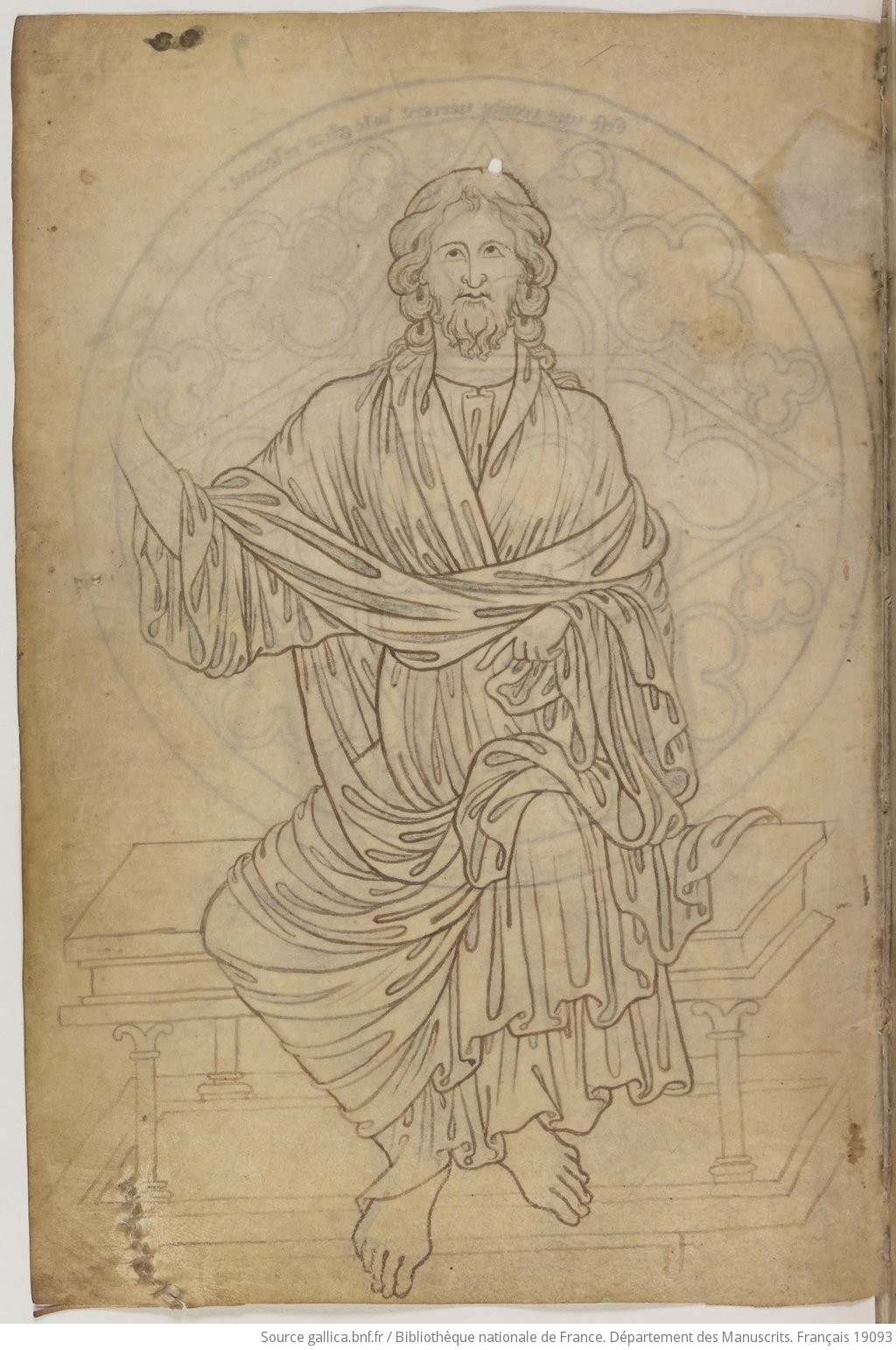
If you think medieval artists lacked skill, check out Villard Honnecourt’s sketchbook, especially the insects on folio 7 and Christ in Majesty on 16: https://www.medievalists.net/2024/12/sketchbook-villard-honn... Medieval art is very stylised, but the quality of the lines, the details in the clothes, the crispness of the composition, all that requires a lot of skill. Check out Jean Bondol’s work for instance https:/…

You convinced me that they lack skill.

The clothing does often look good. In folio 16v ( https://www.medievalists.net/wp-content/uploads/2024/12/Vill... ), it's been overdone and appears to be far wrinklier than fabric could support, suggesting that Jesus is embedded in some kind of strange plant.

The faces are terrible in all cases.

In general, perspective is off, anatomy is off, and you get shown things that aren't physically possible.

Re: Classical statues were not painted horribly

#206
post #134

Earlier quoted context omitted.

And that's a fine standard to maintain when you're writing an academic paper. When you are instead putting together a museum exhibition intended for the general public, and you observe over and over again that they will interpret your work as representing what the statues actually looked like, it is irresponsible to keep giving them that impression. It's not an either/or question. They could do some of the statues wi…

Imagine if we refused to publish any material or exhibit recreations of dinosaurs because the only evidence we have are fossilized skeletons and a few skin texture impressions.

You've highlighted a very cogent comparison!

Dinosaurs in the first Jurassic Park were fairly well represented considering what we knew in the late 80s. But our knowledge of dinosaurs has grown, with feathers being the most emblematic change. Yet the Jurassic Park movies steadfastly refuse to put feathers on their 3D monsters in the current movies, because viewers do not expect feathers on the T-Rex.

We might be at that point with repainted statues. Museum visitors are now starting to expect the ugly garish colours.

Re: Classical statues were not painted horribly

#207

Good read! The idea that these marvels of artistry were painted like my 10th birthday at the local paint-your-own-pottery store always seemed incongruous, at best. > Why, then, are the reconstructions so ugly? > ...may be that they are hampered by conservation doctrines that forbid including any feature in a reconstruction for which there is no direct archaeological evidence. Since underlayers are generally the only…

You graciously omitted the article’s follow-on conclusion: the public is being gently trolled.

“On the other hand, at a time when trust in the honest intentions of experts is at a low, it may be unwise for experts to troll the public.”

Re: Classical statues were not painted horribly

#208
post #28

I will die on this hill, because I'm right. Painters put on the first layer in saturated colors like this, then add detail, highlight and shadow. The base layer stuck to the statues, and the rest was washed away. This whole thing just won't go away because many people are operating outside their area of expertise on this subject. Painters layer paint, starting with a saturated base color. These archaeologists are sim…

Are there really no statues with surviving full paint remnants?

Re: Classical statues were not painted horribly

#209
post #164

Earlier quoted context omitted.

> I am reminded of reading some classicists' attempt to create garum in the kitchen by making some unpleasant horror of mashed fish or something back in the eighties or nineties. No one ever mentioned in those kinds of write-ups back then that they still make fish sauce in Italy. A more modern example might be that recently discovered Babylonian Lamb Stew [0]. Most of the scholarly reconstructions of the stew follow…

I have been reading cookbook from 1767. And mostly you get ingredients and probably not all of them. And sometimes you get amounts. And useful instructions like boil so many times... I have understood that with those really old recipes, the person recording them might at best have been in the same room. But probably was not a chef.

> I have understood that with those really old recipes, the person recording them might at best have been in the same room. But probably was not a chef.

That's going too far. The person recording them might be the same person who is used to making the food, or might be taking literal dictation from that person.

Knowing how to make food isn't the same skill as knowing how to explain the process in a way that someone who isn't already trained to make the food can follow.

Re: Classical statues were not painted horribly

#210
post #28

I will die on this hill, because I'm right. Painters put on the first layer in saturated colors like this, then add detail, highlight and shadow. The base layer stuck to the statues, and the rest was washed away. This whole thing just won't go away because many people are operating outside their area of expertise on this subject. Painters layer paint, starting with a saturated base color. These archaeologists are sim…

I will die on an adjacent hill: when the details had washed away with time leaving behind merely the sturdier and ugly base, people removed the garish base coat cause that thing is uuugggo! Our ancestors were thinking what we're thinking: It looks better white than with only a base.
Post reply on HN