It would seem David Bowie knew about these way before the rest of the world
Are Those Spidery Black Things On Mars Dangerous?
31–40 of 122 posts
Re: Are Those Spidery Black Things On Mars Dangerous?
#32Re: Are Those Spidery Black Things On Mars Dangerous?
#33David Bowie has built a fortress of solitude out of these at the Martian South Pole.
Re: Are Those Spidery Black Things On Mars Dangerous?
#34This stuff blows me away. I think, holy crap this planet has all sorts of real exo-planet kinds of weirdness. I love the idea of reverse icicles although for the life of me I can't imagine what would hold them up once the CO2 gas has vaporized out. One part of me wants to build another Curiosity style rover and catch the next Earth/Mars orbital cycle and put it down near stuff like this. I can believe folks would fin…
Is there any chance they could be plants? relying on underground water reserves and appearing every spring to throw around some pollen before slinking back into the cool darkness.
Re: Are Those Spidery Black Things On Mars Dangerous?
#35Earlier quoted context omitted.
You don't have to use a rover. What about a quadcopter or balloon filled with heated gas?
There is, to a first approximation, no atmosphere on Mars. To a slightly better approximation, there is an atmosphere on Mars, but only enough to cause trouble, not enough to actually be useful for anything.
There's enough atmosphere for Nasa to seriously consider deploying airplanes: http://en.wikipedia.org/wiki/Mars_aircraft
Re: Are Those Spidery Black Things On Mars Dangerous?
#36Earlier quoted context omitted.
When planning a landing site for each rover mission, NASA considers a variety of factors and makes a best-guess as to the fruitfulness of each site from a scientific perspective. Clearly a team of brilliant scientists has not failed to consider the possibility of exploring these strange spidery features, but they have decided against it for the time being. It doesn't really make sense to assess their "strange priorit…
Yeah; just for starters, such a sandy area seems like a serious risk on its own to a rover, never mind the risk actual geysers would pose. The geysers are interesting, but are they worth jeopardizing an entire rover expedition for?
On the other hand, the loss of a rover to one of these plumes could itself provide interesting information: It would conclusively prove that they occur explosively, and if we can photograph the rover afterwards then the displacement of an object with known mass would let us gauge the amount of force these things exert.
Re: Are Those Spidery Black Things On Mars Dangerous?
#37Earlier quoted context omitted.
Good luck.. the highest atmospheric density on Mars is equal to the density found 35 km above the Earth's surface
I think a latex balloon filled with hydrogen could achieve positive buoyancy. Just bring a little bit of water and you can make your own hydrogen.
I don't know of many latexes that are springy at -100 C.
Re: Are Those Spidery Black Things On Mars Dangerous?
#38A good image of the formations is on Wikipedia:
http://upload.wikimedia.org/wikipedia/commons/0/0c/PIA11858_...
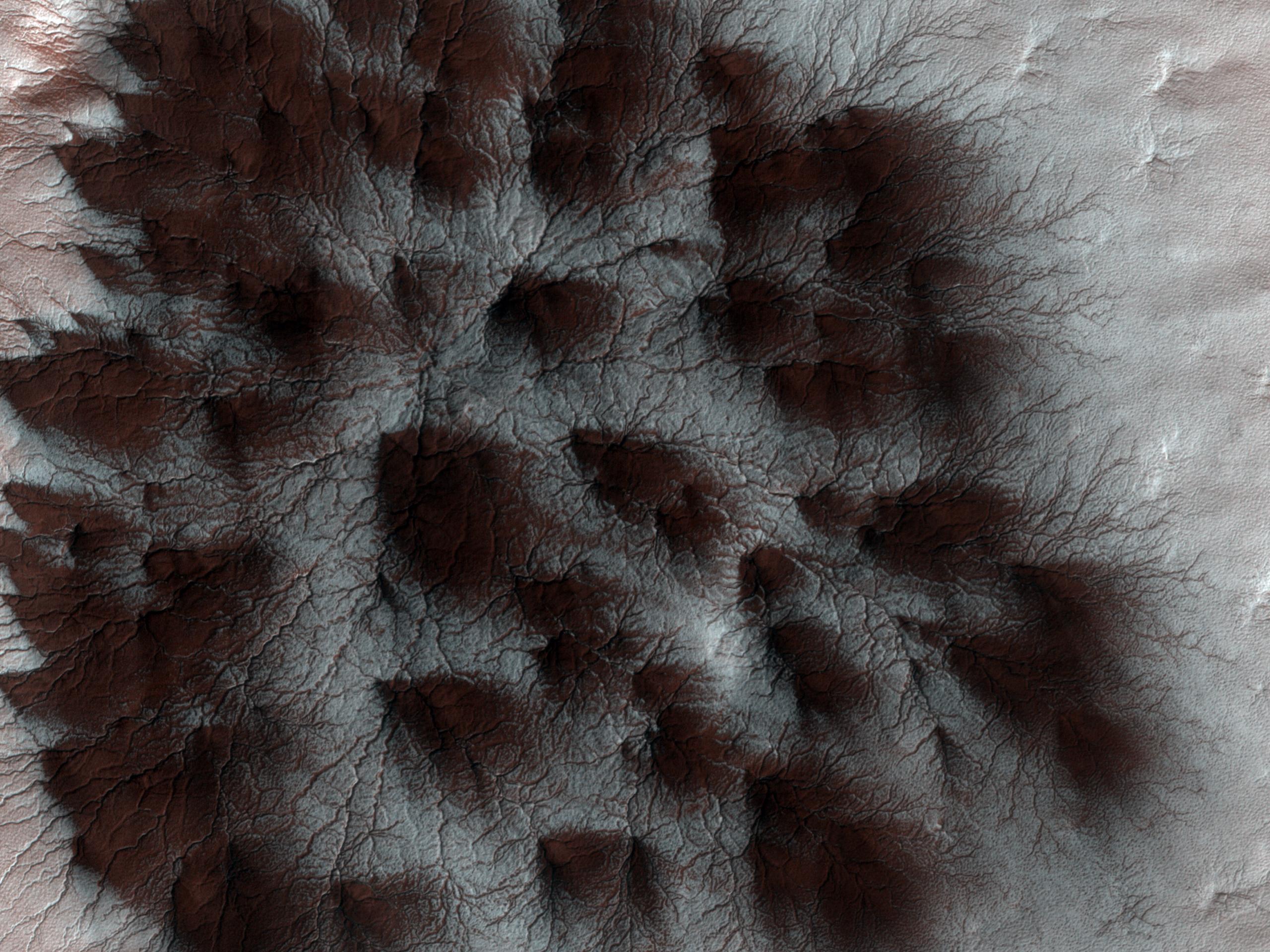
Re: Are Those Spidery Black Things On Mars Dangerous?
#39This stuff blows me away. I think, holy crap this planet has all sorts of real exo-planet kinds of weirdness. I love the idea of reverse icicles although for the life of me I can't imagine what would hold them up once the CO2 gas has vaporized out. One part of me wants to build another Curiosity style rover and catch the next Earth/Mars orbital cycle and put it down near stuff like this. I can believe folks would fin…
Is there any chance they could be plants? relying on underground water reserves and appearing every spring to throw around some pollen before slinking back into the cool darkness.
I'm not a xenobiologist so I couldn't quantify the relative chance of them being 'plants'. But this is the kind of stuff we can speculate on.
First, we'll need to be a bit loose with our definitions since 'plant' means a very specific kind of thing.
So if we define a 'plant' as a chemical process which creates structure in the presence of certain chemicals such that a transformative chemical reaction is enabled whereby energy in the form of sunlight or heat is used to build additional structure. Then we can see if there is a chemical mix that would have this characteristic output.
It is critical to note though that this would also classify a stalactite as a 'plant' which converts calcium carbonate into 'structure' (in this case rock) by exploiting a transfer agent (water).
Interesting questions would be "Why vanish in the winter?" what ever hypothesis we come up with has to include the observed effect and behaviors. This is my biggest issue with my 'frozen geyser' hypothesis, it seems like they would continue to exist during winter.
Finding better imagery from HiRise would be good too, in particular it would be useful to know if these were vertical structures or not. that would show up as shadows.
Lots of fun to think about.
Re: Are Those Spidery Black Things On Mars Dangerous?
#40Earlier quoted context omitted.
Is there any chance they could be plants? relying on underground water reserves and appearing every spring to throw around some pollen before slinking back into the cool darkness.
I'm not a xenobiologist so I couldn't quantify the relative chance of them being 'plants'. But this is the kind of stuff we can speculate on. First, we'll need to be a bit loose with our definitions since 'plant' means a very specific kind of thing. So if we define a 'plant' as a chemical process which creates structure in the presence of certain chemicals such that a transformative chemical reaction is enabled where…
Why not literally a plant? Like leafy, relies on water, comes from a small seed, reproduces via pollen/wind, based on a cell structure.
We have plants in the desert here on Earth that blossom once every X years or decades. Is there a reason such a "plant" could not have survived the harsh later years of mars post surface water?
Bonus idea: if these are plants relying on ground water, their location would give away the position of said ground water. They could be mapped and their spacial density used to find source pools for humans to tap.