Live data from Hacker News

Voyager 1 is about to reach one light-day from Earth

scienceclock.com

231–240 of 411 posts

Re: Voyager 1 is about to reach one light-day from Earth

#231
post #149
post #146

Earlier quoted context omitted.

It's 2025. The first heavier than air flight was barely more than a century ago. The first human in space was less than 70 years ago. These enabling technologies are very, very hard. No doubt about it. That's why we can't do this today, or even a century from now. But the physics show it's possible and suggest a natural evolution of capabilities to get there. We are a curious species that is never happy to keep our p…

First, what's the return on that? You are talking about massive investments to shoot off into space never to return. Who's paying for that? The only way you do that is if you're so fucked, it's your only option and the profit in it is the leaving. Not to mention, we need to solve the problems of living in space. Which we haven't yet. According to NASA. The space people. And it very well could be an insurmountable pro…

My response to the money aspect of this it's just like any other business: money needs to be invested, and then a return will be realized. Resource extraction (i.e, asteroid mining) is one obvious example.

The human compatibility issues with microgravity are well known, as is the solution, which has even been proposed by NASA: centripetal force to create 1G for the astronauts.

As far the the radiation goes, we do indeed know exactly what kinds of radiation they would encounter. And the easiest way to shield humans from it in space is lots of water, or metal. We know this from extensive real work done on earth re: nuclear power plants.

The real issue is money, not technical feasibility. Once the dough rolls in from asteroid mining, it bootstraps the financing issue and pays for itself many times over.
Re: Voyager 1 is about to reach one light-day from Earth

#232

Earlier quoted context omitted.

Space is so ridiculously big that I don't think it will ever happen. Back of the envelope math - 4.2 light years to the nearest star that's not the sun, current vehicles traveling about 10x the speed of voyager (e.g. 1 light day in 5 years). If something was launched today it would get to the nearest star system in about 7,660 years (assuming that star system also a radius of 1 light day). 100x faster than current (1…

Getting the travel time down to 500 years would be a reasonable goal. You'd ship embryos and caregiver robots, start breeding/raising people 30 years before you'd arrive.

Imagine being born and told your life has been determined by some other humans living a comfortable life with unlimited air and water.

You are told you are to about make the great achievement humankind has ever made but all you want is a little bit more food and to take a shower.

Re: Voyager 1 is about to reach one light-day from Earth

#233

Earlier quoted context omitted.

Getting the travel time down to 500 years would be a reasonable goal. You'd ship embryos and caregiver robots, start breeding/raising people 30 years before you'd arrive.

Imagine being born and told your life has been determined by some other humans living a comfortable life with unlimited air and water. You are told you are to about make the great achievement humankind has ever made but all you want is a little bit more food and to take a shower.

Isn't that already all of us?

Re: Voyager 1 is about to reach one light-day from Earth

#234

The Voyagers are just the beginning. We can't see it yet, stuck as we are, in the present moment, filled with strife, failure, and disappointment. But the years and centuries to come will see us colonize the solar system, bringing new opportunities for millions, while easing the drain on Earth's ecosystem. How can I be so sure? Because in the long arc of history that is what we've always done. We went from Africa to…

That colonization was primarily driven by the need to obtain resources. Today and in the future, there is no reason to should send humans to gather resources when we can send robots to do it instead.

There's plenty of resources to be extracted from space. Metals, for one. Also, zero-G drug development and manufacturing is promising too.

Re: Voyager 1 is about to reach one light-day from Earth

#235
post #180

It’s wild how Voyager forces two truths to sit together: Technically, what we’ve done is almost boringly modest. ~17 km/s ~1 light-day in ~50 years No realistic way to steer it anywhere meaningful now On cosmic scales it’s… basically still on our doorstep. Psychologically, it’s still one of the most ambitious things we’ve ever done. We built something meant to work for decades, knowing the people who launched it woul…

This is not an example of nor even an attempt at long horizon thinking. Voyager wasn't built with the intention that it would last for decades. It was a rush job to take advantage of a very rare planetary alignment and it's primary mission was completed 12 years after it started. It is a testament to the ingenuity of the engineers who have worked and are still working on the project that they've managed to keep it to…

Given JavaScript, my headcannon is our galaxy is actually full of "rush jobs" probes from different species.

Re: Voyager 1 is about to reach one light-day from Earth

#236

It’s wild how Voyager forces two truths to sit together: Technically, what we’ve done is almost boringly modest. ~17 km/s ~1 light-day in ~50 years No realistic way to steer it anywhere meaningful now On cosmic scales it’s… basically still on our doorstep. Psychologically, it’s still one of the most ambitious things we’ve ever done. We built something meant to work for decades, knowing the people who launched it woul…

The Voyager project itself has long ended and it's just cute to keep monitoring it and getting data from it. If nothing else, it serves well as a perpetual PR vehicle for NASA. The core of the project I would not say represents long-term thinking of NASA or civilization. I'm not convinced that we're biologically wired to think long-term. It's extremely rare when someone pops up, and they usually end up becoming extremely impactful in society (Lincoln; Jobs; Elon)

Re: Voyager 1 is about to reach one light-day from Earth

#237
post #211

Earlier quoted context omitted.

Space is so ridiculously big that I don't think it will ever happen. Back of the envelope math - 4.2 light years to the nearest star that's not the sun, current vehicles traveling about 10x the speed of voyager (e.g. 1 light day in 5 years). If something was launched today it would get to the nearest star system in about 7,660 years (assuming that star system also a radius of 1 light day). 100x faster than current (1…

> current vehicles traveling about 10x the speed of voyager As I understand it, not really. Parker Solar Probe is crazy fast, but only because it has that trajectory, and is unable to just change course and keep that speed in other directions. If you want to launch something for deep space, the Jupiter-Saturn slingshot is still the most powerful trajectory we know of. Today's rocket engines would give the probe a hig…

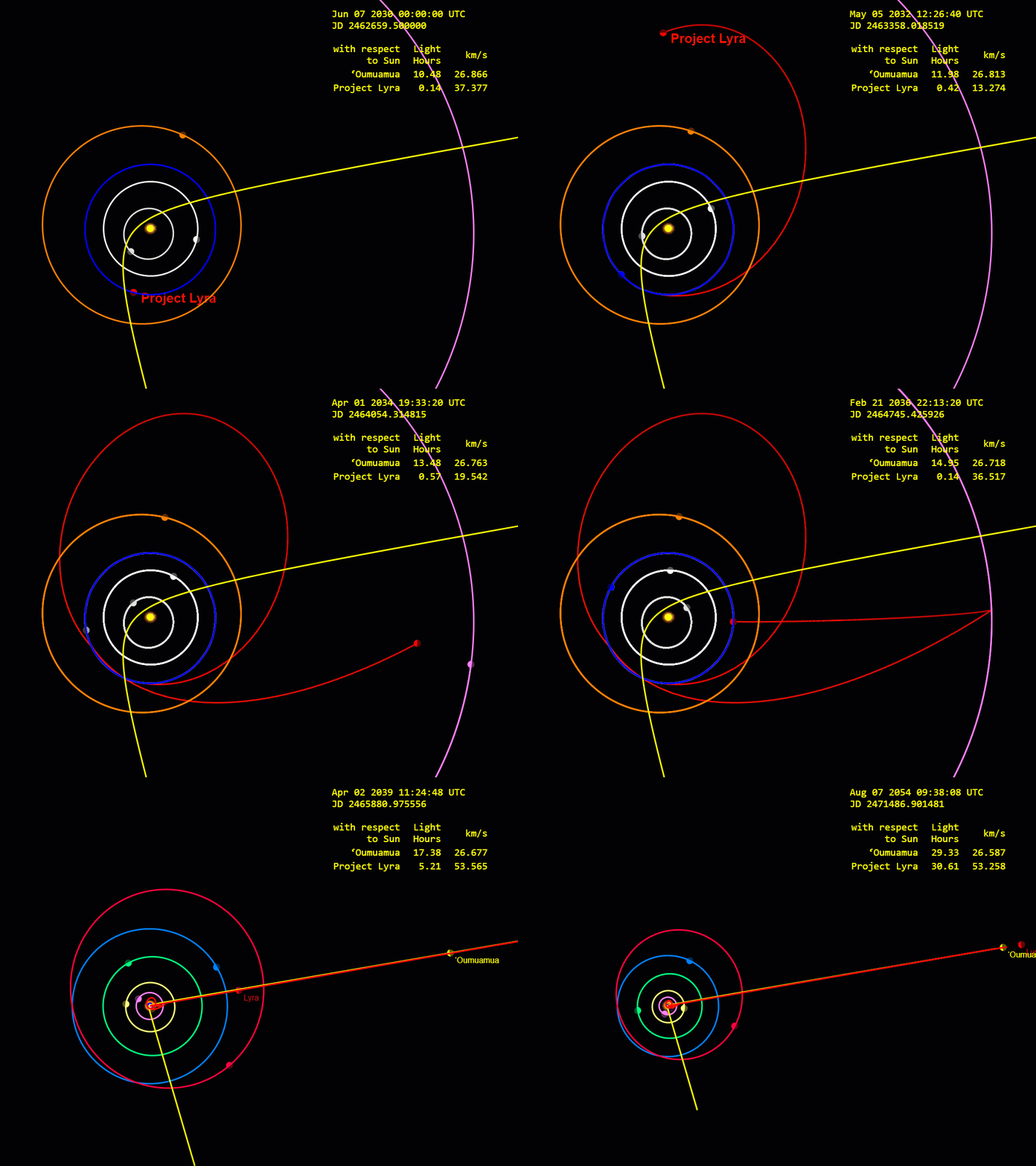
You can do a Sun-diving Oberth maneuver too. Project Lyra was a proposal for an `Oumuamua flyby that got over 50km/s: http://orbitsimulator.com/BA/lyra.gif

Re: Voyager 1 is about to reach one light-day from Earth

#238
post #214

Earlier quoted context omitted.

Space is so ridiculously big that I don't think it will ever happen. Back of the envelope math - 4.2 light years to the nearest star that's not the sun, current vehicles traveling about 10x the speed of voyager (e.g. 1 light day in 5 years). If something was launched today it would get to the nearest star system in about 7,660 years (assuming that star system also a radius of 1 light day). 100x faster than current (1…

> Space is so ridiculously big that I don't think it will ever happen You are underestimating acceleration. To travel and come to a stop at 4.2 light years, a spaceship with 1g acceleration barely needs 3.5 years in relativistic ship time (~6 years earth time). The technology to sustain 1g acceleration through 3.5 years is a different story, but very much within our understanding of physics (and not warp drives, etc)…

Whatever speed advancements we make on earth, they pale in comparison to sling shotting off of a planet. to make an engine that can go significantly faster, we would need the energy of a planet.

Re: Voyager 1 is about to reach one light-day from Earth

#239

It’s wild how Voyager forces two truths to sit together: Technically, what we’ve done is almost boringly modest. ~17 km/s ~1 light-day in ~50 years No realistic way to steer it anywhere meaningful now On cosmic scales it’s… basically still on our doorstep. Psychologically, it’s still one of the most ambitious things we’ve ever done. We built something meant to work for decades, knowing the people who launched it woul…

But the thing is, the Voyager project came about in a much more stable period for the US - and in a more optimistic cultural climate (we could say similar for the Apollo project which wasn't that much earlier). When we used to prioritize spending on basic science and projects like this that basically had no ROI (NASA didn't even much think in those terms back in the 70s). Now we're in a very different place where, in the US anyway, we're very pessimistic about the future. To create a Voyager project you have to have some hope, like you said "with the assumption that that future would exist and might care" - now we're in a very different place where people don't have a lot of hope about the future. And it's also different in that we now ask "what's the payback going to be?" - everything now seems to need to pay it's way.

Not saying that other countries won't be able to do stuff like this - probably China is going to take the position that the US used to hold for this kind of exploration. It seems to be a more optimistic culture at this point, but hard to say how long that lasts.

Re: Voyager 1 is about to reach one light-day from Earth

#240
post #214

Earlier quoted context omitted.

Space is so ridiculously big that I don't think it will ever happen. Back of the envelope math - 4.2 light years to the nearest star that's not the sun, current vehicles traveling about 10x the speed of voyager (e.g. 1 light day in 5 years). If something was launched today it would get to the nearest star system in about 7,660 years (assuming that star system also a radius of 1 light day). 100x faster than current (1…

> Space is so ridiculously big that I don't think it will ever happen You are underestimating acceleration. To travel and come to a stop at 4.2 light years, a spaceship with 1g acceleration barely needs 3.5 years in relativistic ship time (~6 years earth time). The technology to sustain 1g acceleration through 3.5 years is a different story, but very much within our understanding of physics (and not warp drives, etc)…

Is there enough reaction mass on earth to construct a rocket capable of accelerating at 1g for 3.5 years?
Post reply on HN