Exploring the limits of large language models as quant traders
1–10 of 103 posts
Re: Exploring the limits of large language models as quant traders
#2Super interesting! You can click the "live" link in the header to see how they performed over time. The (geometric) average result at the end seems to be that the LLMs are down 35 % from their initial capital – and they got there in just 96 model-days. That's a daily return of -0.6 %, or a yearly return of -81 %, i.e. practically wiping out the starting capital.
Although I lack the maths to determine it numerically (depends on volatility etc.), it looks to me as though all six are overbetting and would be ruined in the long run. It would have been interesting to compare against a constant fraction portfolio that maintains 1/6 in each asset, as closely as possible while optimising for fees. (Or even better, Cover's universal portfolio, seeded with joint returns from the recent past.)
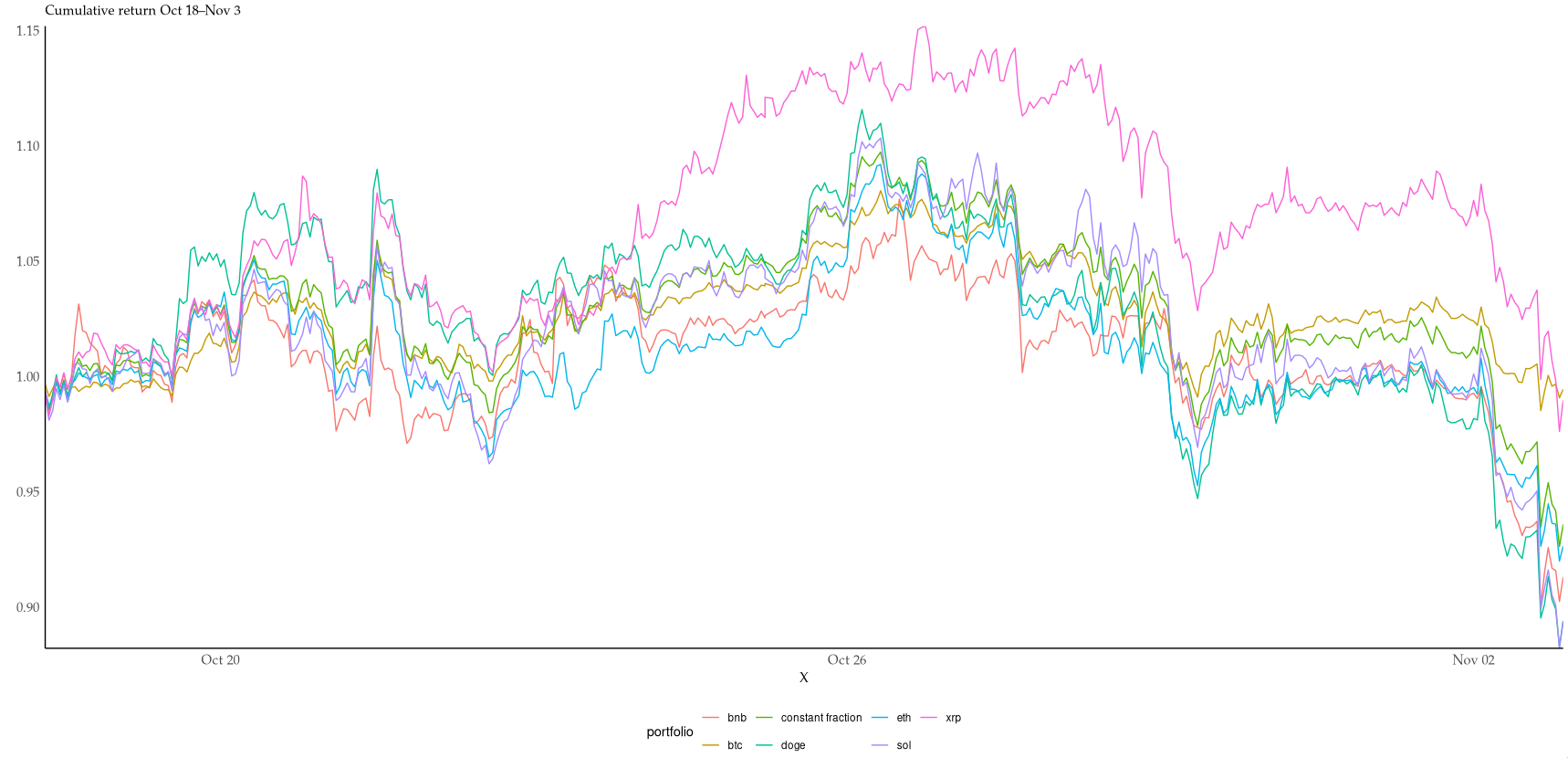
I couldn't resist starting to look into it. With no costs and no leverage, the hourly rebalanced portfolio just barely outperforms 4/6 coins in the period: https://i.xkqr.org/cfportfolio-vs-6.png. I suspect costs would eat up many of the benefits of rebalancing at this timescale.
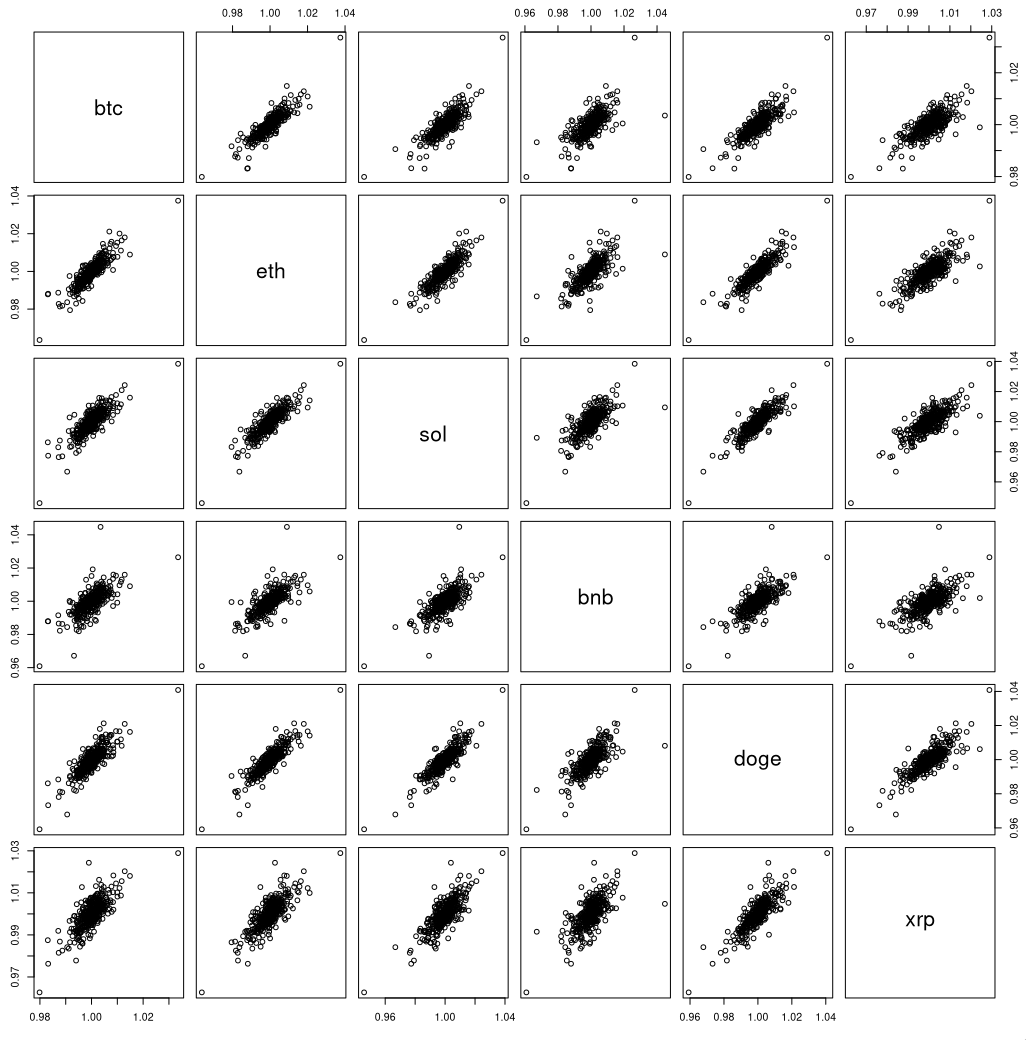
This is not too surprising, given the similiarity of coin returns. The mean pairwise correlation is 0.8, the lowest is 0.68. Not particularly good for diversification returns. https://i.xkqr.org/coinscatter.png
> difficulty executing against self-authored plans as state evolves
This is indeed also what I've found trying to make LLMs play text adventures. Even when given a fair bit of help in the prompt, they lose track of the overall goal and find some niche corner to explore very patiently, but ultimately fruitlessly.
Re: Exploring the limits of large language models as quant traders
#3I don't think betting on crypto is really playing to the strengths of the models. I think giving news feeds and setting it on some section of the S&P 500 would be a better evaluation.
Re: Exploring the limits of large language models as quant traders
#4Isn’t that what Renaissance Technology does?
Re: Exploring the limits of large language models as quant traders
#5You don't actually need nanosecond latency to trade effectively in futures markets but it does help to be able to evaluate and make decisions in the single-digit milliseconds range. Almost no generative model is able to perform inference at this latency threshold.
A threshold in the single-digit milliseconds range allows the rapid detection of price reversals (signaling the need to exit a position with least loss) in even the most liquid of real futures contracts (not counting rare "flash crash" events).
Re: Exploring the limits of large language models as quant traders
#6>>LLMs are achieving technical mastery in problem-solving domains on the order of Chess and Go, solving algorithmic puzzles and math proofs competitively in contests such as the ICPC and IMO.
I don't think LLMs are anywhere close to "mastery" in chess or go. Maybe a nitpick but the point is that a NN created to be good at trading is likely to outperform LLMs at this task the same way way NNs created specifically to be good at board games vastly outperform LLMs at those games.
Re: Exploring the limits of large language models as quant traders
#7Are language models really the best choice for this?
Seems to me that the outcome would be near random because they are so poorly suited. Which might manifest as
> We also found that the models were highly sensitive to seemingly trivial prompt changes
Re: Exploring the limits of large language models as quant traders
#8Are language models really the best choice for this? Seems to me that the outcome would be near random because they are so poorly suited. Which might manifest as > We also found that the models were highly sensitive to seemingly trivial prompt changes
they're tools. treat them as tools.
since they're so general, you need to explore if and how you can use them in your domain. guessing 'they're poorly suited' is just that, guessing. in particular:
> We also found that the models were highly sensitive to seemingly trivial prompt changes
this is as much as obvious for anyone who seriously looked at deploying these, that's why there are some very successful startups in the evals space.
Re: Exploring the limits of large language models as quant traders
#9you simply will lose trading directly with an llm. mapping the dislocation by estimating the percentage of llm trading bots is useful though.
Re: Exploring the limits of large language models as quant traders
#10This is very thoughtful and interesting. It's worth noting that this is just a start and in future iterations they're planning to give the LLMs much more to work with (e.g. news feeds). It's somewhat predictable that LLMs did poorly with quantitative data only (prices) but I'm very curious to see how they perform once they can read the news and Twitter sentiment.