Earlier quoted context omitted.
That limitation only counts for visiting other galaxies. Travel within the galaxy is always possible, regardless of the universe’s expansion. And Alpha Centauri is super close, even within our galaxy.
Specifically the local group, so Milky way + Andromeda and some dwarf galaxies
Analysis indicates that the universe’s expansion is not accelerating
21–30 of 218 posts
Re: Analysis indicates that the universe’s expansion is not accelerating
#22Anyone know how credible this is? If true, then that means the big bounce is back on the menu, and the universe could actually be an infinitely oscillating system.
For claims about how the universe works at scales and timeframes so utterly beyond anything testable, it's a little difficult to say this is credible at all - not dunking on the researchers, but in order to validate their conclusions, there's a whole chain of dependencies and assumptions you'd have to follow along with, and each of those things will be its own complex birds nest tangle of assertions, and I don't see how you can really say one way or another until you have a lot more information and a lot better Theory of Everything than we've got right now.
For what it's worth, for all the impact it'll have on anyone's life outside of academia, I'd say they're 100% correct and people should buy them free beers at their local pubs for at least the next year in return for explaining their ideas at length.
Re: Analysis indicates that the universe’s expansion is not accelerating
#23Universe gong.
Re: Analysis indicates that the universe’s expansion is not accelerating
#24Aside from unanswerable questions (has the universe started to fill it's container? Is a simulation property nearing "1"?), does this make long distance space travel feasible again? I thought there was something around the universe is expanding too fast to visit places like Alpha Centuri (and preventing visitors to us).
Edit: A big brain fart, ignore the retracted part below. Colonizing the universe is of course impossible in 100My, barring FTL. What the paper I referred to [1] says is that colonizing the Milky Way may take less than that, and if you can do that, spreading to the rest of the observable universe is fairly easy, very relatively speaking. According to some calculations, it should in principle be possible to colonize th…
The observable universe is ~93B LY - unless you're assuming FTL (and MUCH faster than light), I don't see how that's possible?
Re: Analysis indicates that the universe’s expansion is not accelerating
#25Aside from unanswerable questions (has the universe started to fill it's container? Is a simulation property nearing "1"?), does this make long distance space travel feasible again? I thought there was something around the universe is expanding too fast to visit places like Alpha Centuri (and preventing visitors to us).
Edit: A big brain fart, ignore the retracted part below. Colonizing the universe is of course impossible in 100My, barring FTL. What the paper I referred to [1] says is that colonizing the Milky Way may take less than that, and if you can do that, spreading to the rest of the observable universe is fairly easy, very relatively speaking. According to some calculations, it should in principle be possible to colonize th…
Interesting way to put it... This doesn't seem that accurate. With sufficiently advanced technology, many of which we already possess, we could expect to propel a minute spacecraft to a considerable fraction of the speed of light, and reach nearby stars possibly within the end of the century. Reaching the other end of the galaxy is a massive undertaking. It's a logarithmic scale at every step of the way.
Pluto is about 38 AU from Earth. Proxima Centauri is about 6.3 × 10^4 AU away (or about 4.24 ly), and that's roughly a 2 × 10^3 multiplication. The Milky Way is about 50000 ly in radius, and the Andromeda Galaxy is about 3 × 10^6 ly away. Going from interplanetary distances to interstellar, and thence to intergalactic, involves at least a 10^5 factor (give or take) at each step.
Re: Analysis indicates that the universe’s expansion is not accelerating
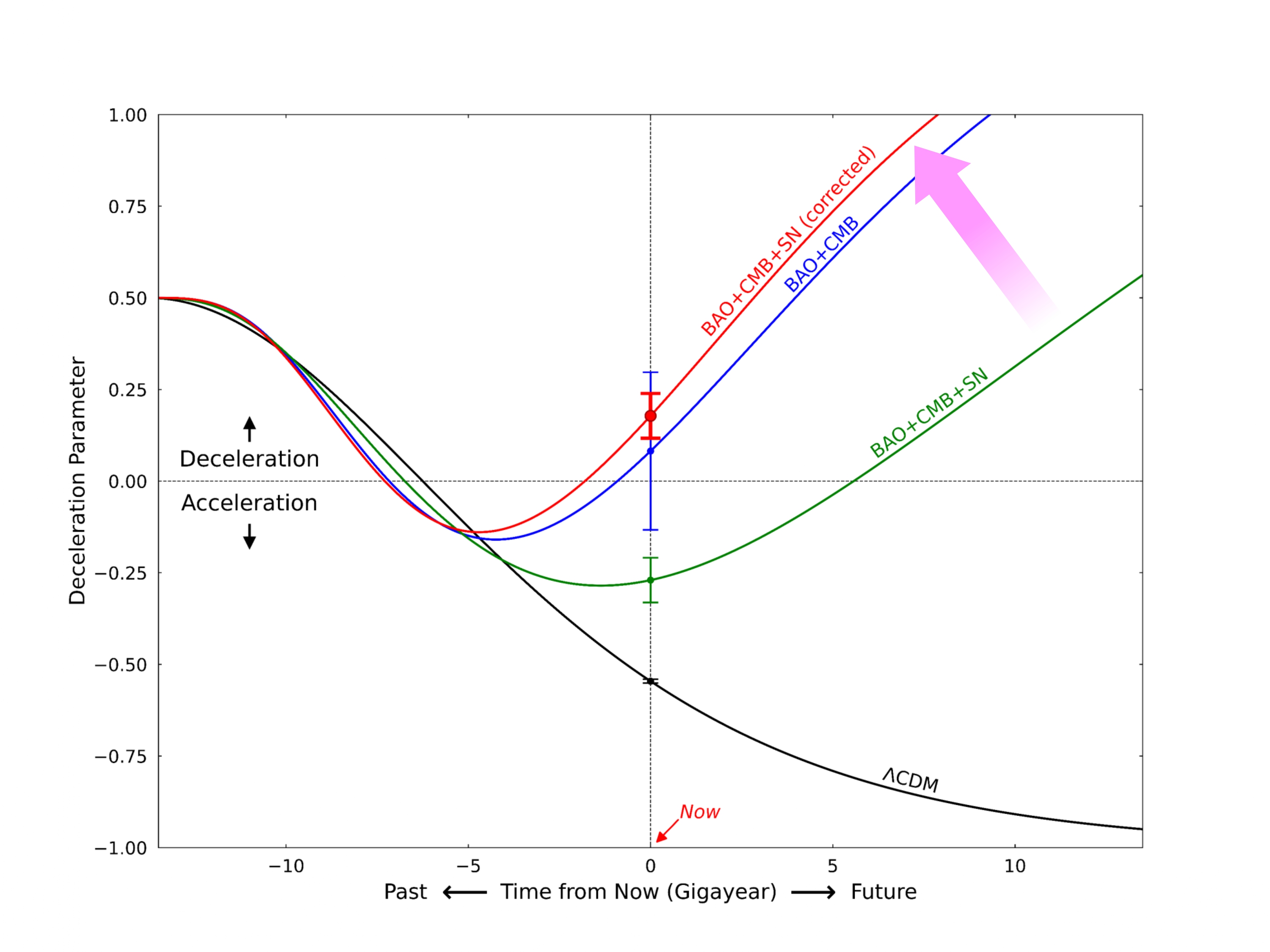
#26What does 'now' mean here?
Re: Analysis indicates that the universe’s expansion is not accelerating
#27Aside from unanswerable questions (has the universe started to fill it's container? Is a simulation property nearing "1"?), does this make long distance space travel feasible again? I thought there was something around the universe is expanding too fast to visit places like Alpha Centuri (and preventing visitors to us).
Edit: A big brain fart, ignore the retracted part below. Colonizing the universe is of course impossible in 100My, barring FTL. What the paper I referred to [1] says is that colonizing the Milky Way may take less than that, and if you can do that, spreading to the rest of the observable universe is fairly easy, very relatively speaking. According to some calculations, it should in principle be possible to colonize th…
...what? That doesn't seem right, just from a really quick gut check it looks like the observable universe has a radius of 45.7 billion light years [0]. Even if the universe wasn't expanding nobody could get to everything any faster than that number of years right? Maybe you saw something that was talking about the local (Virgo) supercluster, which I think has a radius of around 55 million light years, so that sounds more like something that could be done on that timescale "in theory". But there are millions and millions of superclusters in the observable universe overall.
----
Re: Analysis indicates that the universe’s expansion is not accelerating
#28I'll set a reminder to check back at that time to see who was right.
Re: Analysis indicates that the universe’s expansion is not accelerating
#29If we subscribe to a theory of the multiverse, set theory, likelihood, and interaction driven evolution based on gradient type of fundamental laws. Locally changing. Obviously everything sharing a fundamental quality that is part of existence itself. But obviously there are sets, there is differentiation. But it is not created, the infinity of unconstrained possibilities exists in the first place and reorganizes itself a bit like people are attracted to people who share some commonalities or have something they need from each other and form tribes. Same processus kind of works for synapse connections, works for molecule formations, works for atoms... etc... Everything is mostly interacting data.
We could say that the concept of distance is a concept of likelihood. The closer is also the most likely.
Just a little weird idea. I need to think a bit more about it. Somewhat metaphysic?
Re: Analysis indicates that the universe’s expansion is not accelerating
#30Aside from unanswerable questions (has the universe started to fill it's container? Is a simulation property nearing "1"?), does this make long distance space travel feasible again? I thought there was something around the universe is expanding too fast to visit places like Alpha Centuri (and preventing visitors to us).
The universe was always only expanding between galaxies, not within them.