Live data from Hacker News

An eBPF loophole: Using XDP for egress traffic

loopholelabs.io

31–40 of 81 posts

Re: An eBPF loophole: Using XDP for egress traffic

#31

XDP (eXpress Data Path) is the fastest packet processing framework in linux - but it only works for incoming (ingress) traffic. We discovered how to use it for outgoing (egress) traffic by exploiting a loophole in how the linux kernel determines packet direction. Our technique delivers 10x better performance than current solutions, works with existing Docker/Kubernetes containers, and requires zero kernel modificatio…

Forgive me of my ignorance, but is XDP faster than DPDK for packet processing? It seems like DPDK has had a lot of work done for hardware optimizations that allow speeds that I can’t recall XDP being able to do. I have not looked too deeply into this though, so I’m very open to being wrong!

DPDK will give you the absolute best performance, period. But it will do so with tradeoffs that are far from negligible, especially on mixed-workload machines like a docker host/k8s node/hypervisor.

1. to get the absolute best performance, you're running in poll-mode, and burning cpu cores just for packet processing

2. the network interface is invisible to the kernel, making non-accelerated traffic on said interface tricky (say, letting the kernel perform arp resolution for you).

3. your dataplane is now a long-lived process, which means that stopping said process equates to no more network (hello restarts!)

Alleviating most of those takes a lot of effort or some tradeoffs making it less worth it:

1. can be mitigated by adaptive polling at the cost of latency.

2. by using either a software bifurcation by re-injecting non-accelerated traffic in a tap, or with NICs with hardware bifurcation (e.g. connectx) and installing the flows in its flow engine. Both are quite time consuming to get right

3. by manually writing a handoff system between new and old processes, and making sure it never crashes

DPDK also needs its own runtime, with its own libraries. Some stuff will be manual (e.g. giving it routing tables). XDP gives all of those for free:

1. All modern NIC drivers will already perform adaptive polling and interrupt moderation; so you're not burning CPU cycles on polling the card outside of high packet rate scenarios (on which you'd burn CPUs on IRQs and context switches anyways).

2. It's just an extra bit of software in the driver's path, and the XDP program decides whether to handle it itself or pass id down to the kernel. Pretty useful to keep ARP, ICMP, BGP, etc without extra code.

3. XDP is closer to a lambda than anything: the code runs once for every single packet, meaning its runtime is extremely short. This also means that the long-running process is your kernel; and that updating the code is an atomic operation that done on the fly.

4. A lot of facilities are already provided, and the biggest of them is maps. The kernel handles all the stateful things to feed data (routing tables, arp tables, etc) to your dataplane code. CPU affinity is also handled by the kernel in the sense that XDP runs on the CPU responsible for the NIC queue, whose mapping is controlled through standard kernel interfaces, unrelated to XDP (meaning: not on your mind).

Now, speaking purely of optimizations. Yes, DPDK will always be better CPU-wise because you can compile it with -march native while eBPF is JIT-ed when available (and pretty poorly, having already looked at it). However, from experience, the parts that actually take time are map lookups (looking up the nexthop, looking up the mac address, etc), and those are written in C in the kernel, thus are as optimized as the kernel can be. Recompiling the kernel for your CPU can boost performance, but I've never done it myself.

Today, I would consider that unless you absolutely need the absolute best performance, XDP is more than fine. Modern CPUs are so fast that it's not worth it to consider DPDK for most cases.

- container routing like there? the dpdk runtime is a no-go, and the operational flexibility of xdp is a killer.

- network appliances like switches/routers? shell out a few extra bucks and buy a slightly better CPU. if latency is paramount, or you're doing per-packet processing that cannot fit in an ebpf probe, then go the dpdk route.

At a previous job, I rewrote for fun a simple internal dpdk routing application using xdp: only half the performance (in packets per second, not bits per second) on the same hardware with no optimizations whatsoever, in 100 lines or ebpf. Mind you, I could saturate a 100Gbps link with 100 bytes packets, not 64 bytes, what a tragedy /s. On more modern hardware (latest EPYC), I trivially reached 200Mpps on an 8 core CPU using XDP.

Long story short, you'll know when you need DPDK.
Re: An eBPF loophole: Using XDP for egress traffic

#32

Earlier quoted context omitted.

I come from a very different world (optimizing the FreeBSD kernel for the Netflix CDN, running on bare metal) but performance leaps like this are fascinating to me. One of the things that struck me when reading this with only general knowledge of the linux kernel is: What makes things so terrible? Is iptables really that bad? Is something serialized to a single core somewhere in the other 3 scenarios? Is the CPU at 1…

In the case of XDP, the reason it's so much faster is that it requires 0 allocations in the most common case. The DMA buffers are recycled in a page pool that's already allocated and mapped at least queue depth buffers for each hardware queue. XDP is simply running on the raw buffer data, then telling the driver what the user wants to do with the buffer. If all you are doing is rewriting an IP address, this is incred…

Yes, I (with a few others) did a similar optimization for FreeBSD's firewall, with similar results but much greater simplicity using what we call "pfil memory pointer hooks" We wrote a paper about it in 2020 for a conference that was cancelled due to Covid, so its fairly unknown.

On what's now almost 10 year old hardware, we could drop 44Mpps of a volumetric DOS attack and still serve our nominal workload with no impact. See PFILCTL(8) and PFIL(9), focus on ethernet (link layer) packets.

It relies on the same principal -- NIC passes the RX buffer directly to the firewall (ipfw, pf, or ipfilter). If the firewall says the packet is OK, rx processing happens as normal. If it says to drop, then dropping is very fast because it can simply re-use the buffer without re-allocation, re-doing DMA mapping, etc.

Re: An eBPF loophole: Using XDP for egress traffic

#33
post #10

They say "By the time a packet reaches the TC hook, the kernel has already processed it through various subsystems for routing, firewalling, and even connection tracking." but surely this is also true before it reaches the VETH?

Yes, but it does so once. Additionally, you're likely to have a much heavier network path in the main network namespace of e.g. a k8s node than within the container: firewalls, connection tracking, multiple interfaces/bridges/taps/etc, NAT, and so on.

Re: An eBPF loophole: Using XDP for egress traffic

#34

For NAT (Network Address Translation) or any other packet header modifications, you need to recalculate checksums manually Why doesn’t checksum offload in the NIC take care of that?

And I'm confused how they have to correct the TCP checksum but not the IPv4 header checksum...

Oh no we absolutely have to also correct the IPv4 header checksum!

Re: An eBPF loophole: Using XDP for egress traffic

#35
post #8

I understand they are attached to the phrase "loophole" but it feels fairly like they are using it as designed to me?

Yup, I don't really get it either. I've had this exact setup in my mind for a while to make an hypervisor dataplane (thus on TAPs, not VETHs). It's working as designed, and it's precisely for this usecase the veth driver has had quite a lot of care as far as XDP is concerned, getting optimizations and multiqueue support over time.

Honestly, the real news is that they're doing it in production, not that they found anything unique.

Heck, all the XDP development I've ever done was against a veth interface on my laptop, to run later on server metal.

Re: An eBPF loophole: Using XDP for egress traffic

#36
post #5

From 2022: https://www.samd.is/2022/06/13/egress-XDP.html You can also use XDP for outgoing packets for tap interfaces.

This is why I am always skeptical when anyone writes that they are the first to do something… the added caveat is always, “that we know of”

Re: An eBPF loophole: Using XDP for egress traffic

#37

Hi HN, Shivansh (founder) here, happy to answer any questions folks might have about the implementation and the benchmarks!

I come from a very different world (optimizing the FreeBSD kernel for the Netflix CDN, running on bare metal) but performance leaps like this are fascinating to me. One of the things that struck me when reading this with only general knowledge of the linux kernel is: What makes things so terrible? Is iptables really that bad? Is something serialized to a single core somewhere in the other 3 scenarios? Is the CPU at 1…

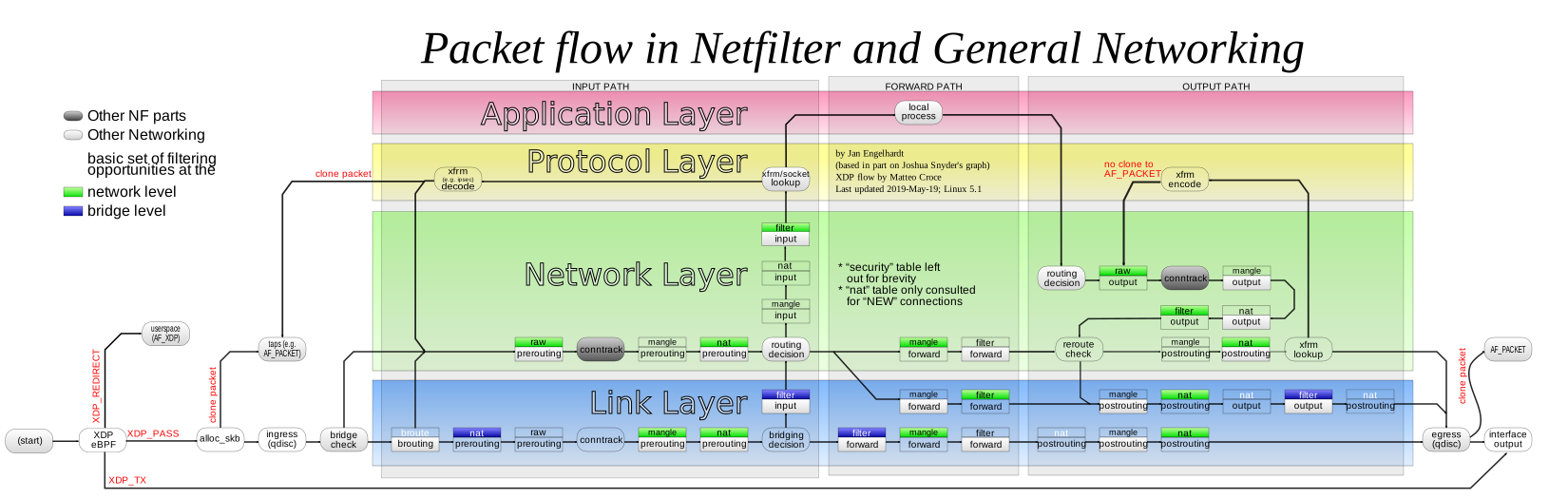
The kernel will allocate, merge packets in skbs if needed, extract data, and do quite a lot. XDP runs as early as possible in the datapath. Pretty much all drivers have to do is call the XDP code when they receive an IRQ from the NIC.

You'll bypass a memory copy (ringbuf -> kernel memory), allocations (skb), parsing (ips & such), firewalling, checking if the packet is local, checksum validation, the list goes on...

The following diagram helps seeing all the things that happens: https://upload.wikimedia.org/wikipedia/commons/3/37/Netfilte...

(yes, xdp is the leftmost step, literally after "card dma'd packet in memory")

Re: An eBPF loophole: Using XDP for egress traffic

#38

Earlier quoted context omitted.

In the case of XDP, the reason it's so much faster is that it requires 0 allocations in the most common case. The DMA buffers are recycled in a page pool that's already allocated and mapped at least queue depth buffers for each hardware queue. XDP is simply running on the raw buffer data, then telling the driver what the user wants to do with the buffer. If all you are doing is rewriting an IP address, this is incred…

Yes, I (with a few others) did a similar optimization for FreeBSD's firewall, with similar results but much greater simplicity using what we call "pfil memory pointer hooks" We wrote a paper about it in 2020 for a conference that was cancelled due to Covid, so its fairly unknown. On what's now almost 10 year old hardware, we could drop 44Mpps of a volumetric DOS attack and still serve our nominal workload with no imp…

This is an essential use case for XDP - this is how FB's firewall works, and above that their LB uses the same technology.

The beauty of XDP is that it's all eBPF. Completely customizable by injecting policy where it's needed and native to the kernel.

Re: An eBPF loophole: Using XDP for egress traffic

#39
XDP, and the eBPF ecosystem in general, is quite neat. However, a word of caution:

* The BPF verifier's DX is not great yet. If it finds problems with your BPF code it will spit our a rather inscrutable set of error messages that often requires a good understanding of the verifier internals (e.g the register nomenclature) to debug

* For the same source code, the code generated by the verifier can change across compiler versions in a breaking way, e.g. because the new compiler version implemented an optimization that broke the verifier (see https://github.com/iovisor/bcc/issues/4612)

* Checksum updating requires extra care. I believe you can only do incremental updates, not just because of better perf as the post suggests but also because the verifier does not allow BPF programs to operate on unbounded buffers (so checksumming a whole packet of unknown size is tricky / cumbersome). This mostly works but you have to be careful with packets that were generated with csum offload, don't have a valid checksum and whose csum can't be incrementally updated.

As the blog post points out, the kernel networking stack does a lot of work that we don't generally think about. Once you start taking things into your own hands you don't have the luxury of ignorance anymore (think not just ARP but also MTU, routing, RP filtering etc.), something any user of userspace networking frameworks like DPDK will tell you.

My general recommendation is to stick with the kernel unless you have a very good justification for chasing better performance and if you do use eBPF save yourself some trouble and try to limit yourself to readonly operations, if your use case allows.

Also, if you are trying to debug packet drops, newer kernels have started logging this information that you can track using bpftrace which gives you better diagnostics.

Example script (might have to adjust based on kernel version):

    bpftrace -e '
        kprobe:kfree_skb_reason {
        $skb = (struct sk_buff *)arg0;
        $ipheader = ((struct iphdr *) ($skb->head + $skb->network_header));
        printf("reason :%d %s -> %s\n", arg1, ntop($ipheader->saddr), ntop($ipheader->daddr));
    }'
Post reply on HN