We all thought it worked :) All of my friends with NES growing up encountered the same problems overtime. It was clearly a design problem as described in the article. The SNES was so well designed, I still use it to this day (almost 20 years later).
Did Blowing Into The NES Cartridge Really Work?
21–30 of 76 posts
Re: Did Blowing Into The NES Cartridge Really Work?
#22Earlier quoted context omitted.
The force was actually borne by the contacts? Man. You'd think they would have put the contacts on something more flexible, and transmit the force with the outer covering.
Yep. I think the idea was to make it behave like the toploading VCRs which were around at the time: insert then press down. Very often customers would refer to the cartridges as "Nintendo tapes".
Sure, the American NES was deliberately designed that way in order to not look so much like a video game device, because everybody was paranoid due to the video game crash having happened recently.
I'm really asking a mechanical question. Basically, if you're going to build an insert-and-press-down device, it would make sense to have a mechanical system to handle all of that separately from the electrical contacts. Basically, you'd have the cartridge slide into some kind of device which captures it and has the springs and latches to make the system work as desired. Within that device, you'd also have the electrical contacts with the cartridge, but set up so that the fragile electrical contacts don't actually transmit the spring's force, which goes through the outer frame instead. You made it sound like the force got transmitted directly through the electrical contacts without any separate spring-loaded device, which seems like a pretty obvious failure point.
Re: Did Blowing Into The NES Cartridge Really Work?
#23As a wee lad in the last millennium I was an authorized Nintendo repairman. Blowing on the cart sometimes worked, if there was errant dust or fluff in the way. But in the long run the salty moist air would cause a corrosive layer of gunk on the contacts. Normal procedure was to open each cart and clean them with a good eraser then an alcohol wash. The bigger problem was bad design in the original NES. The cart plugge…
Blowing on the cart sometimes worked, if there was errant dust or fluff in the way.
How do you know it was the blowing, and not the act of removing and reseating the cart? That's rather the point of the article.
Re: Did Blowing Into The NES Cartridge Really Work?
#24Or if you're really brave you could just replace the 72-pin reader: http://www.amazon.com/Nintendo-NES-Cartridge-Slot-Replacemen... https://nuxx.net/wiki/NES_72-Pin_Edge_Connector_Replacement I did it on mine in college -- and then I did it for my suite-mate after he noticed that I never had any problems with my NES -- and then I did it for everyone on my floor who had an NES... :) Works like brand new.
I have done this and can confirm it was really easy to do the fix. It works, but it should be noted that if you leave your cartridges pushed down in the system all the time it will just wear out quickly again. The design is just flawed.
Re: Did Blowing Into The NES Cartridge Really Work?
#25Is it possible the moisture caused by blowing into the cartridge allowed for better electric conductivity?
Re: Did Blowing Into The NES Cartridge Really Work?
#26I'm surprised seeing those photos of the game boards outside their cartridges. Not only are they much smaller than the cartridge, but they are really just some memory and the lock-out chip!
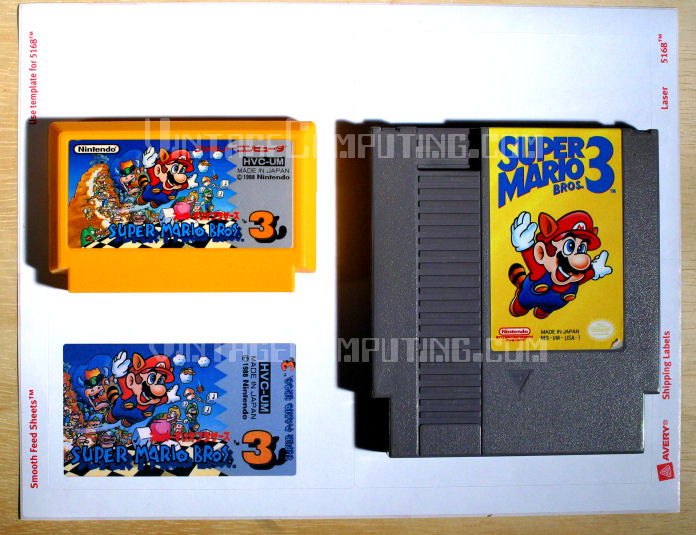
Famicom cartridges (sold in Japan) were much smaller. Here's a size comparison where the orange one is a Famicom cartridge. [1]
[1] http://www.vintagecomputing.com/wp-content/images/smb3j_labe...
Re: Did Blowing Into The NES Cartridge Really Work?
#27Article had a way too low signal/noise ratio. Way too verbose.
Re: Did Blowing Into The NES Cartridge Really Work?
#28I don't think I ever blew into my NES cartridges, but I remember taking them out, giving them a gentle shake with the connector end pointing down, and putting them back in. I expect doing this was as much a placebo as blowing (it's not as if there were chip crumbs stuck in there), but it made me feel like I was doing something productive. :/
Re: Did Blowing Into The NES Cartridge Really Work?
#29The trick that always worked for me was to insert the cartridge and then pull it out just enough to where the near edge of the cartridge would just barely scrape against the console as it was pushed down. This was far more effective than blowing on the cartridge.
Re: Did Blowing Into The NES Cartridge Really Work?
#30I'm surprised seeing those photos of the game boards outside their cartridges. Not only are they much smaller than the cartridge, but they are really just some memory and the lock-out chip!
The article didn't include any pictures of Famicom carts, but basically, they're about half as tall as NES cartridges. I haven't popped open any NES games, but I'd have to guess most, if not all NES games just used a Famicom sized board to simplify manufacturing. Here's a comparison shot of the NES and Famicom versions of Super Mario Bros. 3:
http://www.vintagecomputing.com/wp-content/images/smb3j_labe...
While most later systems featured mostly standardized cartridge designs, Famicom carts wildly vary in color and design from publisher to publisher. They're quite pleasing to look at:
http://famicomblog.blogspot.com/2009/12/aesthetics-of-famico...
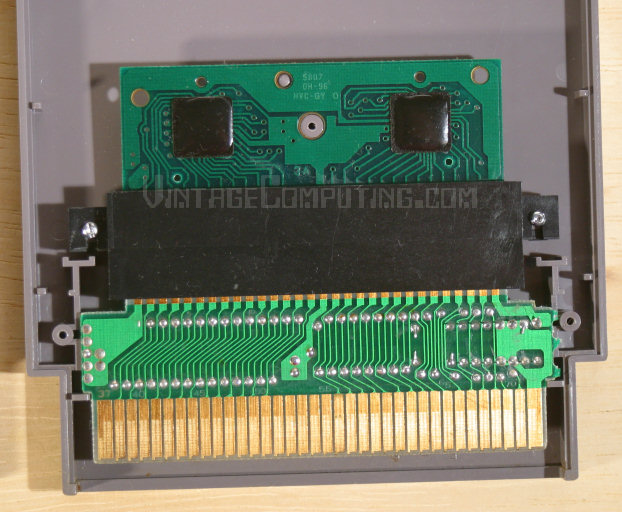
Another piece of trivia: The Famicom had a 60 pin cartridge port, while the NES had a 72 pin cartridge port (iirc they removed a few pins, relocated a few from the Famicom's bottom port, and added pins for the lockout chips). A few early games literally consisted of a Famicom game board plugged into an internal 60-to-72 pin adapter. So, for a while, the cheapest way to get a Famicom converter was to rip apart a cheap game like Gyromite and hope it was part of a certain run. You can see the converter clearly here:
http://www.vintagecomputing.com/wp-content/gyro/gyro7_big.jp...
As for technical details, you're mostly on the dot, but most later games also featured mapper circuitry to allow the NES to address more memory. Some boards used simple 7400 series, while others used customs ICs, some of which were fairly expensive, to expand the system's capabilities. Simpler ones just allowed for more complex bank switching schemes, while the most expensive ones featured things like interrupt generators and additional sound generating hardware. The sky is the limit for what you can stuff in a game cartridge, so the NES and SNES were designed to be very expandable through their cartridge ports. That's part of what makes cartridge-based games special to me; they're not just data on a disc, they're full-fledged hardware extensions of their host console.