Earlier quoted context omitted.
Any time you have hundreds of megawatts of energy stored in a small area there is risk. This includes steam boilers, nuclear reactors, batteries, dams, etc. No getting away from that. Not saying that some battery chemistry might not be easier to manage than others.
Well we're probably going to see flow batteries take over in fixed position arrays which will mitigate the risk of fire pretty substantially, being low density and liquid. It's challenging though not impossible to light salt water on fire.
California invests in battery energy storage, leaving rolling blackouts behind
31–40 of 363 posts
Re: California invests in battery energy storage, leaving rolling blackouts behind
#32[flagged]
>Come back in 5 years time when the batteries are 10 years old and failing like the bridges and schools and universities.
This however is a valid point to make. In my experience with battery systems, regular maintenance and replacing failed units is one of the things that people are quick to not do on preventative schedule. Instead, they wait until the unit is completely dead and then gasp at the cost of battery replacement. Based on how companies like PG&E do not do regular maintenance on their lines, it doesn't bode well for the batteries.
Re: California invests in battery energy storage, leaving rolling blackouts behind
#33I don't really care if the power stays on for five-nines as long as I'm still paying 61¢/kW-h for it :/ https://www.pge.com/assets/pge/docs/account/rate-plans/resid...
Re: California invests in battery energy storage, leaving rolling blackouts behind
#34This is the way. It's become standard practice in China, which now leads to the world with half of all battery installations.
Re: California invests in battery energy storage, leaving rolling blackouts behind
#35[flagged]
random whacko comments >Come back in 5 years time when the batteries are 10 years old and failing like the bridges and schools and universities. This however is a valid point to make. In my experience with battery systems, regular maintenance and replacing failed units is one of the things that people are quick to not do on preventative schedule. Instead, they wait until the unit is completely dead and then gasp at t…
Re: California invests in battery energy storage, leaving rolling blackouts behind
#36Re: California invests in battery energy storage, leaving rolling blackouts behind
#37I don't really care if the power stays on for five-nines as long as I'm still paying 61¢/kW-h for it :/ https://www.pge.com/assets/pge/docs/account/rate-plans/resid...
God forbid you live in any of the more woody parts of California either. You'll have to have your own battery or generator anyway. As someone who plans to live in the Santa Cruz Mountains long term, I will be going completely off grid as PG&E will just cut power forever rather than fix anything.
Re: California invests in battery energy storage, leaving rolling blackouts behind
#38Earlier quoted context omitted.
I think Texas will stay ahead for the foreseeable future. California keeps shooting itself in the foot with regulatory hurdles and permit issues.
And Texans will keep losing power during winter storms due to lack of regulations.
I should point out that cold temperatures place a huge demand on the grid because consumers don't want to winterize for the marginal once-a-decade blizzard any more than utilities; around half our homes have relatively inefficient resistance heaters as opposed to furnaces.
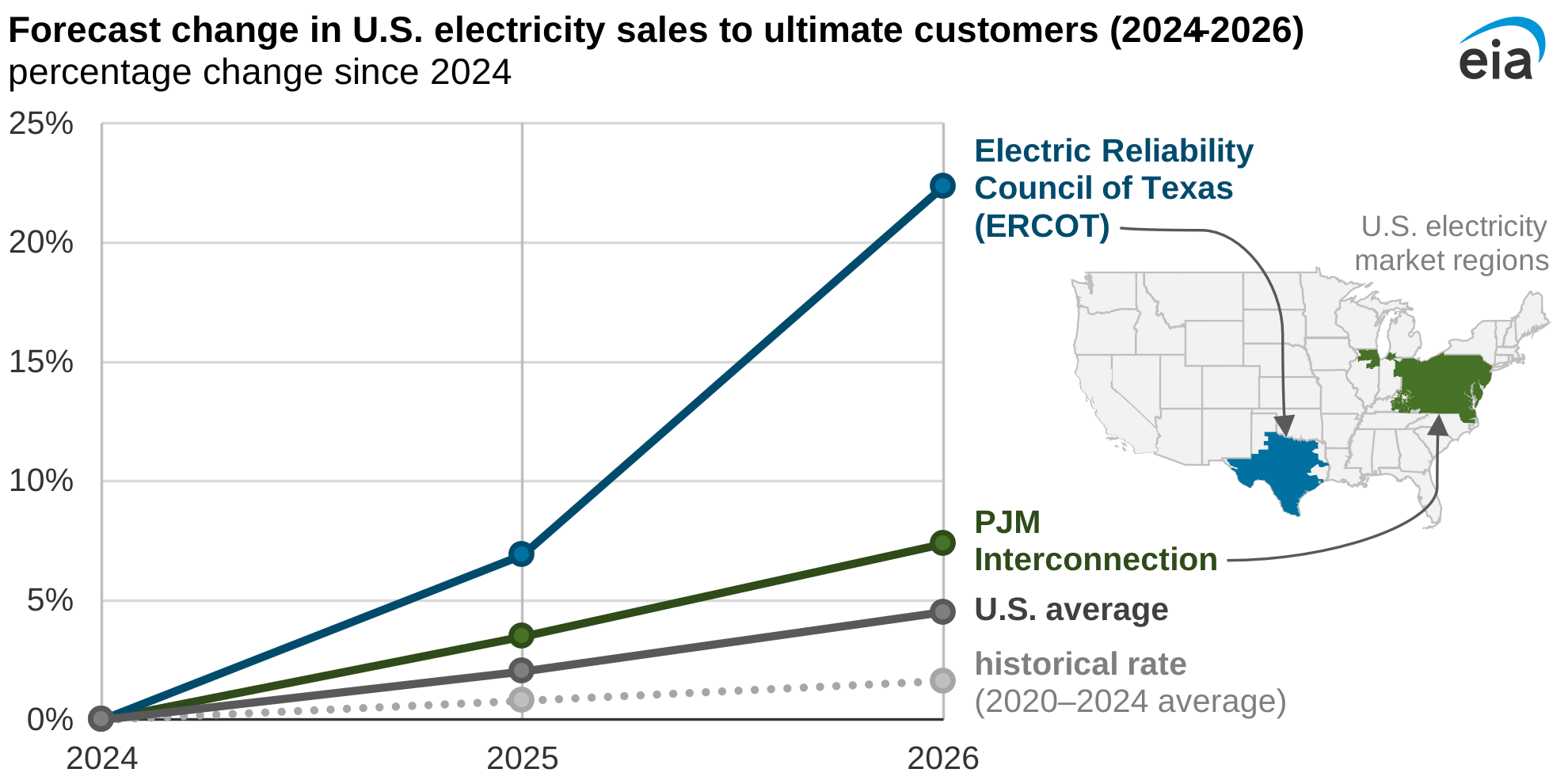
We have a lot more growth in the past few years than most other places, both in relative terms, and in absolute (big state + high growth introduces more absolute friction than small state). Demand is forecast to rise over 20% from 2024 levels vs. an American average under 5%: https://www.eia.gov/todayinenergy/images/2025.07.31/main.svg
So no wonder our reserve margins run thinner when we're already having to build at such speed just to keep pace with regular demand.
Texas has been building a ton of wind and solar to supplement generation capacity and is taking some leadership in the next-gen nuclear stuff for a reliable base load, but in the mean time the shortage of CCGTs is going to bite in a state where demand goes up this much, this fast. SB6 passed this summer also should help with reasonable control and oversight.
ERCOT actually does a pretty okay job, all things considered; it's hard to invest heavily in winterization for rare events when you're having to invest heavily in new generation to keep up with steadily increasing baseline load.
Re: California invests in battery energy storage, leaving rolling blackouts behind
#39I remember the bad old days of rolling black outs when Enron was doing energy arbitrage with Calfifornia's electricity. A more recent negative event was the battery fire at Moss Landing on the Monterrey Bay near where I live. If we use Sodium-ion batteries in the future we won't have that risk. "On January 16, 2025, the Moss Landing 300 battery energy storage system at the Moss Landing Vistra power plant (Monterey Co…
Any time you have hundreds of megawatts of energy stored in a small area there is risk. This includes steam boilers, nuclear reactors, batteries, dams, etc. No getting away from that. Not saying that some battery chemistry might not be easier to manage than others.
Re: California invests in battery energy storage, leaving rolling blackouts behind
#40This is the way. It's become standard practice in China, which now leads to the world with half of all battery installations.
If i'm wrong about China and competely misreading the situation in california please let me know.