That article ends so abruptly and lacking anything you want to know (how was it used for non-defensive purposes?) that I almost wonder if it was written by AI. Hard to tell bad writers from computers anymore.
Adblock on Chrome isn't working anymore, given the huge luxury watch ads every three paragraph I can't read it as anything but content slop to get ad impressions. Doesn't need to be AI, slop has existed for decades.
Does it exist? I could not find a wikipedia article about it. This Gobi Wall can not be a part of what is known as the Great Wall of China as it was built 5 centuries later, no? Can someone explain?
The Great Wall is just part of a larger series of fortifications in eastern Central Asia. One of the others is the less studied Medieval Wall System (MWS). The gobi wall here is a few hundred kilometers of one of the individual walls within the MWS, which as the name suggests is within the gobi desert in the modern country of Mongolia. And just to preclude the usual follow-up, these walls probably weren't major defen…
I don't know, looks like hunting walls to me. When chased, animals naturally follow such walls, however insignificant they are (sometimes they follow even a line drawn on the grass), and get onto predictable trajectory leading them into ambush.
Well, that was pretty anticlimactic. Suggest you go read about a more interesting abandoned city in the Gobi Desert instead: > Built in 1032, the city thrived under the rule of the Tangut-led Western Xia dynasty. It has been identified as the city of Etzina, which appears in The Travels of Marco Polo. ... > According to a legend of the local Torghut population, in 1372 a Mongol military general named Khara Bator was…
Khara Khoto appears to be on or near the extension of the 'Gobi Wall' into present day China, presumably as part of the same system.
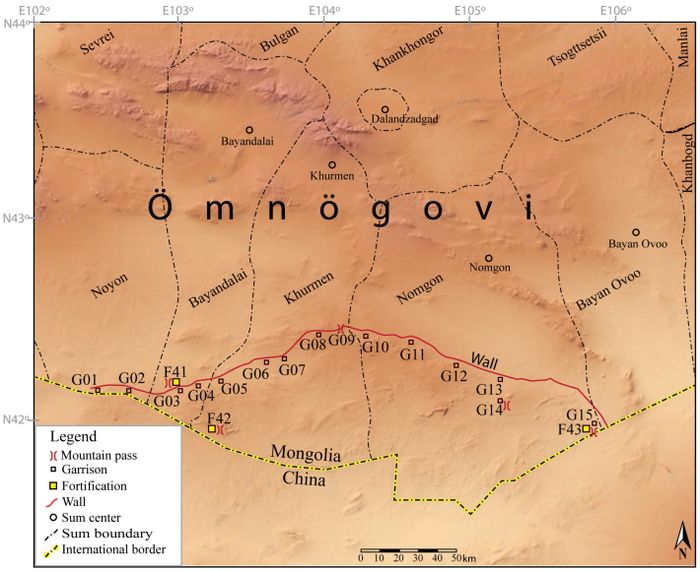
The name 'Gobi Wall' seems to refer to the section of the wall within Mongolia. Its garrisons and forts are numbered from G01 at the western end of the section, where the wall crosses the border.
That article ends so abruptly and lacking anything you want to know (how was it used for non-defensive purposes?) that I almost wonder if it was written by AI. Hard to tell bad writers from computers anymore.
Adblock on Chrome isn't working anymore, given the huge luxury watch ads every three paragraph I can't read it as anything but content slop to get ad impressions. Doesn't need to be AI, slop has existed for decades.
That was honestly what made me finally switch back to Firefox after what must have been close to two decades.
The Great Wall is just part of a larger series of fortifications in eastern Central Asia. One of the others is the less studied Medieval Wall System (MWS). The gobi wall here is a few hundred kilometers of one of the individual walls within the MWS, which as the name suggests is within the gobi desert in the modern country of Mongolia. And just to preclude the usual follow-up, these walls probably weren't major defen…
I don't know, looks like hunting walls to me. When chased, animals naturally follow such walls, however insignificant they are (sometimes they follow even a line drawn on the grass), and get onto predictable trajectory leading them into ambush.
I'm curious how you came to that conclusion. Nothing about these walls resembles desert kites that I can see, except that they both use natural materials in an arid climate.
I don't know, looks like hunting walls to me. When chased, animals naturally follow such walls, however insignificant they are (sometimes they follow even a line drawn on the grass), and get onto predictable trajectory leading them into ambush.
I'm curious how you came to that conclusion. Nothing about these walls resembles desert kites that I can see, except that they both use natural materials in an arid climate.
As a child growing up in Central Asia, I saw people piling up stones, sticks, and other debris along the ancient lines people used to control herds and wild animals.
The ones built for hunting often had a narrow, funnel-like end, while those meant for managing herds could take on almost any shape.
One of the photos in that article looks exactly like the walls I remember from my childhood.
I'm curious how you came to that conclusion. Nothing about these walls resembles desert kites that I can see, except that they both use natural materials in an arid climate.
As a child growing up in Central Asia, I saw people piling up stones, sticks, and other debris along the ancient lines people used to control herds and wild animals. The ones built for hunting often had a narrow, funnel-like end, while those meant for managing herds could take on almost any shape. One of the photos in that article looks exactly like the walls I remember from my childhood.
Yeah, but it's an overkill 2m wide and doesn't have a funnel, nor does it use the topography well for kite. And the fortification is a 100m+ square.
Like I said, the materials are similar. The design isn't.
Well, that was pretty anticlimactic. Suggest you go read about a more interesting abandoned city in the Gobi Desert instead: > Built in 1032, the city thrived under the rule of the Tangut-led Western Xia dynasty. It has been identified as the city of Etzina, which appears in The Travels of Marco Polo. ... > According to a legend of the local Torghut population, in 1372 a Mongol military general named Khara Bator was…
> a Mongol military general named Khara Bator
wait is this dude's name basically 'Black Knight'?
Well, that was pretty anticlimactic. Suggest you go read about a more interesting abandoned city in the Gobi Desert instead: > Built in 1032, the city thrived under the rule of the Tangut-led Western Xia dynasty. It has been identified as the city of Etzina, which appears in The Travels of Marco Polo. ... > According to a legend of the local Torghut population, in 1372 a Mongol military general named Khara Bator was…
> a Mongol military general named Khara Bator wait is this dude's name basically 'Black Knight'?