Live data from Hacker News

What .NET 10 GC changes mean for developers

roxeem.com

161–170 of 253 posts

Re: What .NET 10 GC changes mean for developers

#161

Earlier quoted context omitted.

As long as it's your deployment target and nothing else. For development, both macOS and Linux continue to be second class citizens, and I don't see this changing as it goes against their interests. In most .NET shops around me, the development and deployment tooling is so closely tied to VS that you can't really not use it. It's fine if you stick to JetBrains and pay for their IDE (or do non-commercial projects only…

Well, in most .NET shops around me: > The development and deployment tooling is so closely tied to VS that you can't really not use it. Development tooling: It's 50-50. Some use Visual Studio, some use Rider. It's fine. The only drawback is that VS Live Share and the Jetbrains equivalent don't interoperate. deployment tooling: There is deployment tooling tied to the IDE? No-one uses that, it seems like a poor idea. I…

> is there deployment tooling tied to the IDE?

VS has the “Publish” functionality for direct deployment to targets. It works well for doing that and nothing else. As you said, CI/CD keeps deployment IDE agnostic and has far more capabilities (e.g. Azure DevOps, GitHub Actions).
Re: What .NET 10 GC changes mean for developers

#162
post #27

A hobby audio and text analysis application I've written, with no specific concern for low level performance other than algorithmically, runs 4x as fast in .net10 vs .net8. Pretty much every optimization discussed here applies to that app. Great work, kudos to the dotnet team. C# is, imo, the best cross platform GC language. I really can't think of anything that comes close in terms of performance, features, ecosyste…

Or you can use the "C# without the line noise", which goes under the name of F#.

Yeah, but if you use F# that then you’ll have all the features C# has been working on for years, only in complete and mature versions, and also an opinionated language encouraging similar styles between teams instead of wild dialects of kinda-sorta immutablity and kinda-sorta DU’s, and everything in between, requiring constant vigilance and training… ;)

I’m a fan of all three languages, but C# spent the first years relearning why Visual Basic was very productive and the last many years learning why OCaml was chosen to model F# after. It’s landed in a place where I can make beautiful code the way I need to, but the mature libraries I’ve crafted to make it so simply aren’t recreate-able by most .Net devs, and the level of micro-managing it takes to maintain across groups is a line-by-line slog against orthodoxy and seeming ‘shortcuts’, draining the productivity those high level guarantees should provide. And then there’s the impact of EF combined with sloppy Linq which makes every junior/consultant LOC a potentially ticking time bomb without more line-by-line, function-by-function slog.

Compiler guarantees mean a lot.

Re: What .NET 10 GC changes mean for developers

#163
post #133

Earlier quoted context omitted.

C# will be a force to reckon with if/when discriminated unions finally land as a language feature.

For me, it will be if they ever get checked errors of some sort. I don’t want to use a language with unchecked exceptions flying about everywhere. This isn't saying I want checked exceptions either, but I think if they get proper unions and then have some sort of error union type it would go a long way.

You can get an error union now: https://github.com/amantinband/error-or

Re: What .NET 10 GC changes mean for developers

#164

Earlier quoted context omitted.

> I really can't think of anything that comes close in terms of [...] developer experience. Of all the languages that I have to touch professionally, C# feels by far the most opaque and unusable. Documentation tends to be somewhere between nonexistant and useless, and MSDN's navigation feels like it was designed by a sadist. (My gold standard would be Rustdoc or Scala 2.13 era Scaladoc, but even Javadoc has been.. fi…

I almost exclusively work in C# and have never experienced the Roslyn crashes you mentioned. I am using either Rider or Visual Studio though. > Like cross-project "go-to-definition" takes me to either a list of members or a decompiled listing of source code, even when I have the actual source code right there! If these are projects you have in the same solution then it should never do this. I would only expect this t…

I use VS Code on macOS for all of my C# code over the last 5 years and also never experienced Roslyn crashes.

Re: What .NET 10 GC changes mean for developers

#165
post #55

I am considering dotnet Maui for a project. On the one hand, I am worried about committing to the Microsoft ecosystem where projects like Maui have been killed in the past and Microsoft has a lot of control. Also XML… On the other hand, I’ve been seeing so many impressive technical things about dotnet itself. Has anyone here used Maui and wants to comment on their experience?

I have used MAUI at my previous job to build 3 different apps, used only on mobile (Android and iOS). I don't know why many people dislike XAML, to me it felt natural to use it for UI, I researched flutter and liked MAUI/XAML more. Although the development loop felt smoother with flutter. What I didn't like was the constant bugs, with each new version that I was eager to update to fix current issues, something new ap…

I do think server/backend is C#'s sweetspot because EF Core is soooo good.

But it's curious that it's used widely with game engines (Unity, Godot), but has a pretty weak and fractured UI landscape.

Re: What .NET 10 GC changes mean for developers

#166

I wonder if this makes .net competitive for high frequency trading...

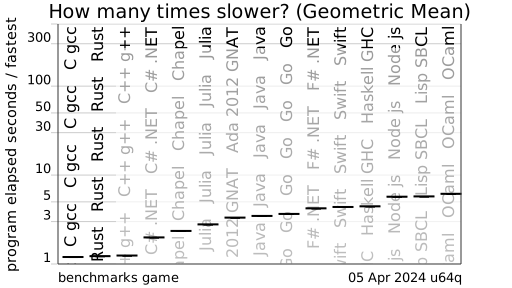
Benchmark Games[0] shows C# just behind C/C++ and Rust across a variety of benchmark types. C# has good facilities for dipping into unmanaged code and utilizing hardware intrinsics so you'd have to tap into that and bypass managed code in many cases to achieve higher performance.

[0] https://benchmarksgame-team.pages.debian.net/benchmarksgame/...

Re: What .NET 10 GC changes mean for developers

#167
post #144

Earlier quoted context omitted.

Not a single user cares about "native ui", it's only a debate among developers. Take the top 20 apps people are using, all of them use their own design system which isn't native. Flutter will always have multiple advantages against React Native (and even Native toolkits themselves) in terms of upgradability, you can do 6 months of updates with only 30mins of work and make sure it 100% works everywhere. The quality of…

Classic HN comment with unapologetic statements. If Flutter were that good, it wouldn't have flatlined so fast after the initial hype a few years ago. I tried it last year, only to see rendering glitches in the sample project.

28% of new iOS apps are made with flutter and it's the #1 cross platform framework on stack overflow 2024 survey so I highly doubt it has flatlined.

https://flutter.dev/multi-platform/ios

https://survey.stackoverflow.co/2024/technology#1-other-fram...

Re: What .NET 10 GC changes mean for developers

#168

Earlier quoted context omitted.

I disagree on this. I am at a (YC, series C) startup that just recently made the switch from TS backend on Nest.js to C# .NET Web API[0]. It's been a progression from Express -> Nest.js -> C#. What we find is that having attributes in both Nest.js (decorators) and C# allows one part of the team to move faster and another smaller part of the team to isolate complexity. The indirection and abstraction are explicit deci…

The trade offs are though that patterns and behind the scenes source code generation is another layer that the devs who have to follow need to deal with when debugging and understanding why something isn’t working. They either spend more time understanding the bespoke things or are bottle necked relying on a team or person to help them get through those moments. It’s a trade off and one that has bit me and others bef…

It has been worth the abstraction in my organization with many teams. Thinking 1000+ engineers, at minimum. It helps to abstract as necessary for new teammates that want to simply add a new endpoint yet follow all the legal, security, and data enforcement rules.

Better than no magic abstractions imo. In our large monorepo, LSP feedback can often be so slow that I can’t even rely on it to be productive. I just intuit and pattern match, and these magical abstractions do help. If I get stuck, then I’ll wade into the docs and code myself, and then ask the owning team if I need more help.

Re: What .NET 10 GC changes mean for developers

#169
post #141

Earlier quoted context omitted.

I notice that none of the examples in your blog entry on functional C# deals with error handling. I know that is not the point of your article, but that is actually one of my key issues with C# and its reliance on implicit, because like so many other parts of C# you'd probably hand it over to an exeception handler. I'd much rather prefer you to deal with it explicitly right where it happens, and I would prefer if you…

My team just recently made the switch from a TS backend to a C# backend for net new work. When we made this switch, we also introduced `ErrorOr`[0] which is a monadic result type. I would not have imagined this to be controversial nor difficult, but it turns out that developers really prefer and understand exceptions. That's because for a backend CRUD API, it's really easy to just throw and catch at a global HTTP pip…

You introduced a pattern that is simply different than the usual in C#. It's also not clearly better, it's different. In languages designed for result types like this the ergonomics of such a type are usually better.

All the libraries you use and all methods from the standard library use exceptions. So you have to deal with exceptions in any case.

There's also a million or so libraries that implement types like this. There is no standard, so no interoperability. And people have to learn the pecularities of the chosen library.

I like result types like this, but I'd never try to introduce them in C# (unless at some point they get more language support).

Re: What .NET 10 GC changes mean for developers

#170
post #55

I am considering dotnet Maui for a project. On the one hand, I am worried about committing to the Microsoft ecosystem where projects like Maui have been killed in the past and Microsoft has a lot of control. Also XML… On the other hand, I’ve been seeing so many impressive technical things about dotnet itself. Has anyone here used Maui and wants to comment on their experience?

I don't really understand why Microsoft didn't do a Tauri like thing for C# devs instead of this Maui stuff. It would be a tiny project in comparison and then isn't completely going against the grain like Maui is. If you want a write once / run in more places compromise, the browser already does that very well.

Because web UI for a desktop app sucks compared to actual native UI. As a user, any time that I see an app uses Electron, Tauri or any of that ilk, I immediately look for an alternative because the user experience will be awful.
Post reply on HN