Live data from Hacker News

Failing to Understand the Exponential, Again

julian.ac

231–240 of 266 posts

Re: Failing to Understand the Exponential, Again

#231

> Given consistent trends of exponential performance improvements over many years and across many industries, it would be extremely surprising if these improvements suddenly stopped. I'm sure people were saying that about commercial airline speeds in the 1970's too. But a lot of technologies turn out to be S-shaped, not purely exponential, because there are limiting factors. With LLM's at the moment, the limiting fac…

Ironically, given that it probably mistakes a sigmoid curve for an exponential curve, "Failing to understand the exponential, again" is an extremely apt name for this blog post.

Re: Failing to Understand the Exponential, Again

#232
post #69
post #54

You'd think that boosters for a technology whose very foundations rely on the sigmoid and tanh functions used as neuron activation functions would intuitively get this...

It's all relu these days

Most LLMs use GeGLU or SwiGLU.

Re: Failing to Understand the Exponential, Again

#233
post #69

Earlier quoted context omitted.

It's all relu these days

When people want a smooth function so they can do calculus they often use something like gelu or the swish function rather than relu. And the swish function involves a sigmoid. https://en.wikipedia.org/wiki/Swish_function

The gated variants of these functions have been dominant for a few years.

Re: Failing to Understand the Exponential, Again

#234
post #213

Earlier quoted context omitted.

> Indeed you can't be sure. But on the other hand a bunch of the commentariat has been claiming (with no evidence) that we're at the midpoint of the sigmoid for the last three years. I haven’t followed things closely, but I’ve seen more statements that we may be near the midpoint of a sigmoid than that we are at it. > Thy were wrong. And then you had the AI frontier lab insiders who predicted an accelerating pace of…

I thought the original article included the strongest objective data point on this: recent progress on the METR long task benchmark isn't just on the historical "task length doubling every 7 months" best fit, but is trending above it. A year ago, would you have thought that a pure LLM with no tools could get a gold medal level score in the 2025 IMO finals? I would have thought that was crazy talk. Given the rates of…

> I thought the original article included the strongest objective data point on this: recent progress on the METR long task benchmark isn't just on the historical "task length doubling every 7 months" best fit, but is trending above it.

There is selection bias in that paper. For example, they chose to measure “AI performance in terms of the length of tasks the system can complete (as measured by how long the tasks take humans)”, but didn’t include calculation tasks in the set of tasks, and that’s a field in which machines have been able to reliably do tasks for years that humans would take centuries or more to perform, but at which modern LLM-based AIs are worse than, say, Python.

I think leaving out such taks is at least somewhat defensible, but have to wonder whether there are other tasks at which LLMs do not become better as rapidly they also leave out.

Maybe it is a matter of posing different questions, with the article being discussed being more interested in “(When) can we (ever) expect LLMs to do jobs that now require humans to do?” than in “(How fast) do LLMs get smarter over time?”

Re: Failing to Understand the Exponential, Again

#236

Earlier quoted context omitted.

Agreed, it surely does require a world-model. I disagree that generic LLMs plus CoT/reasoning/tool calling (ie the current stack) cannot in principle implement a world model. I believe LLMs are doing some sort of world modeling and likely are mostly lacking a medium-/long-term memory system in which to store it. (I wouldn’t be surprised if one or two more architectural overhauls end up occurring before AGI, I also wo…

Isn’t the memory the pre-trained weights that let it do anything at all? Or do you mean they should be capable of refining them in real-time (learning).

The human brain has many systems that adapt on multiple time-frames which could loosely be called “memory”.

But here I’m specifically interested in real-time updates to medium/long term memory, and the episodic/consciously accessible systems that are used in human reasoning/intelligence.

Eg if I’m working on a big task I can think through previous solutions I learned, remember the salient/surprising lessons, recall recent conversations that may indirectly affect requirements, etc. The brain is clearly doing an associative compression and indexing operation atop the raw memory traces. I feel the current LLM “memory” implementations are very weak compared to what the human brain does.

I suppose there is a sense in which you could say the weights “remember” the training data, but it’s read-only and I think this lack of real-time updating is a crucial gap.

To expand on my hunch about scaffolding - it may be that you can construct an MCP module that can let the LLM retrieve or ruminate on associative memories in such a way as to allow the LLM to not make the same mistake twice and be steerable on a longer timeframe.

I think the best argument against my hunch is that human brains have systems which update the synaptic weights themselves over a timeframe of days-to-months, and so if neural plasticity is the optimal solution here then we may not be able to efficiently solve the problem with “application layer” memory plugins.

But again, there is a lot of solution-space to explore; maybe some LoRA-like algorithm can allow an LLM instance to efficiently update its own weights at test-time, and persist those deltas for efficient inference, thus implementing the required neural plasticity algorithms?

Re: Failing to Understand the Exponential, Again

#237
post #180
post #98

Earlier quoted context omitted.

> a lot of technologies turn out to be S-shaped, not purely exponential, because there are limiting factors. Yes of course it’s not going to increase exponentially forever. The point is, why predict that the growth rate is going to slow exactly now? What evidence are you going to look at? It’s possible to make informed predictions (eg “Moore’s law can’t get you further than 1nm with silicon due to fundamental physica…

It has already been trained on all the data. The other obvious next step is to increase context window, but that's apparently very hard/costly.

I don’t think this is true. See https://arxiv.org/html/2211.04325v2 for example.

Re: Failing to Understand the Exponential, Again

#238

Earlier quoted context omitted.

> Looking at information systems as far back as the first coordination of differentiating cells to human civilization is one of exponential improvement. Under what metric? Most of the things you mention don't have numerical values to plot on a curve. It's a vibe exponential, at best. Life and humans have become better and better at extracting available resources and energy, but there's a clear limit to that (100%) an…

> It's a vibe exponential, at best. I am a little stunned you think so. Life has been on Earth about 3.5-3.8 billion years. Break that into 0.5-0.8, 1 billion, 1 billion, 1 billion "quarters", and you will find exponential increases in evolutions rate of change and production of diversity across them by many many objective measures. Now break up the last 1 billion into 100 million year segments. Again exponential. Th…

The progression is much less clear when you don't view it anthropocentrically. For instance, we see an explosion in intelligible information: information that is formatted in human language or human-made formats. But this is concomitant with a crash in natural spaces and biodiversity, and nothing we make is as information-rich as natural environments, so from a global perspective, what we have is actually an information crash. Or hell, take something like agriculture. Cultured environments are far, far simpler than wild ones. Again: an information crash.

I'm not saying anything about the future, mind you. Just that if we manage to stop sniffing our own farts for a damn second and look at it from the outside, current human civilization is a regression on several metrics. We didn't achieve dominion over nature by being more subtle or complex than it. We achieved that by smashing nature with a metaphorical club and building upon its ruins. Sure, it's impressive. But it's also brutish. Intelligence requires intelligible environments to function, and that is almost invariably done at the expense of complexity and diversity. Do not confuse success for sophistication.

> last 1 year - even the basic improvements to AI models in the last 12 months are an unprecedented level of change, per time, looking back.

Are they? What changed, exactly? What improvements in, say, standards of living? In the rate of resource exploitation? In energy efficiency? What delta in our dominion over Earth? I'll tell you what I think: I think we're making tremendous progress in simulating aspects of humanity that don't matter nearly as much as we think they do. The Internet, smartphones, AI, speak to our brains in an incredible way. Almost like it was by design. However, they matter far more to humans within humanity than they do in the relationship of humanity with the rest of the universe. Unlike, say, agriculture or coal, which positively defaced the planet. Could we leverage AI to unlock fusion energy or other things that actually matter, just so we can cook the rest of the Earth with it? Perhaps! But let's not count our chickens before they hatch. As of right now, in the grand scheme of things, AI doesn't matter. Except, of course, in the currency of vibes.
Re: Failing to Understand the Exponential, Again

#239
post #70

Earlier quoted context omitted.

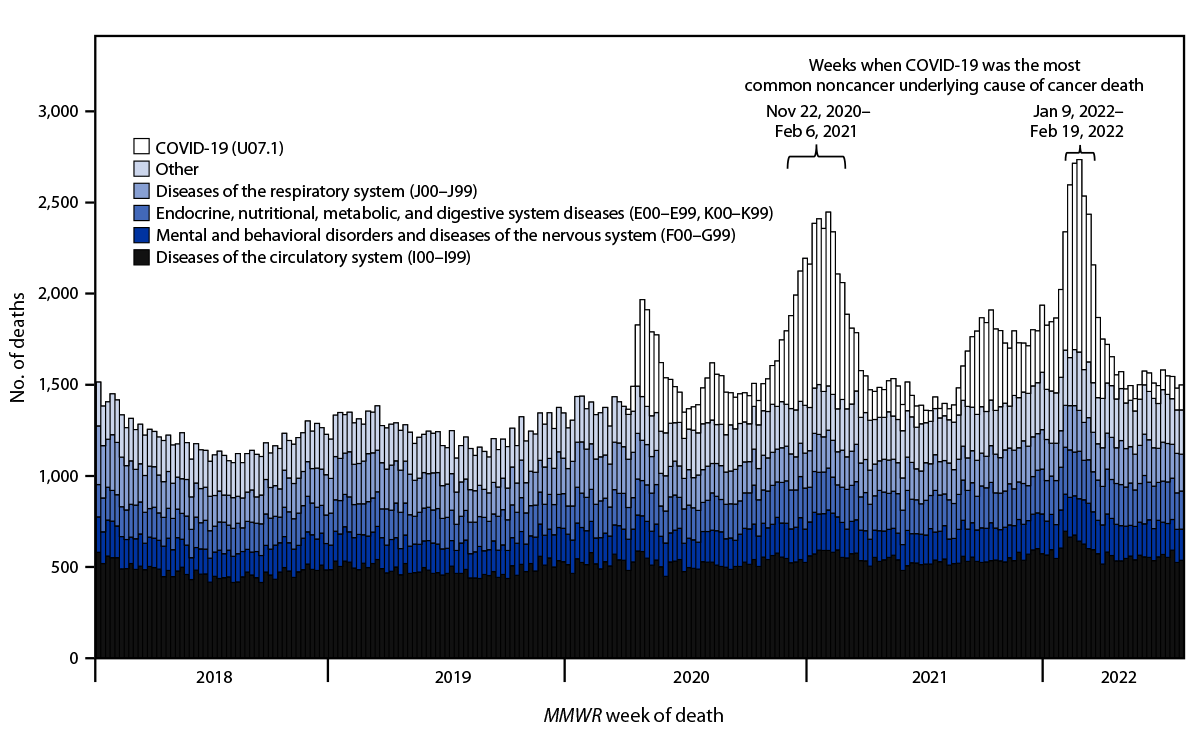
I'm curious as to whether the consensus is that the observed behaviour of COVID waves was ever fully and satisfactorily explained - the tend to grow exponentially but then seemingly saturate at a much lower point than a naïve look at the curve might suggest?

To those interested in numbers it was explained early - even on TV. Anyone interested saw that it was going like a seasonal flue wave. Numbers were following strict mathematics. My area was early - the numbers peaked right before people started to go crazy - the rest was censorship - There was a lot of fakery going on by using very soft numbers. Very often they used reporting date instead of infection date.. and some…

This is easily disproven by looking at all-cause mortality. E.g. https://www.cdc.gov/mmwr/volumes/71/wr/figures/mm7150a3-F2.g...

Did that look like normal seasonal deaths? It's even more stark if you look specifically at the harder hit areas.

Re: Failing to Understand the Exponential, Again

#240

Earlier quoted context omitted.

To those interested in numbers it was explained early - even on TV. Anyone interested saw that it was going like a seasonal flue wave. Numbers were following strict mathematics. My area was early - the numbers peaked right before people started to go crazy - the rest was censorship - There was a lot of fakery going on by using very soft numbers. Very often they used reporting date instead of infection date.. and some…

This is easily disproven by looking at all-cause mortality. E.g. https://www.cdc.gov/mmwr/volumes/71/wr/figures/mm7150a3-F2.g... Did that look like normal seasonal deaths? It's even more stark if you look specifically at the harder hit areas.

Well, the shapes look very seasonal... Do you know something about epidemiological curves?!

The wave 2020 in Europe was often smaller than 2018. And the data was perfectly seasonal. If you know people working in nursing homes and hospitals, you can ask them what happened later in 2021...

I heard a lot of stories - from first hand... They parked old ladies in the cold in front of open windows for fresh air - until they were blue... They vaccinated old people right into an ongoing wave and of course they had more problems caused from a wrongly trained vulnerable immune system - sane doctors don't vaccinate into an ongoing wave. What was going on in hospitals and nursing homes was a crime for money. Just ask the people that were there. A combat medic I know that now works in a hospital called 2021 a crime.

And still - solid Epidemiological data - wherever you could find it - was still perfectly seasonal. You could see some perfect mathematical curves. Just very high because they actively killed people. Even pupils in school spent all day in front of open windows in the cold... To remain healthy... How stupid is that...

Not all places are equal, but I've taken a look at German all cause mortality. 2020 was not special. In 2021 it started rising synchronous with vaccinations.

Post reply on HN