Earlier quoted context omitted.
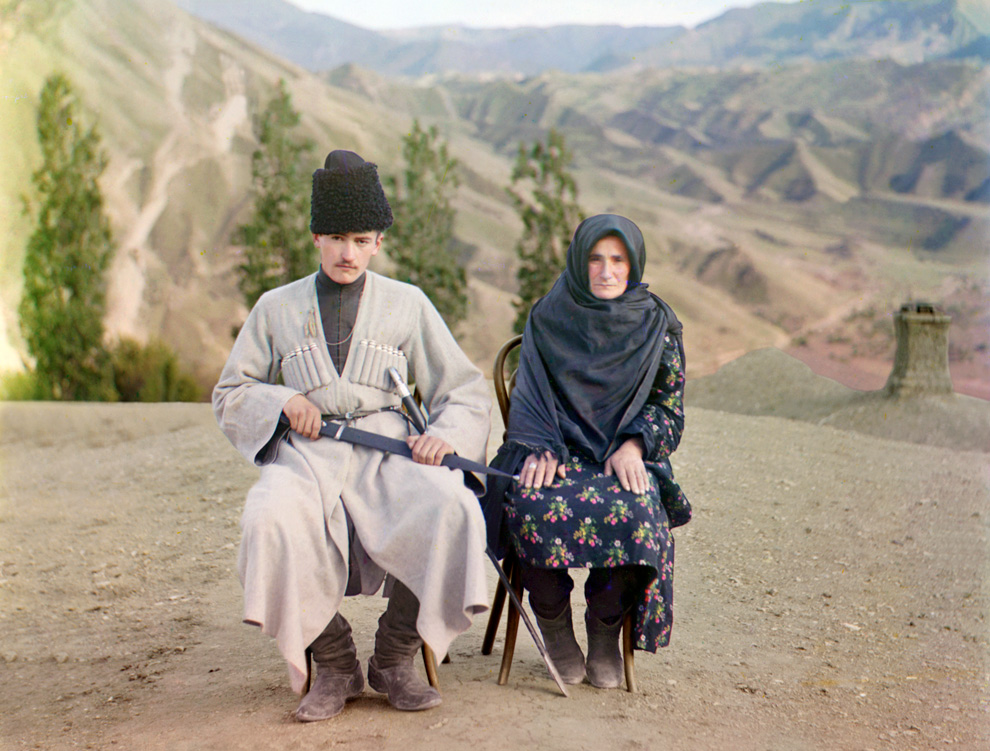
Here: you can talk to yourself here is what I would call an uneditorialized composition of the image you linked http://www.loc.gov/pictures/resource/prokc.21676/?co=prok .......... Now, take a look at this image from Prokudin-Gorsky [as per the linked HN article] http://inapcache.boston.com/universal/site_graphics/blogs/bi... ........... And Here: you can talk to yourself (again) as a control I took the time to downl…
Thank you for taking the time to produce a version yourself and giving us your opinion of which image you consider to best fit your definition of having the Photoshop je ne sais quoi and which does not. That is the direct a to b comparison I had hoped for. These images are no less impressive without a color balance provided by the editor. They are a journey through the former Russian empire and down the old Silk Road…
Russia in color, a century ago
191–196 of 196 posts
Re: Russia in color, a century ago
#192Earlier quoted context omitted.
> This is pure [classic] trolling. If anyone here is a troll, it is you. Only you haven't been coherent enough to be trolling in the traditional fashion. It seems perhaps that you have invented a new style of trolling: State things with an affected air of authority, but never make it exactly clear just what your thesis is. Instead, just kind of ramble on, juxtaposing incontrovertible facts -- such as, "The images are…
nessus42: I got my SB from MIT in Philosophy. MIT's Philosophy program is considered to be in the top few in the country, as is its Linguistics. I was taught creative writing by Joe Haldeman, photography in dark rooms that had been built by Minor White, psychology by Susan Carey, etc. I normally don't call people out. But You're a MIT Philosophy Major spouting off. You know how bad these arguments are. This is my pro…
In the meantime, I'll take one more stab at horribly distorting your position in a trollish and intellectually dishonest fashion. What you seem to be saying is as follows:
With the advent of digital image manipulation tools such as Photoshop, we've discovered the visual equivalent of glutimates, the previously unrecognized fifth "taste", which does not have its own distinct flavor, and yet somehow manages to make everything that is combined with it taste ever so much better. Editorial photographers now use Photoshop to dump glutimates into the images that we routinely see by the bucketful, and these visual glutimates were also liberally sprinkled into the restored Proudin-Gorsky images. Anyone who experiences any particular feeling of "wow" from seeing these restored images, is really just enjoying those glutimates. The original data, sans artificial glutimate enhancement, would never wow the modern eye.
I have no doubt that you are correct about the visual glutimates that are routinely added to our modern visual diet. But I should also think that this is actually nothing new. This has been routinely done long before the invention of Photoshop, just as it was routinely done in cooking before the scientific confirmation a decade or so ago of a fifth kind of taste bud. E.g., Modern French cuisine, as codified in the late 19th century, is largely based on getting plenty of glutimates into food through the use of veal stock and deglazing, etc. There's a similar story for Japanese food, which led to the patenting of monosodium glutimate in 1908.
For a famous editorial photo ladened with darkroom MSG, rather than Photoshop created MSG, we need look no further than the famous photo of RFK after he was shot:
http://www.the1968exhibit.org/sites/the1968exhibit.org/files...
Should I somehow feel cheated that too much MSG has gotten into the meat of what was supposed to be reality? Maybe I should. But I don't. And surely what moves me about this photo is not merely the darkroom. You have stated previously that people who are in awe of the Proudin-Gorsky restorations are really in awe of nothing more than Photoshop. In that case, what moves me in the RFK photo, is nothing more than the darkroom. That, of course, is absurd.
Also, I'm not convinced that this visual MSG in the Proudin-Gorsky photos has quite the immense effect that you seem to imply that it does.
Compare this Proudin-Gorsky image:
http://inapcache.boston.com/universal/site_graphics/blogs/bi...
side-by-side with this scanned Kodachrome slide from 1941:
http://lcweb2.loc.gov/service/pnp/fsac/1a33000/1a33900/1a339...
Yes, the Proudin-Gorsky image looks more modern. But the Kodachrome image from 1941 is as equally impressive in its own way--those girls look like they could step right out of that slide and into my living room. And this is presumably without the addition of any MSG. Or at least not any that is not inherent in the Kodachrome process.
Re: Russia in color, a century ago
#193Earlier quoted context omitted.
Are we supposed to find the "uneditorialized composition" to be any less amazing than the modern renderings? Personally, I don't find that to be the case. Though I do find the "uneditorialized" version to have a greenish cast that if I were working in an old-school darkroom, I would have attempted to fix. Also I would have dodged the sky in order to bring out the cloud details. Though I admittedly don't have much exp…
To change the tone of this conversation -- away from being adverserial -- I'll just throw this out there. re: A more accurate representation of reality Images have information and utility. Keeping this in mind, you can avoid the notion of accurate/inaacurate and real/unreal and make deeper progress in terms of understanding how images are made and how they are used. ....... [this is from review of Hyman, 2006 opp cit…
If you fall into the Continental camp of thought, then that explains why you are so hard to pin down. Continental thought is rife with meaningless hot air. Here's piece of evidence for that assertion, just in case you doubt it:
http://en.wikipedia.org/wiki/Sokal_affair
If you do fall into the Continental camp, you surely are not to blame. I blame society. On the other hand, it's never too late to replan your route to a saner road.
Re: Russia in color, a century ago
#194Earlier quoted context omitted.
To change the tone of this conversation -- away from being adverserial -- I'll just throw this out there. re: A more accurate representation of reality Images have information and utility. Keeping this in mind, you can avoid the notion of accurate/inaacurate and real/unreal and make deeper progress in terms of understanding how images are made and how they are used. ....... [this is from review of Hyman, 2006 opp cit…
Only sloppy-minded Continental philosophers would typically discard the distinction of accurate vs inaccurate. (Though there may certainly still be a large space for variation within images of equal accuracy. If this were not the case, then one might plausibly argue that there is no art in making accurate photographs.) As this book would seem to be written in the more clear-headed Analytic tradition, I am guessing, i…
Also, Like Nietzche, I don't always write to be understood, at least noy just by just anyone. You may need to do some work or have some training. But to those that know, it will make sense.
As a sidebar example: accurate/innacurate.
Think about this at the pixel level. It already is innacurate (its a square). Or with Jpeg compression, its also deleting information and replacing it (less accurate--like areas of information are simplified). And then, at another leve of abstraction consider something like this: http://en.wikipedia.org/wiki/Unsharp_masking. You should read this, but the tl;dr is I can make an image "sharp" by ~blurring it. So, is that "more accurate" (can see it clear) or less accrurate (its more blurry?). I've just lost data. But I gained contrast. Wait, what?
So, there is a problem in continuing the discussion at this level without alot more work. Its a practical problem as well. One just need different mental frameworks to progress. Its just that simple. At the end, only then, can you come back and have a better understanding of "accurate" etc. But don't take my word for it -- that book is really good--and touches on all of this. And it is Rigorous. He's an Oxford man. Etc.
Of course, there is a reason it is a book and not a Hacker News Thread. =D
Re: Russia in color, a century ago
#195No one is smiling. Not even the kids. Maybe the woman in #20 is, who knows? I know in general 'old time' photos didn't have people smiling much - very posed pictures and stoic expressions. I wonder if they had any idea how much this would color our impression of them 100+ years later?
Re: Russia in color, a century ago
#196No one is smiling. Not even the kids. Maybe the woman in #20 is, who knows? I know in general 'old time' photos didn't have people smiling much - very posed pictures and stoic expressions. I wonder if they had any idea how much this would color our impression of them 100+ years later?