Live data from Hacker News

Russia in color, a century ago

archive.boston.com

181–190 of 196 posts

Re: Russia in color, a century ago

#181
post #177

Earlier quoted context omitted.

[I'm not really sure] [the point of your assertions is]. [I think that] [A seeming insinuation of what you are claiming is...] [That insinuation, if present, would seem to be groundless]. Rejecting a false assertion might be clever if it were not falsely asserted [in the first place]. But anyone can play this game. Its almost as good as the false [false dichotomy] that follows. This is pure [classic] trolling. And as…

> This is pure [classic] trolling. If anyone here is a troll, it is you. Only you haven't been coherent enough to be trolling in the traditional fashion. It seems perhaps that you have invented a new style of trolling: State things with an affected air of authority, but never make it exactly clear just what your thesis is. Instead, just kind of ramble on, juxtaposing incontrovertible facts -- such as, "The images are…

nessus42: I got my SB from MIT in Philosophy. MIT's Philosophy program is considered to be in the top few in the country, as is its Linguistics. I was taught creative writing by Joe Haldeman, photography in dark rooms that had been built by Minor White, psychology by Susan Carey, etc.

I normally don't call people out. But You're a MIT Philosophy Major spouting off. You know how bad these arguments are. This is my problem. With this type of background there is no excuse. I'm happy to give the benefit of the doubt to a normal HN reader who may be lacking in technicals or experience. English as a second language. But these argument forms are rhetorical garbage.

I'm not sure in what decade you were at MIT. Maybe that is the problem. Maybe these simple-by-modern-standard ideas, techniques, and technologies are beyond than your training in photography? You owe more to the HN community than that. You owe everybody here some intellectual honesty.

This is the 21st century. We are deconstructing perception and re-constructing it image by image, pixel by pixel. And tools and techniques that have been field tested for two decades. With cognitive psychology in mind. Its a long way from Minor White's Darkroom. These are now the tools of the Documentary photographer.[1]

I happen to have first-hand experience with this. Years worth of training. In school and in the field.

I don't need to "argue" a point when demonstrating or illustrating a standard technique, it's superflous. You confuse actual experience with an "affected air of authority."

The point of my contribution on this thread is to share some experience. So, if nothing else, people can talk more precisely. About what they are looking . I'm not hear to rain on a parade about what people do or don't . Images are ultimately viewed for there enjoyment regardless of provenence.

Time for more enjoying.

______________

[1] A Rigorous and interdiscilinary book, written by a Philosopher: The Objective Eye: Color, Form, and Reality in the Theory of Art (Oxford, 2006)

http://www.amazon.com/The-Objective-Eye-Reality-Theory/dp/02...

Re: Russia in color, a century ago

#182
post #178

Earlier quoted context omitted.

[So, if I understand you correctly now], [your argument does not claim that...] [Instead your claim is that ...] [I might certainly buy that claim.] [As to ... your claim is ...?] [I find that a bit hard to believe.] [A long exposure or a polarizing filter on the camera can do that.] The combination of self-referential straw-man-building and false-false hypthesis rejection is priceless. Polarizing filters and long le…

Perhaps it it is telling when someone claims to be an expert in photography and doesn't know the difference between a "long exposure" and a "long lens". Talk about drunk at the bar shit! Furthermore, half of your little diatribe there misattributes to me things said by michrassena.

Nice try, but too little to late.

On the topic of overexposure: Let us not burn our film.

It is time to move on.

Re: Russia in color, a century ago

#183

Earlier quoted context omitted.

This always makes me wonder whether there isn't something about the imperfections from these analog copies (not to mention various analog playback mechanisms) that 'adds' to the richness/perceived value of the music... Perhaps on some level some percentage of us prefer to know that we have a copy of a copy, or some level of imperfection, in our version that we play, vs a straight up 100% clone

That's completely fine. What I object to is the unqualified use of 'better'. You can't claim that vinyl is somehow 'better' when what you mean is that vinyl is perhaps more 'satisfying' on a personal level. I personally disagree; vinyl's imperfections irritate me just as much as a low bitrate MP3 does. To me vinyl's upsides are the large cover artwork, and the lack of an easy 'skip' button. Less exiting is the knowle…

i agree with you about unqualified use of better - I think it applies to lots of areas of technology, and even areas of culture, etc... It would be nice if people were more understanding that a person's opinion on something is in fact influenced by all of their various value judgements and an enormous level of subjectivity; of course given that people in similar networks will have similar experiences and likely hold similar value judgements this leads to the tendency to 'circle jerk' on an issue, and then something becomes 'better'.. The first time they meet someone who doesn't share these judgements a flame war errupts

Re: Russia in color, a century ago

#184
post #182

Earlier quoted context omitted.

Perhaps it it is telling when someone claims to be an expert in photography and doesn't know the difference between a "long exposure" and a "long lens". Talk about drunk at the bar shit! Furthermore, half of your little diatribe there misattributes to me things said by michrassena.

Nice try, but too little to late. On the topic of overexposure: Let us not burn our film. It is time to move on.

Nice try at what? Yet another post by 001sky that insinuates everything and states nothing!

Re: Russia in color, a century ago

#185
post #94
post #31

Earlier quoted context omitted.

Russians don't walk around smiling, unless something good happens to smile about. In fact, smiling Americans look stupid grinning all the time.

Americans don't walk around being sad, unless something bad happens to be sad about. In fact, sad Russians look stupid wearing sad-face all the time.

Yeah, I don't think Americans look stupid. I was just explaining the cultural difference.

Re: Russia in color, a century ago

#186
post #175
post #174

Earlier quoted context omitted.

user: michrassena created:4 days ago No submissions No comments (besides this thread) So, its safe to say you are a Troll. But, for the faithful HN reader: To sum: [a] digital data is recorded in a non-linear function vs perception by the mind. [1] digital scan translation thus make it 'visible', based on a variety of adjustment parameters. [2] each input and output device has its own gamut, or sub-space of EMR. [3]…

With this in mind, lets walk through the various ramblings. [Troll] [I simply asked for an objective demonstration...] Of differential perception. Nice straw-man. If you want this, you a/b test. no unicorns will be forthcoming. [made the color space of nature] Note: color space is a sub-set of EMR by definition. [The limitation was precisely the latitude of the plates] The plates have two limitations you fail to appr…

if you'll have a look here, you'll see the sky detail, it's at the bottom

http://lcweb2.loc.gov/service/pnp/prok/01600/01676v.jpg

do you know why it appears at the bottom and not the other two frames?

Re: Russia in color, a century ago

#187
post #175

Earlier quoted context omitted.

With this in mind, lets walk through the various ramblings. [Troll] [I simply asked for an objective demonstration...] Of differential perception. Nice straw-man. If you want this, you a/b test. no unicorns will be forthcoming. [made the color space of nature] Note: color space is a sub-set of EMR by definition. [The limitation was precisely the latitude of the plates] The plates have two limitations you fail to appr…

if you'll have a look here, you'll see the sky detail, it's at the bottom http://lcweb2.loc.gov/service/pnp/prok/01600/01676v.jpg do you know why it appears at the bottom and not the other two frames?

Here: you can talk to yourself

here is what I would call an uneditorialized composition of the image you linked

http://www.loc.gov/pictures/resource/prokc.21676/?co=prok

..........

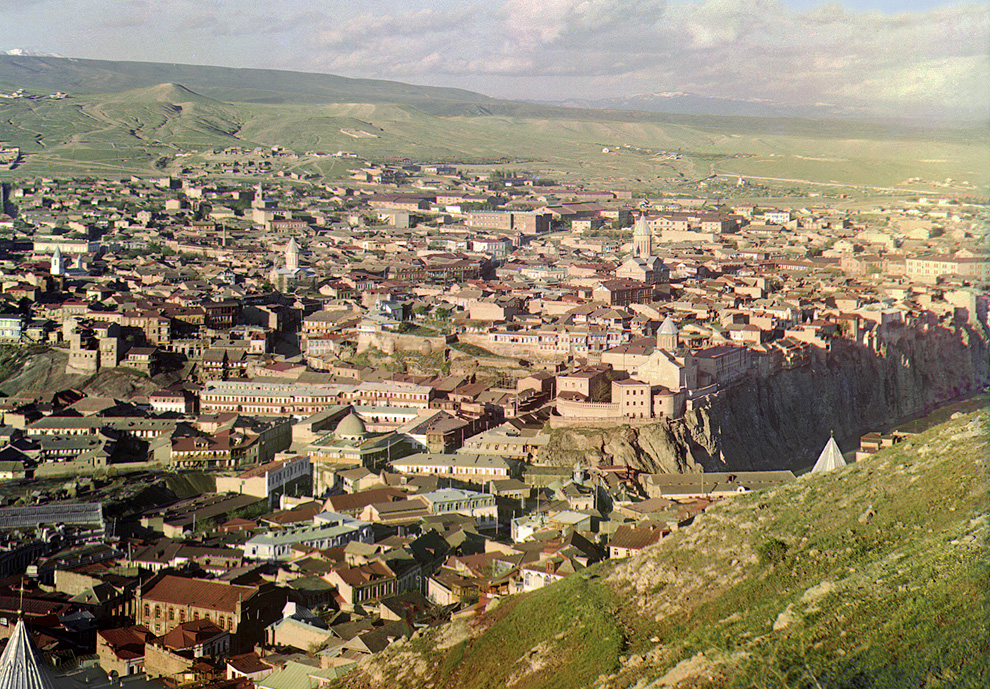
Now, take a look at this image from Prokudin-Gorsky [as per the linked HN article]

http://inapcache.boston.com/universal/site_graphics/blogs/bi...

...........

And Here: you can talk to yourself (again) as a control

I took the time to download and produce my own take on this image. Linked here:

http://imgur.com/wHWmu

Re: Russia in color, a century ago

#188
post #187

Earlier quoted context omitted.

if you'll have a look here, you'll see the sky detail, it's at the bottom http://lcweb2.loc.gov/service/pnp/prok/01600/01676v.jpg do you know why it appears at the bottom and not the other two frames?

Here: you can talk to yourself here is what I would call an uneditorialized composition of the image you linked http://www.loc.gov/pictures/resource/prokc.21676/?co=prok .......... Now, take a look at this image from Prokudin-Gorsky [as per the linked HN article] http://inapcache.boston.com/universal/site_graphics/blogs/bi... ........... And Here: you can talk to yourself (again) as a control I took the time to downl…

Are we supposed to find the "uneditorialized composition" to be any less amazing than the modern renderings? Personally, I don't find that to be the case.

Though I do find the "uneditorialized" version to have a greenish cast that if I were working in an old-school darkroom, I would have attempted to fix. Also I would have dodged the sky in order to bring out the cloud details. Though I admittedly don't have much experience doing such things in a darkroom for color photography, and I suspect that it's harder than for black & white.

Since you don't seem to actually wish to state any thesis on your own, perhaps you'll answer a question:

Which of these of these images, the "uneditorialized" or the Photoshopped version is a more accurate representation of reality, as seen by Prokudin-Gorsky's eyes on that day?

Re: Russia in color, a century ago

#189
post #187

Earlier quoted context omitted.

if you'll have a look here, you'll see the sky detail, it's at the bottom http://lcweb2.loc.gov/service/pnp/prok/01600/01676v.jpg do you know why it appears at the bottom and not the other two frames?

Here: you can talk to yourself here is what I would call an uneditorialized composition of the image you linked http://www.loc.gov/pictures/resource/prokc.21676/?co=prok .......... Now, take a look at this image from Prokudin-Gorsky [as per the linked HN article] http://inapcache.boston.com/universal/site_graphics/blogs/bi... ........... And Here: you can talk to yourself (again) as a control I took the time to downl…

Thank you for taking the time to produce a version yourself and giving us your opinion of which image you consider to best fit your definition of having the Photoshop je ne sais quoi and which does not. That is the direct a to b comparison I had hoped for.

These images are no less impressive without a color balance provided by the editor. They are a journey through the former Russian empire and down the old Silk Road into a past made more accessible by color. Beyond any concerns of the trueness of their rendition, they are a readily comprehended document of a world long gone. These are relics in living color, their faces and fascades as ruddy as the day they were photographed. This is a far-flung agrarian empire and the ancestors of an antique world on the cusp of an upheaval.

Whatever the realities of the world represented and the facts that fill in my poor command of history, this is a world that integrates itself squarely with our everyday world precisely because it is depicted in a familiar fashion. The commonplace monochrome images of the past are colder, more analytical, and more removed than these.

So, aside from the interests of archivalists and historians who need to preserve artifacts as completely as they are found, who gives a damn if the use of Photoshop munged the color space a little and these images are dressed up a bit for eyes who've seen every color? The dressing doesn't alter the substance beneath, and if we are able to see past the process with a little help from the editor and into our imagination of this other world, all the better.

In a more sober assessment, all of these colors in these scenes can be constructed from the world in which we live currently, the grass, the sky, the skin tones, the wood, the stone, the dye in the clothing. The lighting conditions can be replicated for the same time of year, day and weather conditions. All of these sites exist in the world, however excavated or built up. Clothing can be sewn and dyed, models found and dressed. Only then may we know if what we've seen here isn't a very slight fabrication by the editor.

Or we may be assured that what we've seen is good enough and close enough that we had wrung out from it the last drop of evidence of the human condition, and let it rest.

Re: Russia in color, a century ago

#190
post #187

Earlier quoted context omitted.

Here: you can talk to yourself here is what I would call an uneditorialized composition of the image you linked http://www.loc.gov/pictures/resource/prokc.21676/?co=prok .......... Now, take a look at this image from Prokudin-Gorsky [as per the linked HN article] http://inapcache.boston.com/universal/site_graphics/blogs/bi... ........... And Here: you can talk to yourself (again) as a control I took the time to downl…

Are we supposed to find the "uneditorialized composition" to be any less amazing than the modern renderings? Personally, I don't find that to be the case. Though I do find the "uneditorialized" version to have a greenish cast that if I were working in an old-school darkroom, I would have attempted to fix. Also I would have dodged the sky in order to bring out the cloud details. Though I admittedly don't have much exp…

To change the tone of this conversation -- away from being adverserial -- I'll just throw this out there.

re: A more accurate representation of reality

Images have information and utility. Keeping this in mind, you can avoid the notion of accurate/inaacurate and real/unreal and make deeper progress in terms of understanding how images are made and how they are used.

....... [this is from review of Hyman, 2006 opp cit]

“The longer you work, the more the mystery deepens of what appearance is, or how what is called appearance can be made in another medium."—Francis Bacon, painter

This, in a nutshell, is the central problem in the theory of art. It has fascinated philosophers from Plato to Wittgenstein. And it fascinates artists and art historians, who have always drawn extensively on philosophical ideas about language and representation, and on ideas about vision and the visible world that have deep philosophical roots.

John Hyman’s The Objective Eye is a radical treatment of this problem, deeply informed by the history of philosophy and science, but entirely fresh. The questions tackled here are fundamental ones: Is our experience of color an illusion? How does the metaphysical status of colors differ from that of shapes? What is the difference between a picture and a written text? Why are some pictures said to be more realistic than others? Is it because they are especially truthful or, on the contrary, because they deceive the eye?

The Objective Eye explores the fundamental concepts we use constantly in our most innocent thoughts and conversations about art, as well as in the most sophisticated art theory. The book progresses from pure philosophy to applied philosophy and ranges from the metaphysics of color to Renaissance perspective, from anatomy in ancient Greece to impressionism in nineteenth-century France. Philosophers, art historians, and students of the arts will find The Objective Eye challenging and absorbing.

.......

I hope this helps.

Post reply on HN