I don't know if it's selection/survivor bias, but every time I watch a video about computers from the 60s and 70s, I am amazed how spot on they are with the trajectory of the technology. Take this CAD demo from MIT back in 1963 showing features that I commonly use today: https://youtu.be/6orsmFndx_o Then the 80s and 90s rolled in, the concept is computers that entered the mainstream. Imagination got too wild with mov…
One might also take on the more cynical perspective and be disappointed that we are still stuck with these early achievements. FCOL most of us are now happy to have our AI overlords type out software on 80 column displays in plain ASCII because that is what we standardized on with Fortran.
The man with a Home Computer (1967) [video]
31–40 of 54 posts
Re: The man with a Home Computer (1967) [video]
#32The first person with a home computer in the UK, not just a terminal, was probably computer music experimenter Peter Zinovieff, who bought a DEC PDP-8/S for his studio in the late 1960s, for the insane cost of around £80,000 (inflation adjusted to today.) By the mid-70s the studio had turned into this: https://www.thewire.co.uk/audio/tracks/listen_peter-zinovief...
Re: The man with a Home Computer (1967) [video]
#33I don't know if it's selection/survivor bias, but every time I watch a video about computers from the 60s and 70s, I am amazed how spot on they are with the trajectory of the technology. Take this CAD demo from MIT back in 1963 showing features that I commonly use today: https://youtu.be/6orsmFndx_o Then the 80s and 90s rolled in, the concept is computers that entered the mainstream. Imagination got too wild with mov…
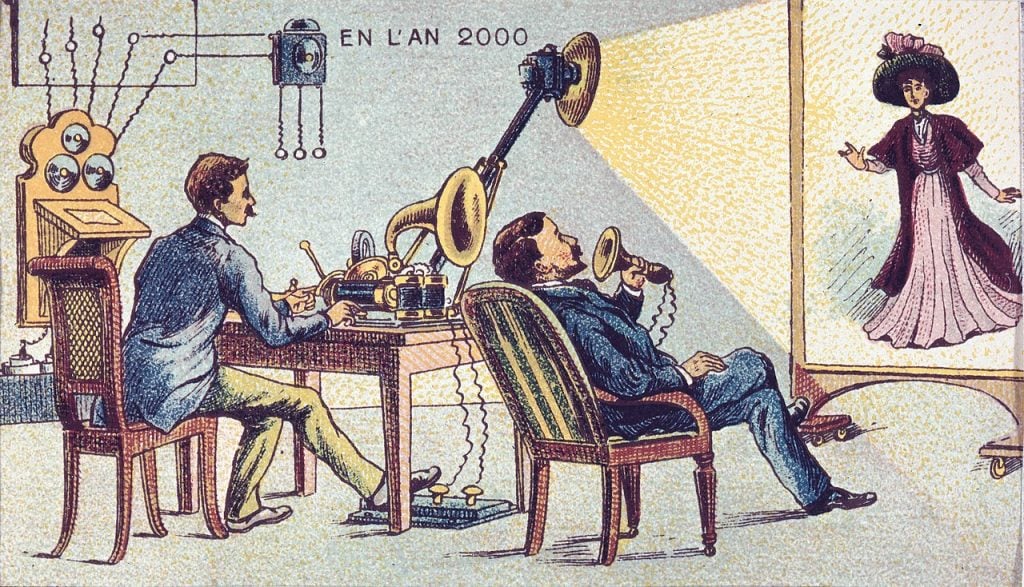
That's one of the reasons why touchscreen smartphones dominated the market in less than one decade. They made the dream of "real-time videotelephony from a rectangle" come true, a dream which had been present in literature and culture for around hundred of years.
Re: The man with a Home Computer (1967) [video]
#34Earlier quoted context omitted.
That's one of the reasons why touchscreen smartphones dominated the market in less than one decade. They made the dream of "real-time videotelephony from a rectangle" come true, a dream which had been present in literature and culture for around hundred of years.
I read and watched quite a bit of sci-fi (including from the golden age) as a kid in the early 90s and don't recall such a dream. What media exactly did I overlook?
Re: The man with a Home Computer (1967) [video]
#35Earlier quoted context omitted.
I think in 1967, an affordable computer terminal was not more than 2-way fax machine. Being able to drive a CRT sounds significantly harder than driving a typewriter.
I'd quite like to hook up a teletypewriter to a modern Linux box, sounds like a fun little project.
The old Teletype in question was a Baudot machine with a 60 mA current loop, rather than ASCII and 20 mA loop for the Model 33.
Re: The man with a Home Computer (1967) [video]
#36Earlier quoted context omitted.
That's one of the reasons why touchscreen smartphones dominated the market in less than one decade. They made the dream of "real-time videotelephony from a rectangle" come true, a dream which had been present in literature and culture for around hundred of years.
I read and watched quite a bit of sci-fi (including from the golden age) as a kid in the early 90s and don't recall such a dream. What media exactly did I overlook?
[1] - https://news.artnet.com/app/news-upload/2021/09/1280px-Franc...
Re: The man with a Home Computer (1967) [video]
#37I don't know if it's selection/survivor bias, but every time I watch a video about computers from the 60s and 70s, I am amazed how spot on they are with the trajectory of the technology. Take this CAD demo from MIT back in 1963 showing features that I commonly use today: https://youtu.be/6orsmFndx_o Then the 80s and 90s rolled in, the concept is computers that entered the mainstream. Imagination got too wild with mov…
Re: The man with a Home Computer (1967) [video]
#38I don't know if it's selection/survivor bias, but every time I watch a video about computers from the 60s and 70s, I am amazed how spot on they are with the trajectory of the technology. Take this CAD demo from MIT back in 1963 showing features that I commonly use today: https://youtu.be/6orsmFndx_o Then the 80s and 90s rolled in, the concept is computers that entered the mainstream. Imagination got too wild with mov…
One might also take on the more cynical perspective and be disappointed that we are still stuck with these early achievements. FCOL most of us are now happy to have our AI overlords type out software on 80 column displays in plain ASCII because that is what we standardized on with Fortran.
We aren't stuck with the terminal and CLIs. We stick with them, because they actually do have value.
80 columns is a reasonable compromise length, once you've accepted monospace text, that works with human perception, visual scanning of text etc. But many programmers nowadays don't feel beholden to this; they use any number of different IDEs, and they have their linters set varying maximum line lengths according to their taste, and make code windows whatever number of pixels wide makes sense for their monitor (or other configuration details), and set whatever comfortable font size with the corresponding implication for width in columns. (If anything, I'd guess programmers who actually get a significant amount of things done in terminal windows — like myself — are below average on AI-assisted-programming adoption.) Meanwhile, the IDE could trivially display the code in any font installed on the system, but programmers choose monospace fonts given the option.
As for "plain ASCII", there just isn't a use for other characters in the code most of the time. English is dominant in the programming world for a variety of historical reasons, both internal and external. Really, all of the choices you're talking about flow naturally from the choice to describe computer programs in plain text. And we haven't even confined ourselves to that; it just turns out that trying to do it in other ways is less efficient for people who already understand how to program.
Re: The man with a Home Computer (1967) [video]
#39Earlier quoted context omitted.
I read and watched quite a bit of sci-fi (including from the golden age) as a kid in the early 90s and don't recall such a dream. What media exactly did I overlook?
Jetsons cartoon, Back to The Future, Space Odyssey, even more distant predictions [1]? That's from the top of my head without even searching thoroughly. [1] - https://news.artnet.com/app/news-upload/2021/09/1280px-Franc...
Yeah, that really just never figured into my visions of "the future" as anything significant, I have to say. And even nowadays it doesn't seem like people often make video calls, given the opportunity. They'd rather take advantage of those displays to doomscroll social media, or see amazingly crisp (and emoji-filled!) text in a messaging app.