Live data from Hacker News

Ultrathin business card runs a fluid simulation

github.com

11–20 of 234 posts

Re: Ultrathin business card runs a fluid simulation

#11
Instead of a business card, I'd love an ultrathin pleasure card you can refill with virtual beer and virtually drink! You could input your weight, and it could track you BAC!

I made "PalmJoint", a beamable Palm pleasure card for CodeCon 2002, when everybody was beaming their contacts around by IR at conferences, I would beam an interactive doobie simulator a bunch of people could play together in a circle. Each person gets their own doobie, and you can have contests to see who can virtually smoke theirs the quickest, or keep it lit for the longest time. I never get around to implementing an IR token passing network:

https://donhopkins.com/home/images/PalmJoint.png
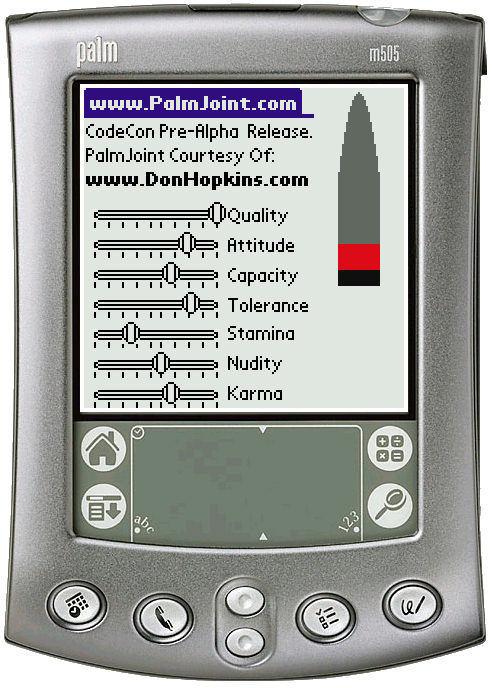
https://donhopkins.com/home/PalmJoint/Src/PalmJointMain.cpp

Some conferences of the era had kiosks with IR LEDs that beamed out a Palm app with a conference map and schedule, which would have been great to hijack for beaming out PalmJoints instead.

Re: Ultrathin business card runs a fluid simulation

#12

Very nice, but probably a bit too expensive to just hand out. I knew a chap that had a similar hardware business card (I don't remember exactly what it did, but it wasn't as cool as this one). I remember that his card was pretty scuffed up, and he insisted I give it back, after he handed it to me. Bit weird.

How much does it cost? The guest passes for hacker conferences are full-on computers these days, if this is in the same price bracket it would be a great idea for those.

Re: Ultrathin business card runs a fluid simulation

#13
post #6

Would love to see more information about how it was built. He must have worked with a company that can do the surface mount assembly?

You can get boards like these made for single-digit dollars per unit* even at prototype scale, through companies like jlcpcb.

*I haven't looked at the specific parts for this board, the LEDs look nice and could be a little pricey.

Re: Ultrathin business card runs a fluid simulation

#14

Instead of a business card, I'd love an ultrathin pleasure card you can refill with virtual beer and virtually drink! You could input your weight, and it could track you BAC! I made "PalmJoint", a beamable Palm pleasure card for CodeCon 2002, when everybody was beaming their contacts around by IR at conferences, I would beam an interactive doobie simulator a bunch of people could play together in a circle. Each perso…

small ad-hoc networks like that with IR and early bluetooth were a lot of fun.

Re: Ultrathin business card runs a fluid simulation

#16
post #6

Would love to see more information about how it was built. He must have worked with a company that can do the surface mount assembly?

Electronics can be surprisingly easy and cheap to build these days. He designed the circuit and layout with software called KiCAD (free and open source) then submitted the designs to a fabrication house - probably a popular offshore one - that easily can handle that level of board and component placement complexity. It would probably cost only a few hundred to build and ship, with 1 month turnaround time.

You can also hand-assemble surface mount parts by applying solder paste carefully to the pads, then placing all the components on the paste and heating the board until all the solder melts. That would have very time consuming for all those LEDs!

Re: Ultrathin business card runs a fluid simulation

#17
post #7
post #4

Off topic, but where should one start learning writing physical simulation? Several years ago I ran into this project [0] and got overwhelmed even the algorithm can be written in 88 lines of C++. I realized that out of all CS topics, physical simulation is probably the one I knew the less (not saying I'm a compiler/database expert or something, but at least I've implemented a toy compiler and some basic data structur…

Rigid body simulations are much much simpler. There’s a siggraph course from 2001 [0] which is a bit of a dense read but it will bring you all the way up to a full blown rigid body simulation and understanding the math behind it too. [0] https://graphics.pixar.com/pbm2001/pdf/notesg.pdf

Though in this case there's not much more than 500 points, which even if you scale up is manageable.

Re: Ultrathin business card runs a fluid simulation

#18

Very nice, but probably a bit too expensive to just hand out. I knew a chap that had a similar hardware business card (I don't remember exactly what it did, but it wasn't as cool as this one). I remember that his card was pretty scuffed up, and he insisted I give it back, after he handed it to me. Bit weird.

How much does it cost? The guest passes for hacker conferences are full-on computers these days, if this is in the same price bracket it would be a great idea for those.

There's a BOM, you can find out. Plus some peanuts for the PCB :)

Now whether you get it populated or not..

https://github.com/Nicholas-L-Johnson/flip-card/blob/main/ki...

Re: Ultrathin business card runs a fluid simulation

#19
post #4

Off topic, but where should one start learning writing physical simulation? Several years ago I ran into this project [0] and got overwhelmed even the algorithm can be written in 88 lines of C++. I realized that out of all CS topics, physical simulation is probably the one I knew the less (not saying I'm a compiler/database expert or something, but at least I've implemented a toy compiler and some basic data structur…

One thing that helped me was doing some tutorials for pico-8, an intentionally 'weak' game platform, one of which is a platform game with a simple / understandable inertia / gravity simulation (jumping, running left/right; think Mario). It was understandable enough with an x / y position for the character and a delta-x / delta-y representing their current speed. Every frame the dx / dy would get changed depending on player input and/or character state.

Ex: if player presses jump button, set state to 'jumping' and dy to 1. Every frame, dy = dy * 0.9. When dy I think those basics are also behind the simpler physics simulations, the 'falling sand' types would be ideal for an application like this.

Post reply on HN