Live data from Hacker News

LLMs pose an interesting problem for DSL designers

kirancodes.me

121–130 of 157 posts

Re: LLMs pose an interesting problem for DSL designers

#121

I notice I am confused. > Suddenly the opportunity cost for a DSL has just doubled: in the land of LLMs, a DSL requires not only the investment of build and design the language and tooling itself, but the end users will have to sacrifice the use of LLMs to generate any code for your DSL. I don't think they will. Provide a concise description + examples for your DSL and the LLM will excel at writing within your DSL. A…

Every language other than machine level assembly instructions as human readable code is a DSL.

Re: LLMs pose an interesting problem for DSL designers

#122
So many unsuccessful (for some definition of the word) pet projects are on GitHub. The code techniques employed there are valid, working software, that aren't found in CRM, CRUD, middleware or data entry software that makes up most of the world's portfolio to date and that makes them the most valuable addition to LLM training data. Arguing against making such projects is insanity.

Re: LLMs pose an interesting problem for DSL designers

#123

Good to see more people talking about this. I wrote about this about 6 months ago, when I first noticed how LLM usage is pushing a lot of people back towards older programming languages, older frameworks, and more basic designs: https://nathanpeck.com/how-llms-of-today-are-secretly-shapin... To be honest I don't think this is necessarily a bad thing, but it does mean that there is a stifling effect on fresh new DSL's…

It’s not just new frameworks, it’s new features. Good luck getting a LLM to write code that uses iOS 26 features, for example.

I’m not convinced simply getting the LLM to inject documentation about the features will work well (perhaps someone has studied this?) because the reason they’re good at doing ‘well known’ things is the plethora of actual examples they’re trained on.

Re: LLMs pose an interesting problem for DSL designers

#124

Good to see more people talking about this. I wrote about this about 6 months ago, when I first noticed how LLM usage is pushing a lot of people back towards older programming languages, older frameworks, and more basic designs: https://nathanpeck.com/how-llms-of-today-are-secretly-shapin... To be honest I don't think this is necessarily a bad thing, but it does mean that there is a stifling effect on fresh new DSL's…

It reminds me of this excerpt from Coders at Work, in Chapter 13 - Fran Allen:

Seibel: When do you think was the last time that you programmed?

Allen: Oh, it was quite a while ago. I kind of stopped when C came out.

That was a big blow. We were making so much good progress on optimizations and transformations. We were getting rid of just one nice problem after another. When C came out, at one of the SIGPLAN compiler conferences, there was a debate between Steve Johnson from Bell Labs, who was supporting C, and one of our people, Bill Harrison, who was working on a project that I had at that time supporting automatic optimization.

The nubbin of the debate was Steve's defense of not having to build optimizers anymore because the programmer would take care of it. That it was really a programmer's issue. The motivation for the design of C was three problems they couldn't solve in the high-level languages: One of them was interrupt handling. Another was scheduling resources, taking over the machine and scheduling a process that was in the queue. And a third one was allocating memory. And you couldn't do that from a high-level language.

So that was the excuse for C.

Seibel: Do you think C is a reasonable language if they had restricted its use to operating-system kernels?

Allen: Oh, yeah. That would have been fine. And, in fact, you need to have something like that, something where experts can really fine-tune without big bottlenecks because those are key problems to solve.

By 1960, we had a long list of amazing languages: Lisp, APL, Fortran, COBOL, Algol 60. These are higher-level than C. We have seriously regressed, since C developed. C has destroyed our ability to advance the state of the art in automatic optimization, automatic parallelization, automatic mapping of a high-level language to the machine. This is one of the reasons compilers are . . . basically not taught much anymore in the colleges and universities.
Re: LLMs pose an interesting problem for DSL designers

#125
The title should be "DSLs pose an interesting problem for LLM users".

It is significant that LLMs in coding are being promoted based on a set of promises (and assumptions) that are getting instantly and completely reversed the moment the technology gets an iota of social adoption in some space.

"Everyone can code now!" -> "Everyone must learn a highly specialized set of techniques to prompt, test generated code, etc."

"LLMs are smart and can effortlessly interface with pre-existing technologies" -> "You must adopt these agent protocols, now"

"LLMs are great at 0-shot learning" -> "I will not use this language/library/version of tool, because my model isn't trained on its examples"

"LLMs effortlessly understand existing code" -> "You must change your code specifically to be understood by LLMs"

This is getting rather ridiculous.

Re: LLMs pose an interesting problem for DSL designers

#126

Good to see more people talking about this. I wrote about this about 6 months ago, when I first noticed how LLM usage is pushing a lot of people back towards older programming languages, older frameworks, and more basic designs: https://nathanpeck.com/how-llms-of-today-are-secretly-shapin... To be honest I don't think this is necessarily a bad thing, but it does mean that there is a stifling effect on fresh new DSL's…

Linguistics and history of language folk: isn't there an observed slowdown of evolution of spoken language as the printing press becomes widespread? Also, "international english"? Is this an observation of a similar phenomenon?

I don't know about that, though I'm not a linguist. Seems to me most people haven't been literate for that long and the printing press would've been "useless" as a tool to modify the language of populations with only 10-20% literacy well into the 19th century. So 100 or so years seems too short to observe that.

Also some of the most widely spoken languages today do feature a high degree of diglossia between spoken and written variety, to a point where the written language has been outpaced. We could call that evolving. Examples would Brazilian Portuguese and American English (some dialects specifically have changed English grammar).

Also, notoriously, Chinese written characters have been used for languages that evolve independently and are not mutually intelligible for millennia. Them being printed on paper instead of written doesn't make a difference.

What we do have today is a higher exposure and dominance of certain dialects, with some countries even mandating a certain type of speech historically, coupled with a higher degree of conectivity in society to a point where not being intelligible to other people very far away carries a much worse penalty. That tampers some of the evolution much more than printing press in my view.

Re: LLMs pose an interesting problem for DSL designers

#127

Earlier quoted context omitted.

Not only that. This article starts with "gaming" examples. Simplified to hell but "gaming". How many games still look like they're done on a Gameboy because that's what the engine supports and it's too high level to customize? How about the "big" engines, Unity and Unreal? Don't the games made with them kinda look similar?

I love writing shaders and manually shovelling arrays into the graphics card as much as anyone, and I know first hand how this will give the game very much your own style. But is that the direction LLM coding goes? My experience is that LLM produces code which is much more generic and boring than what skilled programmers make.

But do users care that your code is boring?

Re: LLMs pose an interesting problem for DSL designers

#128

Earlier quoted context omitted.

Linguistics and history of language folk: isn't there an observed slowdown of evolution of spoken language as the printing press becomes widespread? Also, "international english"? Is this an observation of a similar phenomenon?

I don't know about that, though I'm not a linguist. Seems to me most people haven't been literate for that long and the printing press would've been "useless" as a tool to modify the language of populations with only 10-20% literacy well into the 19th century. So 100 or so years seems too short to observe that. Also some of the most widely spoken languages today do feature a high degree of diglossia between spoken an…

A big example would be "standard arabic", a language with millions of readers and no native speakers.

Re: LLMs pose an interesting problem for DSL designers

#129

Good to see more people talking about this. I wrote about this about 6 months ago, when I first noticed how LLM usage is pushing a lot of people back towards older programming languages, older frameworks, and more basic designs: https://nathanpeck.com/how-llms-of-today-are-secretly-shapin... To be honest I don't think this is necessarily a bad thing, but it does mean that there is a stifling effect on fresh new DSL's…

It reminds me of this excerpt from Coders at Work, in Chapter 13 - Fran Allen: Seibel: When do you think was the last time that you programmed? Allen: Oh, it was quite a while ago. I kind of stopped when C came out. That was a big blow. We were making so much good progress on optimizations and transformations. We were getting rid of just one nice problem after another. When C came out, at one of the SIGPLAN compiler…

The fact that things are still dog slow on modern hardware means we didn't go far enough into C like thinking. And compilers and hardware were much, much worse in the 70s. There is a reason C got adopted so quickly, and languages after those other languages took decades to become practical. That counter history is just made up nonsense. If we didn't have a convenient language back then, people would either just give up and keep writing assembly, or computing would have just slowed or stopped.

Re: LLMs pose an interesting problem for DSL designers

#130

The title should be "DSLs pose an interesting problem for LLM users". It is significant that LLMs in coding are being promoted based on a set of promises (and assumptions) that are getting instantly and completely reversed the moment the technology gets an iota of social adoption in some space. "Everyone can code now!" -> "Everyone must learn a highly specialized set of techniques to prompt, test generated code, etc.…

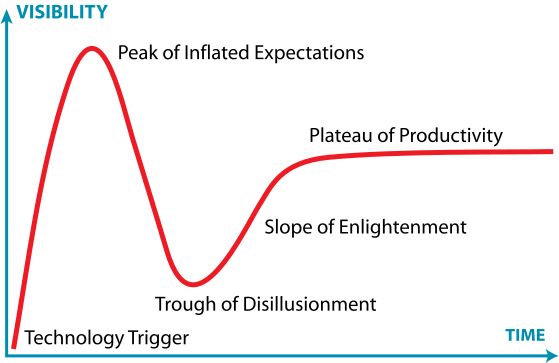
Don't make me get the graph.

https://upload.wikimedia.org/wikipedia/commons/9/94/Gartner_...

Post reply on HN