Live data from Hacker News

Gemini Diffusion

simonwillison.net

21–30 of 252 posts

Re: Gemini Diffusion

#21

That's...ridiculously fast. I still feel like the best uses of models we've seen to date is for brand new code and quick prototyping. I'm less convinced of the strength of their capabilities for improving on large preexisting content over which someone has repeatedly iterated. Part of that is because, by definition, models cannot know what is not in a codebase and there is meaningful signal in that negative space. En…

If you make models fast enough, you can onboard that expert developer instantly and let them reason their way to a solution, especially when giving access to a RAG to. Over time, I models will add more memory and institutional knowledge capture rather than starting from a blank slate each time.

I thought of that as I wrote my comment, but I think the infrastructure and glue to make that possible in a consistent, fast and scalable way is still a few years out.
Re: Gemini Diffusion

#24
I am so excited about diffusion language models. They may be the piece we need to make our voice-to-code game mechanic be as smooth as we envision it.

Cerebras and Groq are amazing, but the fact that they use custom hardware really limits the ability to finetune or scale. The other route would be an MoE that has barely 0.5b parameters active, but that would be a major undertaking that we can't prioritize at the moment.

--- If anyone at Google/Deepmind reads this, please give us API access.

We are building generative sandbox games. First title is a monster trainer where you get to actually command your creature in realtime, here is an early prototype: https://youtu.be/BOwpLyj2Yqw

Re: Gemini Diffusion

#25
post #16
post #12

This is insanely fast, my guess is that the tradeoff here is that the GPUs will always be working at max capacity and there will be minimal compute savings from batching, which I realize now is not really a tradeoff. My only worry is that the diffusion objective will be worse than AR in terms of model capabilities, if that's the case hopefully multi-token AR models will perform as well as diffusion, or we can use thi…

Why do you suspect dLLMs should not match (or surpass) arLLMs in quality? The general idea is that it is easier to treat the output as a structured whole (idea, points, concepts, words - in a tree) which is iteratively treated - that should go in the direction of "proper" quality.

My intuition is that the harder it is for an LLM to do something during training the more actual compression/learning will be encoded in it's weights. With multi-token/diffusion it becomes much easier to "reward/loss hack" your way, this won't matter much during pretraining, but I assume a lot of "cheating" will happen in the finetune/RL phase.

Re: Gemini Diffusion

#26
Anyone able to summarize the current 'hold up' with diffusion models? I know exactly how Transformers work, but I'm not a diffusion expert. Diffusion is so much more powerful tho (from what I know) it seems like diffusion would already be beating Transformers. Why isn't it?

Re: Gemini Diffusion

#28

Why are you obsessed with Pelicans? What’s your story?

I'm from the UK originally. On one of my first trips to California I was up on the cliffs in Marin County and a squadron flew by and I was amazed by them - and the Californians I was with were like "yeah, you see them all the time".

Now I live in California and I still can't believe I get to see them here. They're absurd - they don't look like they should be able to fly at all. They're also incredibly pretty, especially in their breeding plumage.

I live in Half Moon Bay, just south of San Francisco, which turns out to be home to the second largest mega-roost of the California Brown Pelican (my favourite kind of pelican) in the world.

We've even rescued two of them (injured birds, we got them in a carrier and took them to the animal rescue place).

They make for a fun theme for all sorts of different AI experiments.

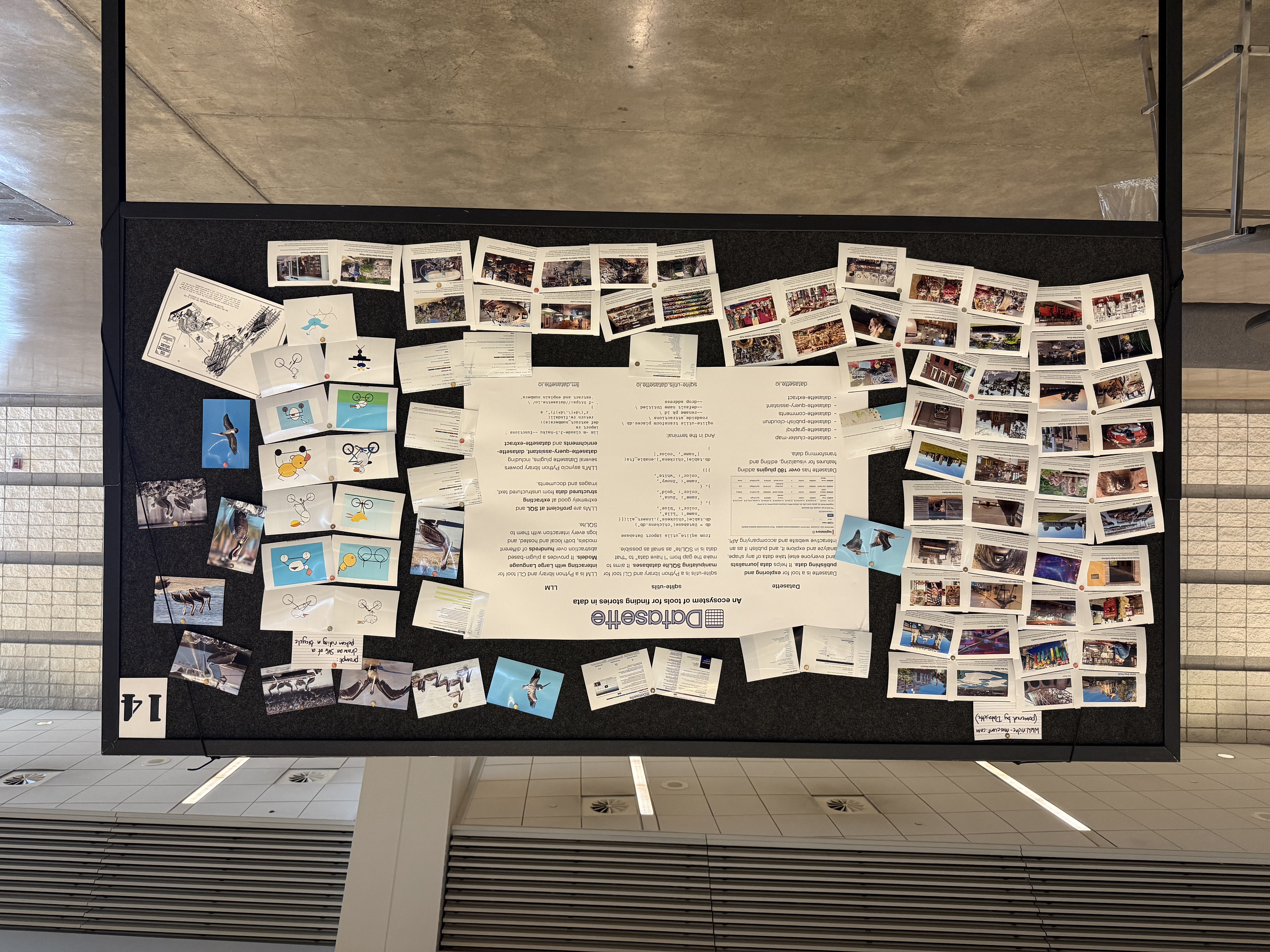
They're also very photogenic - I had a bunch of photos I've taken on my PyCon poster recently (you have to zoom in quite a bit to see them though): https://static.simonwillison.net/static/2025/poster-full-siz...

Re: Gemini Diffusion

#29

Nit: Diffusion isn't in place of transformers, it's in place of autoregression. Prior diffusion LLMs like Mercury [1] still use a transformer, but there's no causal masking, so the entire input is processed all at once and the output generation is obviously different. I very strongly suspect this is also using a transformer. [1] https://www.inceptionlabs.ai/introducing-mercury

Isnt there masked diffusion as well?

Re: Gemini Diffusion

#30
This is something I have been thinking about integrating into a sampler for standard autoregressive LLMs. The idea is to buffer N context tokens from the ongoing autoregressive generation. Then, every K tokens, a section of this buffer (or perhaps the whole buffer) could be processed by a diffusion model, guided by one or more specific commands to operate on that buffered text.

One application I envision for this kind of sampler, leveraging the diffusion model's capabilities, would be to detect and potentially correct instances of post-hoc reasoning within the buffer. The diffusion model could then help ensure that proper causal reasoning chains are established in that segment before the autoregressive model continues generating. You could also allow for slight, controlled backtracking or revision within that buffer window if the generation starts to go off-track, again using the diffusion model to smooth or adjust the text before committing it and moving forward.

Post reply on HN