Live data from Hacker News

Xiaomi MiMo Reasoning Model

github.com

141–150 of 203 posts

Re: Xiaomi MiMo Reasoning Model

#141
post #5

These benchmark numbers cannot be real for a 7b model

The smaller models have been creeping upward. They don't make headlines because they aren't leapfrogging the mainline models from the big companies, but they are all very capable. I loaded up a random 12B model on ollama the other day and couldn't believe how good it competent it seemed and how fast it was given the machine I was on. A year or so ago, that would have not been the case.

Which model?

Re: Xiaomi MiMo Reasoning Model

#142
post #139

Earlier quoted context omitted.

You'd be correct. The largest portion of all languages in Common Crawl (aka the "whole open internet" training corpus) is English with 43%. No other language even reaches double digit percentages. The next biggest one is Russian at 6%, followed by German at 5%.

I wonder where are you getting your data. According to wikipedia russian is #7 https://en.wikipedia.org/wiki/Languages_used_on_the_Internet Only place where russian is in top 5 is in Wikipedia views. Russian part of internet steadily goes down, as russian imperialism crumbles.

> The largest portion of all languages in Common Crawl

https://commoncrawl.github.io/cc-crawl-statistics/plots/lang...

Re: Xiaomi MiMo Reasoning Model

#143
post #142
post #139

Earlier quoted context omitted.

I wonder where are you getting your data. According to wikipedia russian is #7 https://en.wikipedia.org/wiki/Languages_used_on_the_Internet Only place where russian is in top 5 is in Wikipedia views. Russian part of internet steadily goes down, as russian imperialism crumbles.

> The largest portion of all languages in Common Crawl https://commoncrawl.github.io/cc-crawl-statistics/plots/lang...

Thanks!

I wonder where this discrepancy comes from

Re: Xiaomi MiMo Reasoning Model

#144
post #65

Why are there so many English-first AI models from China? Are they not interested in serving their own population? Or is it that if they publish Chinese-first models it won't get publicity in the West?

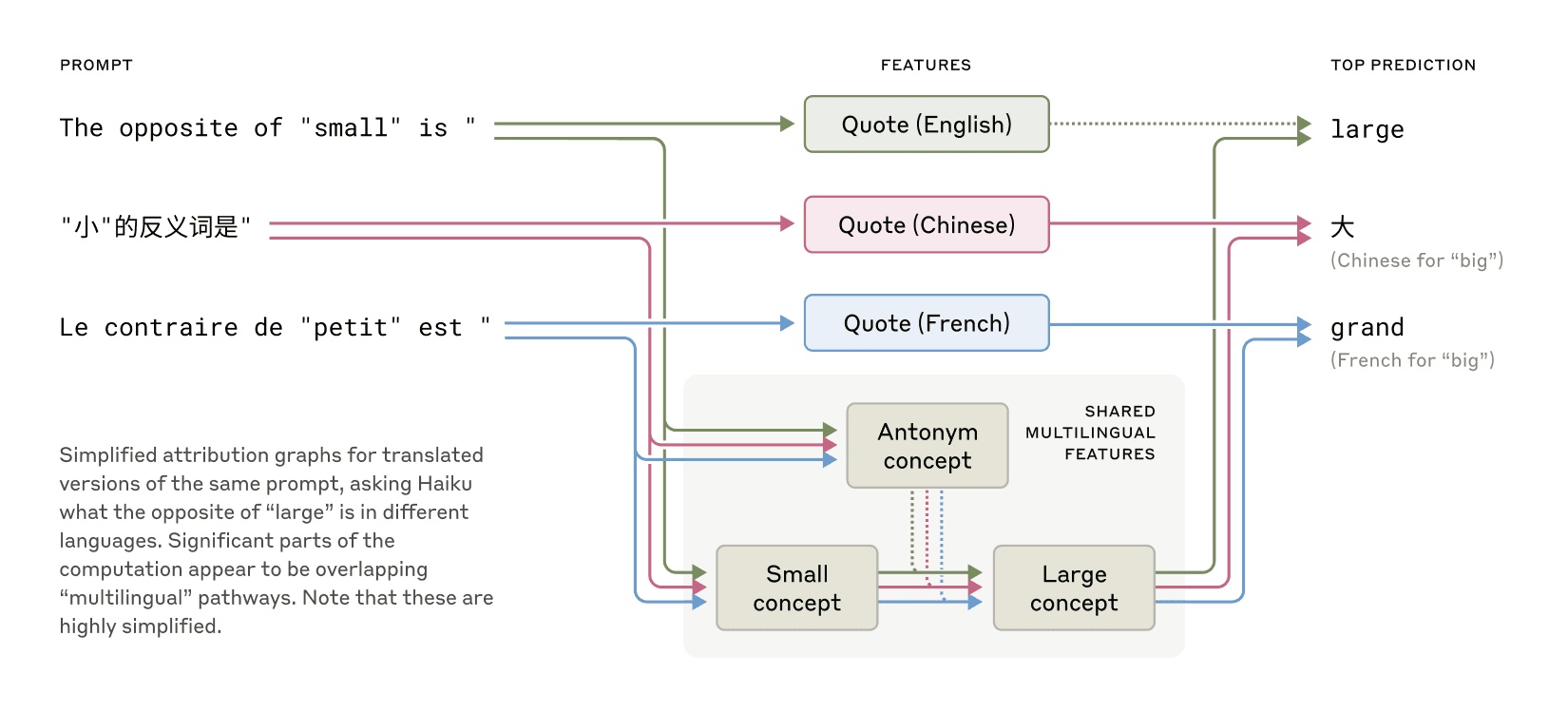
One thing I thought was interesting about this paper [1] on understanding LLMs was how the models associate words/concepts in different languages with each other in what they call Multilingual Circuits.

So the example they give:

English: The opposite of "small" is " → big

French: Le contraire de "petit" est " → grand

Chinese: "小"的反义词是" → 大

Cool graphic for the above [2]

So while English is the lingua franca of the interenet and represents the largest corpus of data, the primary models being built are able to use an English dataset to build associations across languages. This might create significantly stronger AI and reasoning even for languages and regions that lack the data, tech and resources to build local models

[1] https://www.anthropic.com/research/tracing-thoughts-language...

[2] https://www.anthropic.com/_next/image?url=https%3A%2F%2Fwww-...

Re: Xiaomi MiMo Reasoning Model

#145
post #65

Why are there so many English-first AI models from China? Are they not interested in serving their own population? Or is it that if they publish Chinese-first models it won't get publicity in the West?

Haven't we reached a situation where English is the de facto language of scientific research, especially AI benchmarks ? It's clearly impossible for me to try anything in Chinese, I'd need a translation.

Correct. Lingua franca for at least the last 75 years, if not longer.

Re: Xiaomi MiMo Reasoning Model

#147
From the paper, I was intrigued by how they handled their RL step for Code Data. They trained against hard but solvable code generation tasks by running unit testing. Is that training step done by the other models?

> Code Data For coding problems, we curate a high-quality training set comprising open-source datasets and our newly collected problem set. We remove problems without test cases. For problems with golden solutions, we exclude those where the golden solution failed to pass all test cases. For problems without golden solution, we discard problems where no test case can be solved in 16 rollouts of advanced reasoning models. Similar to math data, we utilize an SFT version of MiMo-7B to filter out easy problems that are perfectly solved in all 16 rollouts. This rigorous cleaning process yields 30K code problems.

> During each RL iteration, we evaluate thousands of problems to compute the rewards, with each problem potentially containing hundreds of test cases. To improve reward computing efficiency and eliminate GPU idle time, we developed an online judge environment that enables parallel execution of extremely high-volume unit tests.
Re: Xiaomi MiMo Reasoning Model

#148

Earlier quoted context omitted.

English won. The Chinese youth struggle to write their own calligraphy characters they can read now. Typing favors English.

Source? This smacks of "I saw a headline once"-itis. Especially the fact that you refer to the Chinese characters as "calligraphy characters", as if that were the general term or something.

These are probably the headlines they're thinking about,

https://www.globaltimes.cn/content/747853.shtml

https://www.bbc.com/news/blogs-china-blog-28599392

Or more recently this one about character amnesia

https://globalchinapulse.net/character-amnesia-in-china/

None of these really mean that English has won, though. Rather that phonetics-based writing systems are easier to remember and use, especially in conjunction with digital systems that make it easy to map sound and context to symbols.

I wouldn't be surprised if characters are faster to read though. In English we have all these subconscious shortcuts like looking at the shape of the word, first and last letters, etc. But I think symbology can convey more at a glance. Thus the popularity of emoji

Re: Xiaomi MiMo Reasoning Model

#149

Earlier quoted context omitted.

The smaller models have been creeping upward. They don't make headlines because they aren't leapfrogging the mainline models from the big companies, but they are all very capable. I loaded up a random 12B model on ollama the other day and couldn't believe how good it competent it seemed and how fast it was given the machine I was on. A year or so ago, that would have not been the case.

exactly, it seems to validate my assumption from some time ago, that we will mostly use local models for everyday tasks.

Not just local models but bespoke apps. The number of bespoke apps I've created shot up dramatically in the last 6 months. I use one to do my recipes/meal plan every week. I have one that goes through all my email addresses and summarizes everything daily. I just finished an intelligent planner / scheduler for my irrigation system that takes into account weather forecast and soil moisture levels. If something is annoying and there is no commercial solution or open-source solution that has the features I want I just make it now and it's fantastic.

I've had friends/family ask to use some of them; I declined. I don't want to do support / feature requests.

Re: Xiaomi MiMo Reasoning Model

#150
post #65

Why are there so many English-first AI models from China? Are they not interested in serving their own population? Or is it that if they publish Chinese-first models it won't get publicity in the West?

One reason is that there is no "good" search engine in China. The most popular one, Baidu, is like garbage compared to Google search. The most useful training data in Chinese would likely be from the social media and video sharing platforms, which I guess is much more difficult to crawl and clean up.

> The most popular one, Baidu, is like garbage compared to Google search

It must be very bad when you see the walking turd that Google search has become over the years…

Post reply on HN