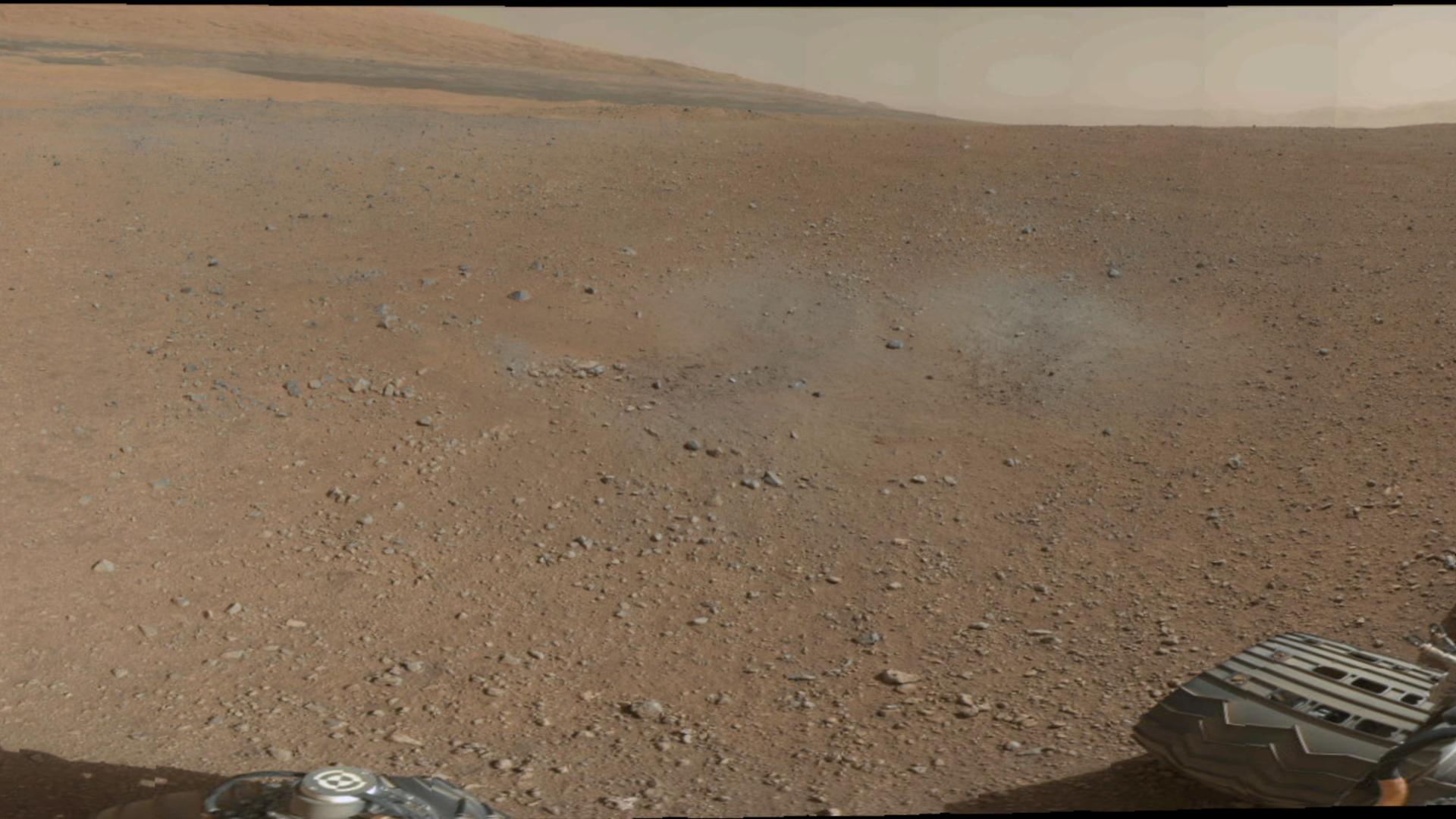
Why is it all black-and-white? Is it because color cameras are too heavy/expensive to take or because color photography is for some reason impossible under those conditions?
Here is a color photo: http://photojournal.jpl.nasa.gov/jpeg/PIA16032.jpg
51–60 of 106 posts
Why is it all black-and-white? Is it because color cameras are too heavy/expensive to take or because color photography is for some reason impossible under those conditions?
http://www.youtube.com/watch?v=xy3r8k8hX-8
Sadly its not the panorama Curiosity took but the one from the previous Mars rover.
Sill its pretty awesome.
I'm still trying to wrap my head around the fact that this piece of metal traveled 350 million miles through space and then landed on Mars.
Can someone explain how/why a $2.6 billion piece of equipment appears to have cameras that can't match a $100 digital camera? I know it takes a long time for data to travel from there to here, but I am sure a lot of people wouldn't mind waiting for 1080p, full-color video footage of the red planet. Instead, we get these 1-megapixel, black-and-white shots that need to be stitched together to create a half decent panor…
These are still from the navigation cameras. The main camera, not yet deployed, can take 1600x1200 full-color pictures and HD video at 10fps. There's actually two of it, so it can also make 3D images/video. Other features are wide/telephoto lens, panorama stitching and 8GB flash storage. Before complaining about resolution, this is like having a GoPro 3D on Mars, it has plenty of detail.
One of the articles mentions that the cameras are provided by the same manufacturer as the Viking missions, so they must certainly have improved. Expect some awesome images in the coming months!
More info: http://mars.jpl.nasa.gov/msl/mission/instruments/cameras/mas..., http://msl-scicorner.jpl.nasa.gov/Instruments/Mastcam/, http://www.nasa.gov/mission_pages/msl/news/msl20110531.html
Earlier quoted context omitted.
Several articles have mentioned bandwidth limitations of about 250 megabits per day, which also has to be used to send instrument data. But I haven't seen an explanation why bandwidth is so low -- is it lack of spectrum? Interference issues?
The bandwidth to the orbiters is up to 2 Mbps, but because they're in low orbit they're only in sight 8 minutes per day. http://mars.jpl.nasa.gov/msl/mission/communicationwithearth/...
Anyone know what the circular symbols (similar to the BMW logo) all over the rover mean?
Its still somehow unbelievable that I'm actually seeing photos from another planet almost realtime.
Earlier quoted context omitted.
Thanks! The reason seems to be: It's the way it was planned 10 years ago and we don't go back on planning on a project like this one.
Maybe Instagramm built the camera? But seriously, I guess for the same reason Couriosity runs on old PowerPC processors. They are just well tested and less likely to fail. If you want a high res image, you can always take 10 images and glue them together, result is the same.
Earlier quoted context omitted.
When the $100 camera fails in Mars you can't just replace it with another one. You can't take it to the repair shop either. You can't try to "shake it a bit". Hell, you can't even bang it on your knee: http://www.pechorin.com/m/2006/06/13/SONY_Cybershot_E6100_ER...
You know, I didn't claim to understand the reasons behind the technical limitations, but the reactions of some of you are puzzling to me. We can go on and on about familiarity considerations, and planning considerations, and instrumentation considerations, and scientific concerns, etc. It all sounds like excuses after a bit. Let's reformulate the question: Why not keep the same enclosure, the same lens assembly, the…
  > Why not keep the same enclosure, the same lens assembly,
  > the same mechanical parts and simply swap the 2MP sensor for a 20MP sensor?
  > The other advantage of the Truesense Imaging chips was the team's familiarity
  > with their behavior. 'We've built-up decades of cumulative experience of working
  > with Kodak and now Truesense interline sensors. We know how to clock them and
  > drive them - they're a very easy CCD to drive,' says Ravine. A similar level of
  > confidence was needed for the cameras’ memory, he says: 'the flash we ended up
  > using was because we had a lot of radiation test data for it.'