Live data from Hacker News

Textmate2 Goes Open Source

github.com

121–130 of 314 posts

Re: Textmate2 Goes Open Source

#121
post #89

If we are completely honest, Textmate was always a sub-par editor. No Vim or Emacs style brilliantness, no BBEdit style tons of features and mature engine, no IntelliJ like, er, intelligence, no ST2 comprehensiveness, etc etc. Plus, the Textmate 1.x text engine was probably a mess too -- I remember the very first versions being laggy (and that's coming from someone who doesn't find even Eclipse laggy). That he couldn…

This is pretty harsh, but you're right: it was always sub-par, with some compelling features. As a long-time BBEdit (and thus Mac) user, my impression was Textmate appealed to "switchers" who may not have been aware of better options.

I tried Textmate many times, but single-character undo was always unforgivable.

Re: Textmate2 Goes Open Source

#122
post #89

If we are completely honest, Textmate was always a sub-par editor. No Vim or Emacs style brilliantness, no BBEdit style tons of features and mature engine, no IntelliJ like, er, intelligence, no ST2 comprehensiveness, etc etc. Plus, the Textmate 1.x text engine was probably a mess too -- I remember the very first versions being laggy (and that's coming from someone who doesn't find even Eclipse laggy). That he couldn…

It won so many adopters because it was simple and pretty. The advanced features are great, but TM won because it didn't have Emacs/Vim learning curve, and it mostly just worked.

Re: Textmate2 Goes Open Source

#123
post #53

I don't want to pick on Allan Odgaard, but I think the way he's handled the TM2 project is pretty bad. Allen is a great guy and I love TM. However, here are some facts. TM2 has taken SIX YEARS. It was "90% done" 2009. This is a living, breathing case study in why quick customer-driven releases are better than "big upfront plans" and "giant system rewrites." Anyone who has developed a major application knows what I'm…

Sounds like a textbook example of Second System Syndrome.

Re: Textmate2 Goes Open Source

#124
post #89

If we are completely honest, Textmate was always a sub-par editor. No Vim or Emacs style brilliantness, no BBEdit style tons of features and mature engine, no IntelliJ like, er, intelligence, no ST2 comprehensiveness, etc etc. Plus, the Textmate 1.x text engine was probably a mess too -- I remember the very first versions being laggy (and that's coming from someone who doesn't find even Eclipse laggy). That he couldn…

[deleted]

Re: Textmate2 Goes Open Source

#125

Earlier quoted context omitted.

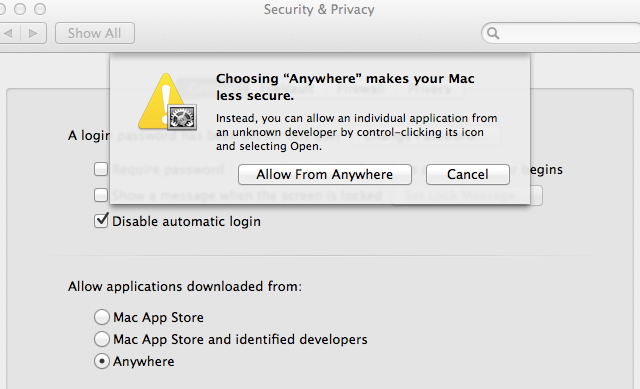
That setting only changes the ability to launch an app right after download by double clicking it. It doesn't actually prevent the program from running, you just have to take more steps to launch it the first time. However TM is being kept out of the app store for other reasons, such as it's ability to prompt for an administrator password to allow writing to protected files.

Yeah, this is not true. There is a separate setting which controls a pop-up confirming whether or not you want to run an app that you downloaded, the first time you attempt to run it. The setting referred to here actually BLOCKS the running of new non-app-store (or, by default, non-signed) applications. http://imgur.com/7bduA Apparently, you can alt-click and select open, but my gut tells me that this was an oversigh…

Control-Click. I don't think it is an oversight, because "Manual Override" is touted officially as a feature:

http://www.apple.com/osx/whats-new/features.html#gatekeeper

And even explicitly mentioned in a system dialogue:

http://cdn.arstechnica.net/wp-content/uploads/2012/07/gateke...

I am still not on Mountain Lion, so I don't know if you need to enter a password (which children shouldn't have) or right clicking is enough?

Re: Textmate2 Goes Open Source

#126

Awesome! Can someone comment on how probable it would be to port it to linux (and windows)?

OK, so I've been looking through the code and from what I see I suspect a big reason for the rewrite was to move huge chunks into platform-independent C++ for an ultimate Win32/Linux/Mac trifecta release (maybe for TM3). If so, this would explain why things got so bogged down.

The actual layout/folding code, for example, is in C++. When it needs to draw it calls Core Graphics C functions. A lot of the other things like commands are similarly abstracted. But the thing is, if you look in Frameworks/layout/src/layout.cc for example (the code that actually lays out the text), it looks like nice platform-independent C++ code. Ah, you think, this will be easy! Until you get to, say, CGRect layout_t::rect_for (row_tree_t::iterator rowIter). The return type is CGRect and it's calling CGRectMake. These are Mac-specific Core Graphics calls. The drawing code is similarly Mac-specific.

So the first thing you'd need to do is follow the architecture and start TRULY abstracting the core functionality into these C++ classes and, when they make a call to something platform-specific, you'll need to replace it with something platform-independent.

To do this, you'll need to:

- Make or move to an abstracted Graphics Context library. You could use something like Cairo or roll your own (which is what WebKit does).

- Further abstract the application structure away from the actual classes. So, for example, you would have platform neutral code to talk about the UI logically but then have each "MyWindow" C/C++ class hold a "PlatformWindowHandle" which, on Linux might be a GTKWindow pointer, on Win32 might be a Window HANDLE or COM object reference to a .NET Window, and on Mac be a pointer to an NSWindow. You'd obviously need similar platform-neutral library infrastructure to call into each of these with a similar API and translate to the platform actually running at the bottom. You could write this yourself, or you could maybe just use wxWidgets or some other library that's had a decade-long head start. You lose some control that way, though.

- Repeat with all other areas of the app that are still Mac-specific.

My opinion is this would be a good starting point for such a thing, and if you really wanted to make it happen you could. But you're NOT going to just go in there and replace NSWindows with GTKWindows and NSButtons with GTKButtons and call it a day. It will be MUCH more work than that.
Re: Textmate2 Goes Open Source

#127
post #84
post #20

Earlier quoted context omitted.

Erm, Objective-C probably isn't the problem, even NeXt used gcc for that (not sure how much of the current feature bloat isn't in copyrighted libraries). But GNUStep isn't exactly up to par with Cocoa, never mind not exactly the default desktop environment. Porting the whole editor from Obj-C++/Cocoa to C++/KDE or C/Gtk would be a pretty huge task, where you'd better off starting from scratch anyway (as with a lot of…

> Erm, http://twitter.com/karlvanhoet

Context?

Re: Textmate2 Goes Open Source

#128
post #89

If we are completely honest, Textmate was always a sub-par editor. No Vim or Emacs style brilliantness, no BBEdit style tons of features and mature engine, no IntelliJ like, er, intelligence, no ST2 comprehensiveness, etc etc. Plus, the Textmate 1.x text engine was probably a mess too -- I remember the very first versions being laggy (and that's coming from someone who doesn't find even Eclipse laggy). That he couldn…

>I don't think Textmate deserved all that success --it should have happened to a better editor.

This doesn't make much sense. You say it appeared at the right time and was pretty and native on OS X. What better editors deserved the success it had that were available when TextMate was popular? Which editors were available on OS X that weren't giant IDEs or VIM and Emacs style editors that have a ridiculously steep learning curve?

I've never understood when people say something or someone doesn't deserve something they've earned. TextMate is successful because lots of people bought it. Who are you to judge what deserves to be successful and what doesn't, especially when history seems to disagree with you?

Re: Textmate2 Goes Open Source

#129
post #92

Earlier quoted context omitted.

Until you get RSI from your crappy keyboard. Which is why people will pay $100+ for a keyboard. I've bought 3 Microsoft Natural 4000s (about a $60 keyboard) over the past 3 years simply because I was away from my office for an extended period of time and my wrists started hurting.

No see, you are including more sensible factors in your calculation of utility. The issue is just justifying price with "how much have you used it for work related activities" , which is silly for just about everything except maybe soothing buyers remorse. I have an old Model M at home that I value at a hell of a lot more than $10; I am not here to argue the merits of expensive keyboards. My point though is that the…

I downvoted your original response, but your point became better articulated as you went.

The value is in replaceability. It comes down to the question, "if I take this away from you, what will you do then?".

Textmate was valuable because it was a piece of software that its users could not easily replace to their satisfaction.

If I take your $10 keyboard away, your next move would be to pick up some other $10 keyboard. Hence why the value is $10.

Some pieces of software are valuable even if you barely ever use them. It may be something you use once a year to complete a project, but if it's not easily swapped out for some other replacement, and completing that project is something of high value to you, then that piece of software is valuable - much more so than the small amount of time you spend using it would indicate.

Re: Textmate2 Goes Open Source

#130
post #89

If we are completely honest, Textmate was always a sub-par editor. No Vim or Emacs style brilliantness, no BBEdit style tons of features and mature engine, no IntelliJ like, er, intelligence, no ST2 comprehensiveness, etc etc. Plus, the Textmate 1.x text engine was probably a mess too -- I remember the very first versions being laggy (and that's coming from someone who doesn't find even Eclipse laggy). That he couldn…

I must disagree with you. I have used TextMate 1 for many years. Lighter weight than Emacs for quick edits and rapid file browsing. My usual use case is working in a shell and using the mate command line alias to quickly view/edit files. BTW, I use IDEs for serious development: I don't open TextMate and stay in it for an hour, rather using it for fast little tasks. I have received huge value for a low price.
Post reply on HN