Is this good or bad
It's good if you are looking for clearer weather, and bad if you follow the science of stratospheric ozone depletion. ( Counter intuitive. )
261–270 of 349 posts
Is this good or bad
Earlier quoted context omitted.
I don't understand why acknowledgment of climate change would lead to nuclear over solar/wind.
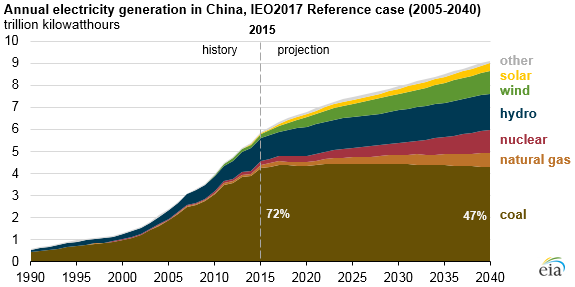
There seems to be a delusional part of the Internet that is convinced that nuclear is the only future, and solar and wind aren’t. To settle this, you basically need to look at what China is doing —- which is to build a lot of nuclear and then exponentially more solar and wind. We’re a huge percentage of the way down the slide to a mostly renewable world with storage, and some nuclear at the edges. But it isn’t a comp…
Whatever the cheapest (clean) option deployable is people should be wanting to throw it in as fast as we can until we actually hit a technology limit with its usability instead of worrying it won't be able to get us to 100% or not. Instead, the conversation tends to read like we've already succeeded in deploying clean energy fast enough and we should stop looking or that we are still looking for a technology which can cut our current emissions and waiting for an answer. Neither are true, we're still burning more fossil fuels during the day. The US at least managed to hit break even growth in electricity generation https://upload.wikimedia.org/wikipedia/commons/a/aa/US_Elect... even after stalling nuclear outputs but there's still a lot to go there all the same. I'm not as familiar with Europe.
About the only stances I've been able to make sense of (even though I don't personally agree with them) are the concern nuclear is a step back rather than a step forward and that's why we shouldn't deploy it and the people that just want the cheapest power regardless of source. Everyone else doesn't seem to have a reason to worry about "what" as much as "how to deploy more" for the moment. The dirtier power tends to be the one that's easier to spin up/down very rapidly anyways - "keep the capacity for now and just run it less when you can" is still a great thing.
Ultimately the Earth will warm up, the ice caps melt, the coasts lose as the seas rise 10m
Not that it changes the outcome, but I swear I remember reading that the majority of sea-level rise actually comes from the thermal expansion of liquid water, not displacement from thawing of ice caps. Can anyone confirm/refute this?
Earlier quoted context omitted.
Is that possible? Can you describe the chain of events that would lead to that? Seems vanishingly unlikely to me, on the face of it, but I admit I am not read up on all the possible doomsday scenarios.
it all started with the invention of Ice9
Earlier quoted context omitted.
The base units of the metric system are often not very ergonomic. Why is a meter so damn big? And why is a gram so damn small? I can barely detect a gram. And a meter is frickin huge, causing people to usually divide it into hundredths of a meter, which you can hardly picture in your mind unless you already know what it looks like, especially arbitrary counts of cm. Metric's only real advantage is that it shares the…
As a metric user: This is about your lack of familiarity. E.g. can picture lumber expressed in cm or mm very easily. E.g., if you work with beams that are 48mm / 5 cm or 98mm / 10cm a lot then those sizes becomes second nature. Just as easy to picture as 2 inch, 4 inch, 1/2 inch, 3/4 inch etc that is in use in US. And saying that something is 200m away is exactly as intuitive as however many feet that is. A large met…
As a kid, one of my science educators spoke about the many benefits people gain from becoming familiar with basic units. I bought in and did so during the big metric push that happened around that time.
I ended up more familiar with Imperial units.
Then, later in life, I entered a young industry, with strong users of metric, Standard International units.
So I did the work to build familiarity just as I did long ago. Took half a year and today I enjoy the benefits.
And those are:
Ease of understanding unit values meaning in my daily life.
Ease of expression of same to others.
Greater accuracy estimating.
Easier computation and unit checks.
And so on...
Earlier quoted context omitted.
> There seems to be a delusional part of the Internet that is convinced that nuclear is the only future, and solar and wind aren’t. "Exponentially more" means literally nothing. 1 is also an exponent. China is building literally everything. It's also a geographically diverse country, with wide ranges of different climates. Solar is appropriate for Hainan, but makes little sense for Harbin.
Have a Look at the statistics, before nitpicking. Solar and wind dwarfs nuclear in China and increasingly so.
Dwarfs is the most apt description. (~250x)
Earlier quoted context omitted.
Probably is. NOAA and other gov sources help us predict things like clear air turbulence related to the jet stream. One probably doesn’t want to politicize those kinds of predictions too much or risk scraping passengers and their dinners from ceilings.
Too late! NOAA's budget is getting slashed and they're stopping weather balloon launches, starting with the plains states. Good luck with those turbulence forecasts! https://www.forbes.com/sites/marshallshepherd/2025/03/21/wea...
Earlier quoted context omitted.
I’m here to say that the cuts to the NSF, NIH, DoE (both energy and education) and IRS are not overhyped at all; if anything they are badly underhyped. What is overhyped is the actual “savings” that they are producing with all of this.
What would you cut? I don’t know what I would, but I do know that the United States is heading for a financial apocalypse unless drastic measures are taken now. I know there’s a lot of hysteria around this, but I’m still at the place where I can be optimistic that the US will come out ahead. At least they’re doing something besides spending more money and acting like everything‘s OK. From a long-term financial stabil…
Part of that might involve being able to show some kind of financial analysis about what was being cut, to justify it and to get buy-in from congress and other relevant stakeholders, and to do the cuts in a way that minimized their impacts, gave everybody who was going to be affected adequate time to be part of the process, and to plan for how to manage their side of the situation.
Needless to say, what we are seeing now is… none of those things.
A good example of what a saner process might look like would be the federal workforce reductions that followed a big analysis on government efficiency that Al Gore and his team led during the first Clinton presidency; look up the Federal Workforce Restructuring Act of 1994 to see how it all went down. They spent six months making a plan, then got it through congress to fund buyouts (it passed with major bipartisan support).
Earlier quoted context omitted.
I honestly figured it’d be one of the first. That being said, France, UK, and USA are all moving towards more nuclear power. It might be at the point where it’s no longer possible to pretend we care about solar/wind, and can no longer realistically ignore climate change. I’ve been saying for years that we’d know when governments were finally getting scared of climate change because we’d see real, very fast moves to i…
I don't understand why acknowledgment of climate change would lead to nuclear over solar/wind.
Your fashion sense is awesome; however, this is engineering, and we need as many options as we can get. There is zero sense in playing favorites here.
Earlier quoted context omitted.
I don't understand why acknowledgment of climate change would lead to nuclear over solar/wind.
There are no "unsolved problems" for nuclear (because the safe storage of fissile waste for 10k years isn't a problem we need to solve, apparently). By contrast, getting solar+wind fully up and running requires totally solving the storage problem. Plus the libs love it. Hence ... nuclear.
It literally isn't. There are two known solutions already. The stupid way, which is to put it in a dry hole in a geologically stable desert, and the smart way, which is to use it as fuel because it isn't actually waste anyway.
Neither of these things are currently happening for only one very specific reason: The global fossil fuel industry (including Russia) lobbies against them because they want to retain a piece of political rhetoric to argue against replacing fossil fuels with nuclear.
But that's a self-solving problem, because if you actually do replace fossil fuels with nuclear then the fossil fuel industry goes away, stops lobbying against anything, and then you can use either of the known solutions. Which means we'd only have to store the material for a few decades until that happens. The solution to that is what we're already doing at existing reactors, which is largely to keep the spent fuel rods at the power plant.
It may also give you some indication of the scale of the problem to realize that you can hold all of the spent fuel ever generated by a reactor that has been in operation for decades on the site of the reactor itself.