Live data from Hacker News

Backblaze Drive Stats for 2024

backblaze.com

91–100 of 209 posts

Re: Backblaze Drive Stats for 2024

#91
post #85

I bought a bunch of 28 TB Seagate Exos drives refurbished for not that much money. I still can't believe that 28TB drives are even possible.

Saw this recently: "Seagate: 'new' hard drives used for tens of thousands of hours": https://news.ycombinator.com/item?id=42864788

Check your FARM logs. It sounds like people who were using the drives to mine the Chia cryptocurrency are dumping large capacity drives as Chia's value has fallen.
Re: Backblaze Drive Stats for 2024

#92

Earlier quoted context omitted.

US -> DE latency hurts though. I used them when I was in europe but migrated away after I came stateside. Not a problem for cold-storage/batch jobs of course.

you should still be able to saturate your bandwidth with poor latency

Not unless the protocol you use accounts for that. Smb for instance is tragic.

Re: Backblaze Drive Stats for 2024

#93

Earlier quoted context omitted.

An amazing amount if you consider that 16EB is the amount of data a 64-bit quantity can address, and this is over a quarter of that.

Wow, that’s a cool stat. I wonder if people will ever seriously use 16EB of memory in a single system and will need to change to a more-than-64-bit architecture or if 64 bit is truly enough. This has „640k ought to be enough for anybody“ potential (and I know he didn’t say that).

From 2011: https://rwmj.wordpress.com/2011/10/03/when-will-disk-sizes-g...

nbdkit can emulate disks up to 2^63-1 which is also the same maximum size that the Linux kernel currently supports: https://rwmj.wordpress.com/2018/09/05/nbdkit-for-loopback-pt... https://rwmj.wordpress.com/2018/09/06/nbdkit-for-loopback-pt...

Re: Backblaze Drive Stats for 2024

#94
post #49

It continues to surprise me why Backblaze still trades at a fraction of its peak COVID share price. A well-managed company with solid fundamentals, strong IP and growing.

I feel very confident that in 30 years AWS, Azure and Google Cloud will still be operating and profitable.

I think there's a very small chance that Backblaze will be.

Nothing against them, but it's virtually impossible to compete long-term with the economies of scale, bundling and network effects of the major cloud providers.

Re: Backblaze Drive Stats for 2024

#95
post #88
post #68

Earlier quoted context omitted.

Nowadays you can get a petabyte in a single machine (50 drives 20TB each).

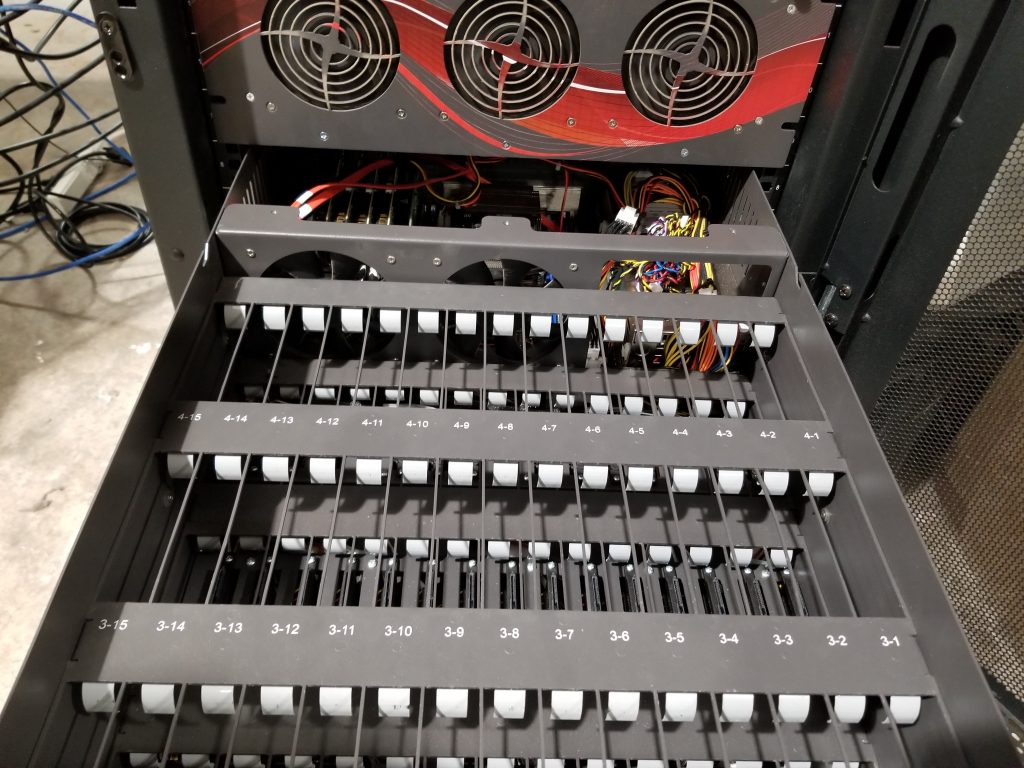
Out of curiosity, what server cases can actually accommodate 50 drives?

If you google "supermicro 72 drive server" it's definitely a thing that exists, but these use double-length drive trays where each tray contains two drives. Meaning that you need a "whole machine can go down" software architecture of redundancy at a very large scale to make these useful, since pulling one tray to replace a drive will take two drives offline. More realistically the normal version of the same supermicro chassis which has 1 drive per tray is 36 drives in 1 server.

There are other less publicly well known things with 72 to 96 drive trays in a single 'server' which are manufactured by taiwanese OEMs for large scale operators. The supermicro is just the best visual example I can think of right now with a well laid out marketing webpage.

edit: some photos

https://www.servethehome.com/supermicro-ssg-6047r-e1r72l-72x...

Re: Backblaze Drive Stats for 2024

#96

It's not a best practice, but the last 10 years I've run my home server with a smaller faster drive for the OS and a single larger disk for bulk storage that I choose using Backblaze Drive Stats. None of have failed yet (fingers-crossed). I really trust their methodology and it's an extremely valuable resource for me as a consumer. My most recent drive is a WDC WUH722222ALE6L4 22TiB, and looking at the stats (albeit…

Take these stats with a grain of salt. I am becoming more and more convinced that hard drive reliability is linked to the batch more than to the individual drive models themselves. Often you will read online of people experiencing multiple failures from drives purchased from the same batch. I cannot prove this because I have no idea about Blackblazes procurement patterns but I bought one of the better drives in this…

>Often you will read online of people experiencing multiple failures from drives purchased from the same batch

I'll toss in on that anecdata. This has happened to me a several times. In all these cases we were dealing with drives with more or less sequential serial numbers. In two instances they were just cache drives for our CDN nodes. Not a big deal, but I sure kept the remote hands busy those weeks trying to keep enough nodes online. In a prior job, it was our primary storage array. You'd think that RAID6+hot spare would be pretty robust, but 3 near simultaneous drive failures made a mockery of that. That was a bad day. The hot spare starting doing its thing with the first failure, and if it had finished rebuilding before the subsequent failures, we'd have been ok, but alas.

Re: Backblaze Drive Stats for 2024

#97
Great to see this every year.

Although a minor pet peeve (knowing this is free): I would have loved to see a 'in-use meter' in addition to just 'the drive was kept powered on'. AFR doesn't make sense for a HDD unless we know how long and how frequently the drives were being used (# of reads/writes or bytes/s).

If all of them had a 99% usage through the entire year - then sure (really?).

Re: Backblaze Drive Stats for 2024

#98
post #88
post #68

Earlier quoted context omitted.

Nowadays you can get a petabyte in a single machine (50 drives 20TB each).

Out of curiosity, what server cases can actually accommodate 50 drives?

Those are specialized NAS chassis. We have a number of them, 4U size, too heavy to move when the drives are in.

edit: They look like this: https://knowledgebase.45drives.com/wp-content/uploads/2019/0... (image from ddg)

Re: Backblaze Drive Stats for 2024

#99
post #9

I had five Seagates fail in my Synology NAS in less than a year. Somebody suggested it was a "bad" firmware on that model, but I switched to WD and haven't had a single failure since.

Unfortunately using all the same type of drive in any kinda of system is a recipe for disaster. Incompatibilities between the drive firmware and the device they're in can cause problems. Subtle harmonic issues with how the drives are mounted, which might be fine for some drives and disastrous for others. I've always found the best strategy with mechanical hard drives is to have various brands and models in the same d…

This. I don't care about brand or model or anything. I care about interface/speed requirements and then $/size.

Drives are interchangeable for a reason. :)

Re: Backblaze Drive Stats for 2024

#100

Earlier quoted context omitted.

hopefully you have 2x of these drives in some kind of raid mirror such that if one fails, you can simply replace it and re-mirror. not having something like this is risky.

Wasn’t the issue with large drives that remaining drive has a high chance of failure during re-silvering?

If you're doing statistics to plan the configuration of a large cluster with high availability, then yes. For home use where failures are extremely rare, no.

Home use is also much more likely to suffer from unexpected adverse conditions that impact all the drives in the array simultaneously.

Post reply on HN