Live data from Hacker News

Think your dog can understand words? This scientist says you might be right

cbc.ca

21–30 of 67 posts

Re: Think your dog can understand words? This scientist says you might be right

#21
post #4
post #3

Earlier quoted context omitted.

The article talks about having dogs talk back by pressing buttons for various words.

Maybe buttons are necessary when humans don't understand dog words? Or to put it another way, buttons demonstrate dogs being multilingual across species...

Words are a human construct - language. Dogs don't naturally have words or language - there's no bark that conveys a static meaning. They do correlate noises, like whines, barks, growls, with things they have experience with, and are clever enough to string complex and abstract concepts together. That level of reasoning and communication is not language, however.

What the buttons demonstrate is that dogs are capable of learning and using language. Complex concepts, like fire being hot and dangerous, yet needed to keep the house warm, so start the fire before the walk (a recent Bunny episode.)

This goes beyond Cesar Milan being the dog whisperer and into something novel. For the first time, we have dogs and other animals demonstrating that they can learn words and rules of grammar, connecting sequences of words together to form a specific meaning. That means a dog can say "go walk later" "ouch paw" and so forth, and bring about some sort of reaction from their human that would have been impossible without buttons. In the study they've been doing, dogs have demonstrated the capacity for humor, combining the semantics of different words to create new words, assigning nicknames, and stringing together upwards of 5 words to express a coherent idea.

This should cause us all to stop and question whether our perception of animals needs changing. To all appearances, any mammal, or animal with functionality comparable to a neocortex, is capable of using language. Cows, pigs, horses, dogs, cats, rabbits, and all sorts of other animals have learned to use these button systems. Birds and primates have long been known to use sign language, able to understand spoken words and respond with fairly intelligent and complex language of their own. Bears, lions, dolphins, orcas, and whales are likely to be among the most intelligent and linguistically facile creatures aside from humans.

Perhaps the neural structure imposed by learning language results in a significant shift in capacity. When you consider feral humans, and the extreme difficulties they have with language acquisition, and then think on Helen Keller's description of language and communication resulting in her becoming conscious and aware, maybe teaching language to these animals is inducing a real change in consciousness, providing them the foundations of a life and experience with which we can directly empathize.

Courts recently ruled against elephants being people - well, we should take a hard look at what "people" really means. Mysticism and religious traditions aren't sufficient in a world inhabited by science. Humans aren't people "because God said so" or "the holy book says all other animals are lesser."

We are where we are because our brains, mouths, hands, and eyes give us an advantage in controlling our environments. Left feral, we're often no more capable or extraordinary than other primates. Given culture, education, and language, and humanity becomes some significantly more powerful and impactful in the world. Giving dogs language probably isn't going to result in dogs writing blogs, or horses filing legal briefs, but humans could establish a culture that lifts them up, empowers them, and provides a set of tools by which dogs (and other animals) are able to express more agency and have a much more potent impact on the world.

For example, imagine a standardized education for dogs, in which a set of 100 words are taught to them as puppies, consistently modeled. This would mean that almost any dog you encounter would have a shared means of communication - for dogcatchers, that'd be a pretty good deal. It'd also mean "yes, good friend. come treat." or similar phrases might be used to put a dog at ease. Most dog attacks happen because you have a terrified animal in an unpredictable situation, and all the dog knows is how to react with fear and aggression. Layering communication into that definitely wouldn't solve everything, but hey, it'd be a lot better than nothing.

I can't wait for Cesar or a comparably talented trainer to grab on to the dog button trend; there's a subtle but deep difference between being greeted by a flurry of wiggles and joyful bouncing, and all the wiggles and bouncing with "Dad hi love you play" or "Mom friend human".
Re: Think your dog can understand words? This scientist says you might be right

#24

So where are all the people who apparently think that pets can't understand basic vocabulary? It's treated like some wild revelation when it comes up in articles like this, but anyone who's ever had a dog or cat knows what the reactions are like when words like "walk" or "bath" or "tuna" get mentioned. For particularly attentive dogs you can even end up with the euphemism treadmill from "walk" to "W-A-L-K" to substit…

Lots of people think animals are dumb beasts. My neighbor threw a party with a bunch of people in his PhD program. Our dogs hang out and we left the gate open between our properties so the dogs could go back and forth. One of the PhD students was amazed that if you threw a ball over the fence the dog knew how to go around the fence and through the gate to get the ball.

They can certainly learn things like using gates, however they don't seem to have a concept of object permanence. If they go to the other side of the fence and do not find the ball, they will tend to begin a spiraling search for it, rather than concentrate on where the ball logically should be if you tracked the trajectory of it and formed a concept of where it went even after it left your sight.

Re: Think your dog can understand words? This scientist says you might be right

#25
post #20

So where are all the people who apparently think that pets can't understand basic vocabulary? It's treated like some wild revelation when it comes up in articles like this, but anyone who's ever had a dog or cat knows what the reactions are like when words like "walk" or "bath" or "tuna" get mentioned. For particularly attentive dogs you can even end up with the euphemism treadmill from "walk" to "W-A-L-K" to substit…

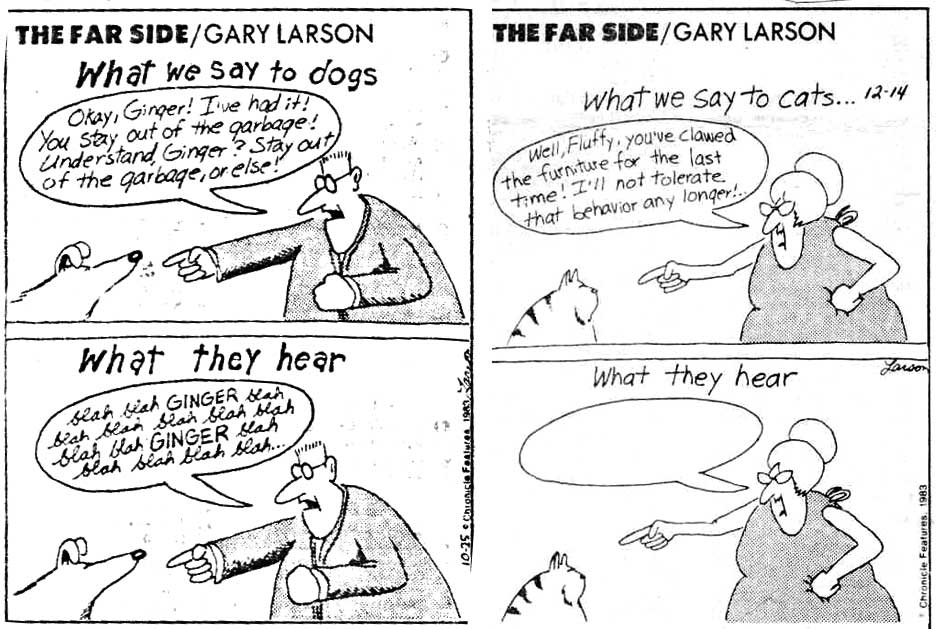
I can believe it with dogs, but my cat of almost 20 years has never indicated any understanding of or interest in human speech. She sometimes reacts to tone of voice, sometimes to specific noises (like treat baggie crumbling when opened), but not any particular words. Half the time she could care less about the tone or noises as well. That seems pretty in line with my general understanding of cat "psychology".

Gary Larson expressed this best:

https://www.marketingfirst.co.nz/wp-content/uploads/2009/08/...

Re: Think your dog can understand words? This scientist says you might be right

#26
post #4

Earlier quoted context omitted.

Maybe buttons are necessary when humans don't understand dog words? Or to put it another way, buttons demonstrate dogs being multilingual across species...

Words are a human construct - language. Dogs don't naturally have words or language - there's no bark that conveys a static meaning. They do correlate noises, like whines, barks, growls, with things they have experience with, and are clever enough to string complex and abstract concepts together. That level of reasoning and communication is not language, however. What the buttons demonstrate is that dogs are capable…

What blew my mind was when one of the first dogs to use buttons was confronted with her "beach" button being broken. She started using the phrase "outside-water" to compensate for being unable to say "beach".

This is like when Alex the parrot was confronted with an apple for the first time and called it a "banerry", using the names of fruits he knew (banana and cherry). The ability not just to use words, but form original linguistic constructs in response to novel situations, is something we humans long thought was our domain alone, but it turns out we share it with far more birds and beasts than we realize even today.

Re: Think your dog can understand words? This scientist says you might be right

#27
The article is clearly a stark example of selection bias, ignoring all the times where the dog didn't press relevant buttons and highlighting random successes.

There are countless proofs that dogs don't understand words, and it's extremely easy to demonstrate: https://youtube.com/shorts/CIDZG7bdP7k

Re: Think your dog can understand words? This scientist says you might be right

#28

So where are all the people who apparently think that pets can't understand basic vocabulary? It's treated like some wild revelation when it comes up in articles like this, but anyone who's ever had a dog or cat knows what the reactions are like when words like "walk" or "bath" or "tuna" get mentioned. For particularly attentive dogs you can even end up with the euphemism treadmill from "walk" to "W-A-L-K" to substit…

[deleted]

Re: Think your dog can understand words? This scientist says you might be right

#29
post #4
post #3

Earlier quoted context omitted.

The article talks about having dogs talk back by pressing buttons for various words.

Maybe buttons are necessary when humans don't understand dog words? Or to put it another way, buttons demonstrate dogs being multilingual across species...

My dog used to get really worked up and bite me when she wanted something, so I started teaching to answer my questions. So, when she wants something, she sits in front of me and I start asking: What do you want? Food? Water? Poop? When I reach the word, she bumps on me with the front paws.

I guess this is the equivalent of the soundboard.

Re: Think your dog can understand words? This scientist says you might be right

#30

Earlier quoted context omitted.

Lots of people think animals are dumb beasts. My neighbor threw a party with a bunch of people in his PhD program. Our dogs hang out and we left the gate open between our properties so the dogs could go back and forth. One of the PhD students was amazed that if you threw a ball over the fence the dog knew how to go around the fence and through the gate to get the ball.

They can certainly learn things like using gates, however they don't seem to have a concept of object permanence. If they go to the other side of the fence and do not find the ball, they will tend to begin a spiraling search for it, rather than concentrate on where the ball logically should be if you tracked the trajectory of it and formed a concept of where it went even after it left your sight.

Dogs obviously have a concept of object permanence, since they know to go around the fence to look for a ball in the first place. They wouldn't look for it once it's left their sight around a fence otherwise. That they're confused if they cannot immediately find the ball only shows that they struggle to calculate arcs, which many humans also do.
Post reply on HN