Live data from Hacker News

Prime number patterns

jasondavies.com

41–50 of 105 posts

Re: Prime number patterns

#41
post #15

I think he meant "El Padrón de los Números Primos". Patrón means "boss", not "pattern".

It also means pattern. The source page also uses patrón. http://www.polprimos.com/

Ah, good. The title is meant to be an homage to the original source of the idea.

My Spanish is somewhat rusty so I didn't know it also meant boss. :)

Re: Prime number patterns

#42
post #33

Earlier quoted context omitted.

this chart basically includes a set of periodic curves, even though it looks nice but what does it tell you about prime numbers ? Intersected by only two curves 1 and itself ??? well, everyone knows this, no need to make a chart.

It tells you that prime numbers and periodic curves might be related more than you might have thought at first blush. I.e., if you can mathematically describe and analyze this set of periodic curves, then you have also described and can analyze the prime numbers. As I mentioned, I don't know much about number theory, but I do know that it uses a lot of math that is counterintuitive at first blush. Perhaps this visual…

>if you can mathematically describe and analyze this set of periodic curves, then you have also described and can analyze the prime numbers.

Dude, no offense, you are really making stuff up. The periodicity has to to with the divisors of the composites. Every prime p has exactly 2 curves - the wave of period 1, and the wave of period p. There's nothing interesting or useful to take way from that observation. otoh, you look at a composite c - it has several divisors & each divisor d generates a curve of period d, and those curves intersect in interesting ways...though I don't see how you could mathematically analyze them to tell you anything about the primes nearby. They are mostly pretty patterns, not mathematically useful...here are 2 quite famous & useful diagrams on periodicity in primes if you are interested in that sort of thing -

1. the prime number cross - http://img841.imageshack.us/img841/1329/primenumbercross.gif

2. hippocampal neurons & primes - http://www.hindawi.com/journals/amp/2011/519178/fig8/

Re: Prime number patterns

#43
Very, very lovely. You might (or might not) also be familiar with the Ulam Spiral[1] or the arguably more beautiful Sacks Spiral[2], which do reveal certain patterns in the distribution of the primes.

I used the software from this site[3] to generate a large Sacks spiral graphic, which I had custom-printed on my shower curtain. To most folks who see it, it's just some pattern of dots, but knowing the order within gives me great joy.

[1] https://en.wikipedia.org/wiki/Ulam_spiral

[2] http://www.numberspiral.com

[3] http://www.dcs.gla.ac.uk/~jhw/spirals/index.html

Re: Prime number patterns

#44

Two things that were non-obvious to me but made me extremely happy when they worked: panning and zooming.

Exactly, I'm not much of a numbers guy but this was really beautiful and when I hit the scroll wheel on my mouse and it got bigger I was "oh, now that's cool."

Re: Prime number patterns

#45
post #42

Earlier quoted context omitted.

It tells you that prime numbers and periodic curves might be related more than you might have thought at first blush. I.e., if you can mathematically describe and analyze this set of periodic curves, then you have also described and can analyze the prime numbers. As I mentioned, I don't know much about number theory, but I do know that it uses a lot of math that is counterintuitive at first blush. Perhaps this visual…

>if you can mathematically describe and analyze this set of periodic curves, then you have also described and can analyze the prime numbers. Dude, no offense, you are really making stuff up. The periodicity has to to with the divisors of the composites. Every prime p has exactly 2 curves - the wave of period 1, and the wave of period p. There's nothing interesting or useful to take way from that observation. otoh, yo…

I take it, then, that you find nothing inspirational in the videos made by Vi Hart either. To each, their own.

As to the diagrams you pointed me at, they mean nothing to me, and do not inspire me. If I knew more about number theory, perhaps they would. Some things are not about information, they are about inspiration.

The visualization in the OP provides inspiration that number theory is connected to other fields of math. You can see structure in the way that the periodic curves intersect and the primes are the gaps. If you could understand that structure, then maybe you could understand the gaps. Then again maybe not. That doesn't mean that the question and the visualization doesn't cause you to think and wonder.

Sure, this is old hat to mathematicians, and for all I know, this approach is a complete dead end. Sometimes dead ends are interesting too.
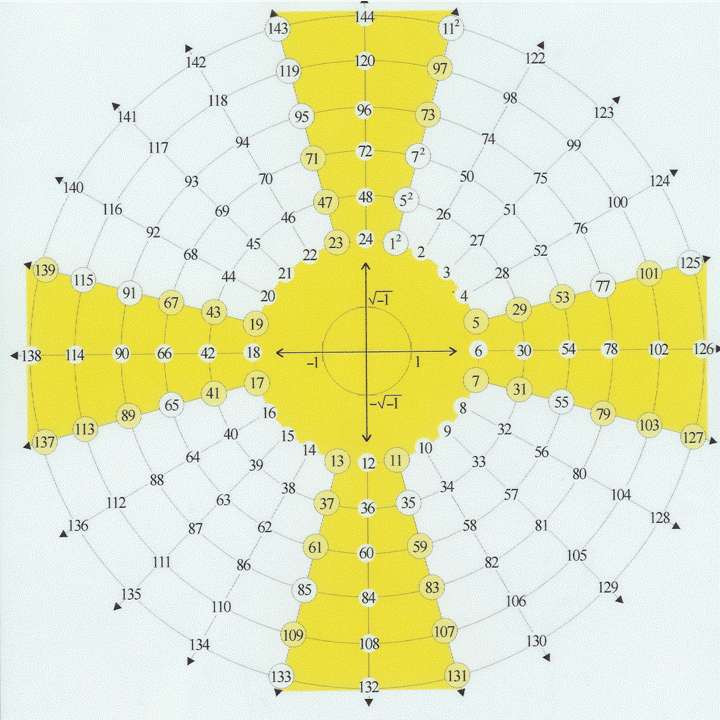
Re: Prime number patterns

#46
post #42

Earlier quoted context omitted.

It tells you that prime numbers and periodic curves might be related more than you might have thought at first blush. I.e., if you can mathematically describe and analyze this set of periodic curves, then you have also described and can analyze the prime numbers. As I mentioned, I don't know much about number theory, but I do know that it uses a lot of math that is counterintuitive at first blush. Perhaps this visual…

>if you can mathematically describe and analyze this set of periodic curves, then you have also described and can analyze the prime numbers. Dude, no offense, you are really making stuff up. The periodicity has to to with the divisors of the composites. Every prime p has exactly 2 curves - the wave of period 1, and the wave of period p. There's nothing interesting or useful to take way from that observation. otoh, yo…

It does give you a good intuition as to why twin primes aka N, N+2 are so common.

Re: Prime number patterns

#47

Earlier quoted context omitted.

It also means pattern. The source page also uses patrón. http://www.polprimos.com/

Ah, good. The title is meant to be an homage to the original source of the idea. My Spanish is somewhat rusty so I didn't know it also meant boss. :)

What you created is pretty boss.

Re: Prime number patterns

#48
Stop it, stop it, stop it, just stop. Once an article reaches the front page, it's title is no longer editable. It causes confusion and frustration, and is obviously an issue that a lot of people dislike. I don't care about prime numbers, this article was all about the visualization to me. Every time a title gets changed like this, you are telling your user base that you don't care about what they think. I feel like I'm back in Digg, waiting for something like Reddit to pop up so I don't have to deal with the 'power' users.

/rant

Re: Prime number patterns

#49

Very, very lovely. You might (or might not) also be familiar with the Ulam Spiral[1] or the arguably more beautiful Sacks Spiral[2], which do reveal certain patterns in the distribution of the primes. I used the software from this site[3] to generate a large Sacks spiral graphic, which I had custom-printed on my shower curtain. To most folks who see it, it's just some pattern of dots, but knowing the order within giv…

Thanks for the links. Math is awesome, and this kinda stuff really gets one going. No wonder some people (mathematicians) get hooked on prime numbers for the rest of their lives. It's beautiful.

Re: Prime number patterns

#50

Stop it, stop it, stop it, just stop. Once an article reaches the front page, it's title is no longer editable. It causes confusion and frustration, and is obviously an issue that a lot of people dislike. I don't care about prime numbers, this article was all about the visualization to me. Every time a title gets changed like this, you are telling your user base that you don't care about what they think. I feel like…

What are you talking about?
Post reply on HN