Live data from Hacker News

Building a replacement 386/486 CMOS battery

rubenerd.com

21–30 of 38 posts

Re: Building a replacement 386/486 CMOS battery

#21
post #2

The only thing worse than these soldered-in batteries are those motherboards with the Dallas DS1287 RTC “brick” ICs. They had a coin cell buried inside the chip[1] with no way to provide external power should it drain. [1]: http://www.mcamafia.de/mcapage0/dsrework.htm

Dedication and a cutter knife do it. I did it myself, twice.

Once while it was soldered into a mainboard :P
Re: Building a replacement 386/486 CMOS battery

#23
post #14
post #2

The only thing worse than these soldered-in batteries are those motherboards with the Dallas DS1287 RTC “brick” ICs. They had a coin cell buried inside the chip[1] with no way to provide external power should it drain. [1]: http://www.mcamafia.de/mcapage0/dsrework.htm

Necroware has a replacement design for Dallas RTCs: https://github.com/necroware/nwX287

I don't know why there is a replacement design. You can still buy them new from Mouser. They last 20 odd years usually.

Re: Building a replacement 386/486 CMOS battery

#24

Lots of older Apple hardware used soldered-in 1/2AA lithium batteries. You can replace them with a removable battery holder that was used on some later board versions. https://www.mouser.com/ProductDetail/Keystone-Electronics/10... https://www.mouser.com/ProductDetail/Keystone-Electronics/10...

Just a note with those holders. They shouldn't be used in anything that will be shipped as the battery can get knocked out. The original shipped batteries were soldered in so they could be shipped safely. In fact a lot of the time the cells were taped or cable tied as well as soldered in on some bits of hardware!

The newer CR2032's have much lower mass and can withstand many more G's before it's an issue so they are usually in holders.

Re: Building a replacement 386/486 CMOS battery

#25
post #15

Why not use a 5F/5V supercapacitor, DGH505Q5R5 or anything alike ? You may need to solder a 10R current reducing resistor in series.

Super capacitors have very high self discharge rates relative to a lithium battery. For something like an RTC which only uses a tiny amount of power, you’d quickly discharge the cap and have no way to charge it again.

Re: Building a replacement 386/486 CMOS battery

#26

Lots of older Apple hardware used soldered-in 1/2AA lithium batteries. You can replace them with a removable battery holder that was used on some later board versions. https://www.mouser.com/ProductDetail/Keystone-Electronics/10... https://www.mouser.com/ProductDetail/Keystone-Electronics/10...

Just a note with those holders. They shouldn't be used in anything that will be shipped as the battery can get knocked out. The original shipped batteries were soldered in so they could be shipped safely. In fact a lot of the time the cells were taped or cable tied as well as soldered in on some bits of hardware! The newer CR2032's have much lower mass and can withstand many more G's before it's an issue so they are…

That is why I added the second Mouser link for the retaining clip, which is frequently missing from old stock. It takes a screwdriver to unclip it, plenty secure for transportation.

Re: Building a replacement 386/486 CMOS battery

#27
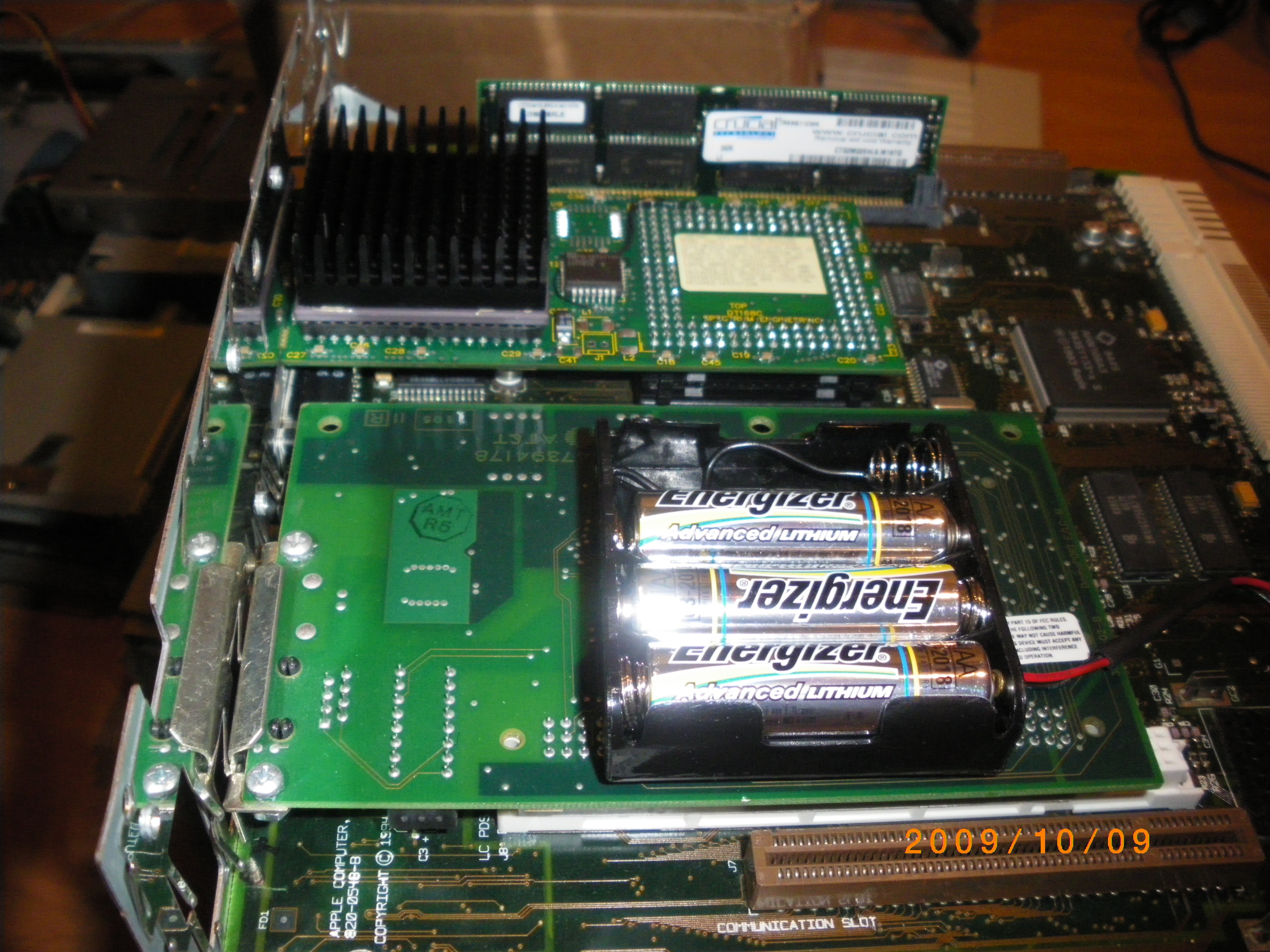
It's good to see this getting some attention. People should know that removing batteries and replacing them with something modern, particularly non-leaking modern, is a good thing.

Most motherboards work with 3 to 4.5 volts. If a circuit doesn't charge, then it's a simple matter of using two or three AA or AAA batteries. If it does, we can use rechargeable batteries (I've a box of Ikea ones), or we can put a diode in line.

For instance, here's a replacement set for a Quadra 630 motherboard:

https://www.klos.com/~john/q630_batteries.png

Re: Building a replacement 386/486 CMOS battery

#28
post #2

The only thing worse than these soldered-in batteries are those motherboards with the Dallas DS1287 RTC “brick” ICs. They had a coin cell buried inside the chip[1] with no way to provide external power should it drain. [1]: http://www.mcamafia.de/mcapage0/dsrework.htm

There were lots of test equipment with variants of those, and unlike CMOS settings, they held critical calibration constants.

Re: Building a replacement 386/486 CMOS battery

#30

It's good to see this getting some attention. People should know that removing batteries and replacing them with something modern, particularly non-leaking modern, is a good thing. Most motherboards work with 3 to 4.5 volts. If a circuit doesn't charge, then it's a simple matter of using two or three AA or AAA batteries. If it does, we can use rechargeable batteries (I've a box of Ikea ones), or we can put a diode in…

AA or AAA batteries will leak.
Post reply on HN