Live data from Hacker News

Show HN: I made the slowest, most expensive GPT

ithy.com

1–10 of 61 posts

Show HN: I made the slowest, most expensive GPT

#1
This is another one of my automate-my-life projects - I'm constantly asking the same question to different AIs since there's always the hope of getting a better answer somewhere else. Maybe ChatGPT's answer is too short, so I ask Perplexity. But I realize that's hallucinated, so I try Gemini. That answer sounds right, but I cross-reference with Claude just to make sure.

This doesn't really apply to math/coding (where o1 or Gemini can probably one-shot an excellent response), but more to online search, where information is more fluid and there's no "right" search engine + text restructuring + model combination every time. Even o1 doesn't have online search, so it's obviously a hard problem to solve.

An example is something like "best ski resorts in the US", which will get a different response from every GPT, but most of their rankings won't reflect actual skiers' consensus - say, on Reddit https://www.reddit.com/r/skiing/comments/sew297/updated_us_s... - because there's so many opinions floating around, a one-shot RAG search + LLM isn't going to have enough context to find how everyone thinks. And obviously, offline GPTs like o1 and Sonnet/Haiku aren't going to have the latest updates if a resort closes for example.

So I’ve spent the last few months experimenting with a new project that's basically the most expensive GPT I’ll ever run. It runs search queries through ChatGPT, Claude, Grok, Perplexity, Gemini, etc., then aggregates the responses. For added financial tragedy, in-between it also uses multiple embedding models and performs iterative RAG searches through different search engines. This all functions as sort of like one giant AI brain. So I pay for every search, then every embedding, then every intermediary LLM input/output, then the final LLM input/output. On average it costs about 10 to 30 cents per search. It's also extremely slow.

https://ithy.com

I know that sounds absurdly overkill, but that’s kind of the point. The goal is to get the most accurate and comprehensive answer possible, because it's been vetted by a bunch of different AIs, each sourcing from different buckets of websites. Context limits today are just large enough that this type of search and cross-model iteration is possible, where we can determine the "overlap" between a diverse set of text to determine some sort of consensus. The idea is to get online answers that aren't attainable from any single AI. If you end up trying this out, I'd recommend comparing Ithy's output against the other GPTs to see the difference.

It's going to cost me a fortune to run this project (I'll probably keep it online for a month or two), but I see it as an exploration of what’s possible with today’s model APIs, rather than something that’s immediately practical. Think of it as an online o1 (without the $200/month price tag, though I'm offering a $29/month Pro plan to help subsidize). If nothing else, it’s a fun (and pricey) thought experiment.
Show HN: I made the slowest, most expensive GPT
ithy.com

Re: Show HN: I made the slowest, most expensive GPT

#3
i like this, a lot.

i asked a subjective history question about England and Ithy's analysis was great, and did indeed add to other GPTs!

i did find the UI a bit confusing at first, that's my only nitpick. i signed in (nice easy flow) and will definitely continue to use!

looks like anthropic is slowing down ithy analysis/responses, at least today during my tests just now anyway.

great app! well done o7

Re: Show HN: I made the slowest, most expensive GPT

#6
This is pretty impressive. Given the following scenario, "A bliirg is any non-wooden item, which is the opposite of a glaarg. In addition, there are neergs (non-existent things) and eeergs (things which actually exist). Now a glaarg which is also a neerg is called a bipk, whereas a glaarg which is a eeerg is known as a vokp. Also, a bliirg which is an eeerg is refererred to as a jokp, otherwise it is known as a fhup. So the question is, which of those could be used to make an actual fire: a jokp, bipk, fhup, or vokp? Explain your reasoning." The results were absolutely spot on. "(...) A vokp, being a real, existing wooden object, can serve as a fuel source. A jokp, being a real, existing non-wooden object, might serve as a fuel source if it is combustible. However, a bipk and a fhup, being non-existent things, cannot be used to make a fire. The ability to actually start a fire also depends on the presence of an ignition source, oxygen, and potentially tinder, which are not addressed by the definitions of these terms." Any plan to make the project open source?

Re: Show HN: I made the slowest, most expensive GPT

#9
`how to build a birdhouse to attract a bluebird`

https://ithy.com/article/4b116d2032e54c03862db84e71bcfc8f

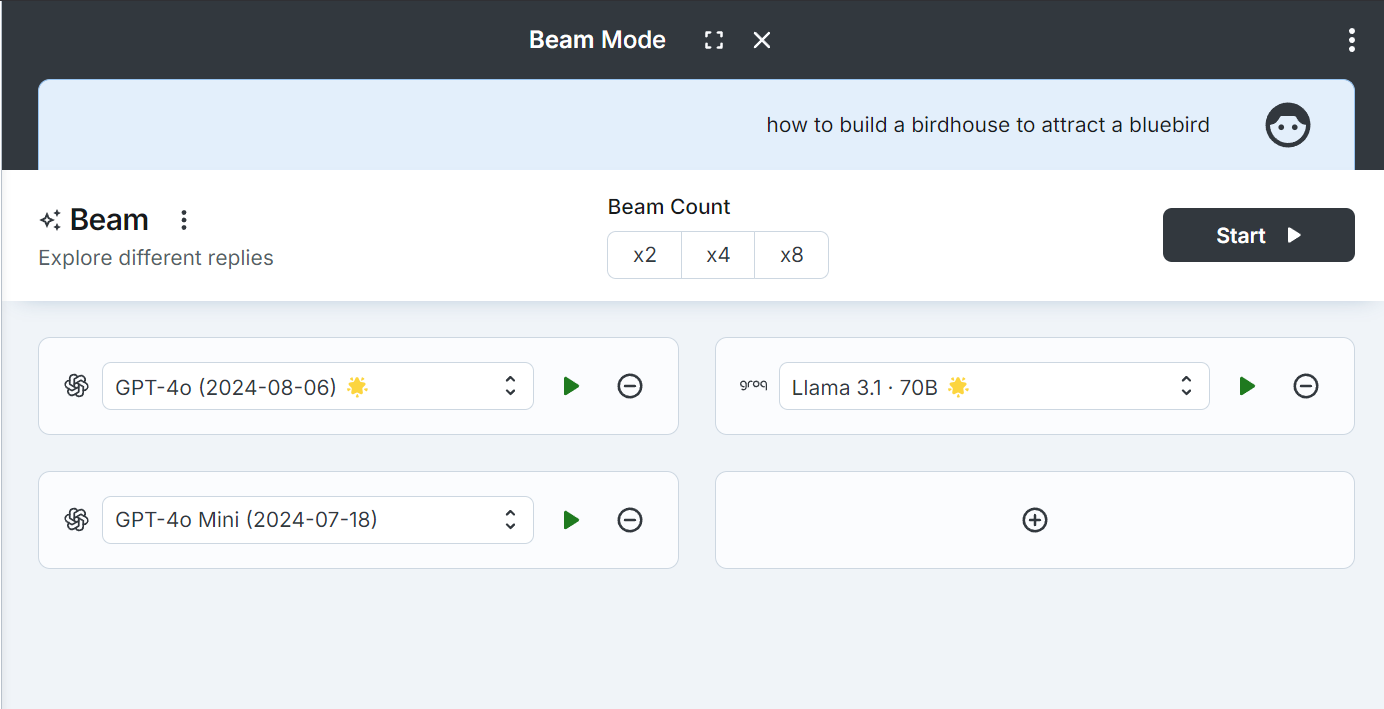
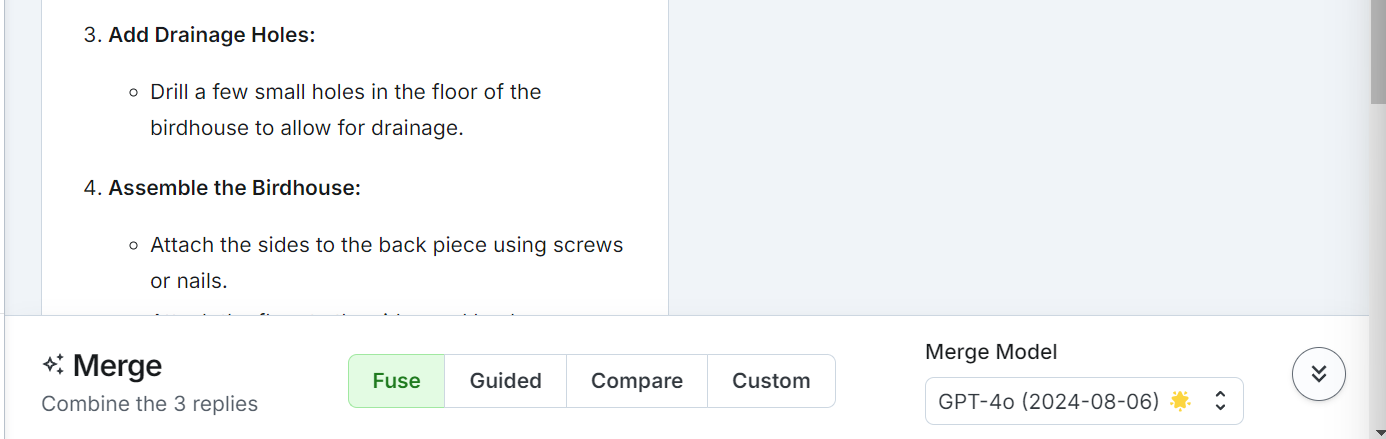
https://big-agi.com/ has this "BEAM" concept as well where you can put your message through as many models as you have configured then run fuse/guided/compare/custom to merge them all together into one comprehensive. more expensive response.

https://files.catbox.moe/tr82vs.png

https://files.catbox.moe/beuyfx.png

However Ithy does produce something much much better! This is really cool! I wonder if you could cache questions and answers, and start creating your own "reddit" knowledgebase to RAG from and avoid having to dive deep again $$$.

Post reply on HN