Live data from Hacker News

Setelinleikkaus: When Finns snipped their cash in half to curb inflation

jpkoning.blogspot.com

201–210 of 246 posts

Re: Setelinleikkaus: When Finns snipped their cash in half to curb inflation

#201
post #82

Earlier quoted context omitted.

I described Open Market Operations, see https://en.wikipedia.org/wiki/Open_market_operation > The Fed sets the interest rate directly. So which interest rate does the Fed set directly, and how does that setting have any effect on the economy? (I know they have interest on excess reserves. I already accounted for those in my original comment. I know, they are annoying and misguided. I was mostly talking about the syst…

The Fed directly sets the Overnight Rate, also known as the Federal Funds Rate. It's the rate at which banks can borrow from one another overnight to satisfy reserve requirements. This rate indirectly affects the interest rate of all other lending instruments because the higher cost of overnight bank to bank lending is passed on to the customers in the form of higher loan rates, credit card rates, mortgage rates, etc…

The Fed can only 'set' the Overnight Rate by being ready to borrow or lend at the Overnight Rate. The Fed still has to stand ready to actually engage in these transactions.

As a counterfactual: we can imagine a world where the Fed 'sets' these rates by just announcing the rate but not engaging in any transactions and legislators pass a law that forbids banks from borrowing from one another at any other rates.

The interbank lending market would just not clear in that case, and you'd either have a glut of demand or a glut of supply.

The Fed sidesteps this by actually borrowing and lending in the interbank lending market. And that's economically equivalent to buying and selling very short term bonds, even if the legal form is different.
Re: Setelinleikkaus: When Finns snipped their cash in half to curb inflation

#202
post #25

> It's not just the size of Operation Gutt that is striking to the modern eye. It's also the oddity of the tool being used. Today, we control inflation with changes in interest rates, not changes in the quantity of money. To soften the effect of the global COVID monetary overhang, for instance, central banks in the U.S., Canada, and Europe began to raise rates in 2022 from around 0% to 4-5% in 2024. It's a bit more i…

> Simplified: the central bank decide on an interest rate that they want to see. By itself that decision doesn't do anything. I get the simplified qualifier and I see what you’re saying but it’s more accurate to say this is not true, it hasn’t really been substantially true since February 1994. > What happens next is that they buy and sell government bonds in the open market Again i feel it’s better to say exactly wh…

Yes, expectations and anticipation are very, very important in all markets, and especially financial markets.

But they only work, because the Fed can and will back up its announcements with large transactions at the announced prices and rates.

> There’s many reasons for this - not least that it’s futile to fight against the currency issuer.

You'd hope so, but not all currency issuers are so confident. I remember the Swiss central bank recently giving up on its exchange rate target to the Euro: they let the Swiss Frank appreciate against the Euro in the end, even though they control the printing presses and could always print enough Franks to drive their price down as much as they want to.

We saw similar reluctance to do whatever it takes for Japan since the 1990s and the Fed and the ECB during the 2010s, when they all failed comically to push inflation up to their targets, and came up with various excuses.

(The failure of the Fed is particularly funny, because one of the guys in charge had earlier written a piece telling the Japanese exactly how to get out of their own trap in the 1990s, but then did not practice his own preaching.)

Re: Setelinleikkaus: When Finns snipped their cash in half to curb inflation

#203

Earlier quoted context omitted.

> Today, we control inflation with changes in interest rates, not changes in the quantity of money. That is also not quite correct, I believe. The FED can invest money created out of thin air any time it wants („fiat money“ — „there shall be money“), usually it buys government bonds to help the federal government run its deficit. Sometimes this scheme is called „quantitative easing“ which is a charming euphemism. Thi…

>> This is what drove and still drives inflation directly and indirectly QE is fascinating. On the one side of QE you have central banks, absolutely baffled by the fact they create all these reserves, we’re talking utterly un-relatable numbers for a human, numbers that belong in the field of astronomy rather than finance. And yet they fail to hit their inflation targets for over a decade. On the other side you have a…

> We don’t have fractional reserve in the USA, the UK, Aus etc and haven’t had for a number of years at this point.

What do you mean by that?

Re: Setelinleikkaus: When Finns snipped their cash in half to curb inflation

#204

Earlier quoted context omitted.

>> This is what drove and still drives inflation directly and indirectly QE is fascinating. On the one side of QE you have central banks, absolutely baffled by the fact they create all these reserves, we’re talking utterly un-relatable numbers for a human, numbers that belong in the field of astronomy rather than finance. And yet they fail to hit their inflation targets for over a decade. On the other side you have a…

> The onset of inflation correlates more closely with global energy supply shocks than with changes in QE policy or “printing” money in Covid stimulus. Hmmm. [1] > USA, the UK, Aus etc and haven’t had for a number of years at this point Indeed, the US abolished the 10% reserve requirement in 2020. Crazy. I hope you guys also save in inflation hedges. [1] https://fred.stlouisfed.org/series/M2SL

Canada (and other places) never had a reserve requirement, and they are doing fine.

Reserve requirements are mostly bullshit anyway. What you want is for banks to have enough loss absorbing capital. Reserves are almost meaningless.

Re: Setelinleikkaus: When Finns snipped their cash in half to curb inflation

#205
post #91

Earlier quoted context omitted.

Huh? What does this have to do with inflation at all?

Unless I miss something, it's very much not a standard measure of inflation. That said, leaning on that "at all": If wages are stickier than expenses, then the gap between wages and expenses will represent recent inflation to some degree.

If inflation is stable (and low-ish), then stickiness doesn't matter.

Sticky prices are only important, when expectations are invalidated.

So to fix your sentence:

> If wages are stickier than expenses, then the gap between wages and expenses will represent recent unexpected inflation to some degree.

Re: Setelinleikkaus: When Finns snipped their cash in half to curb inflation

#206
post #196

Earlier quoted context omitted.

To be more precise, they already had the port, but were afraid to lose it to the new government of Ukraine. This is also a big reason why Crimea, by and large, supported annexation - it has very large proportions of the population that are either active or retired Soviet/Russian navy.

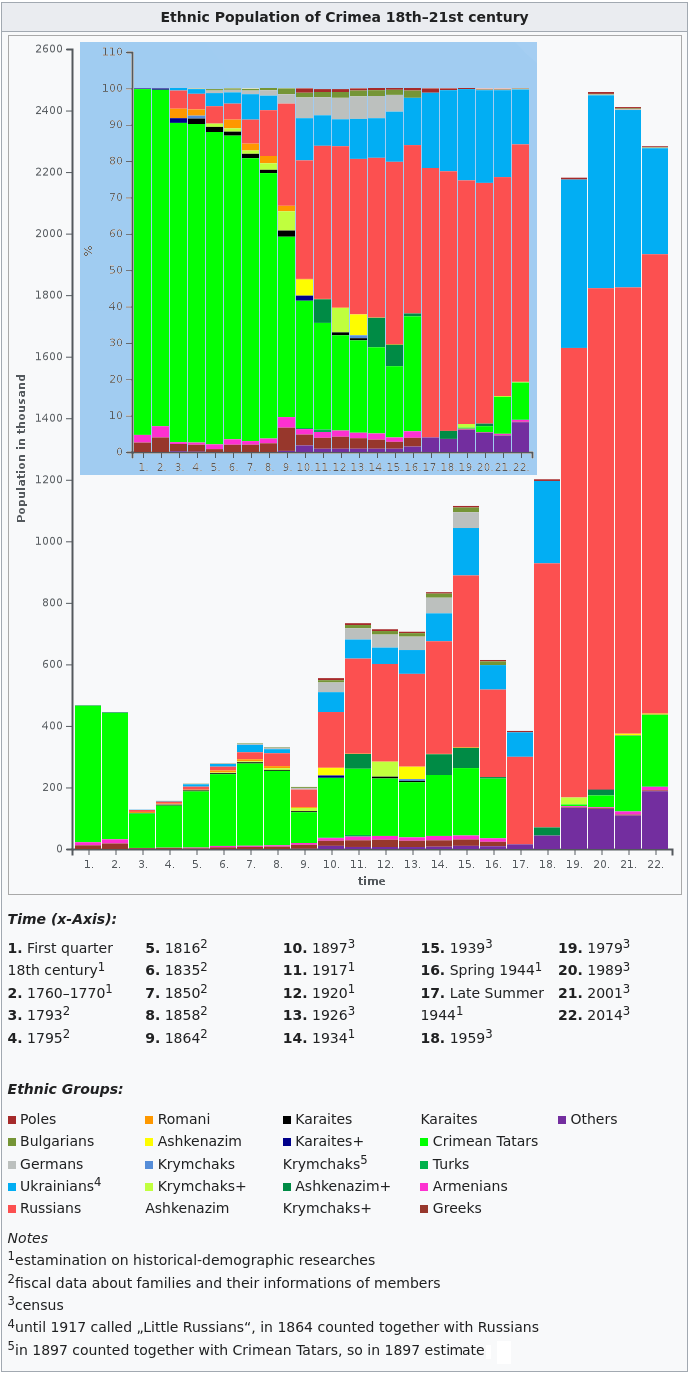
The Russia Empire and the Soviet Union ran concerted efforts to Russianise the population of Crimea by various means, like moving in ethnic Russians, removing the locals (to put it mildly) etc.

removing the locals (to put it mildly) etc.

Virtually the entire indigenous and otherwise non-Slavic population (some 30 percent of the total population of the peninsula) to be precise, according to this graph:

https://upload.wikimedia.org/wikipedia/commons/6/6a/Ethnic_P...

Re: Setelinleikkaus: When Finns snipped their cash in half to curb inflation

#207

Earlier quoted context omitted.

IIRC the reasoning was that only criminals have large amounts of valuable notes and by demonetising them they'd hit the criminals where it hurts. But it turns out that tons of people in rural India had their life savings under mattresses in large denomination bills...

It essentially forced people into getting a bank account.

Yea and caused massive queues of people desperately trying to deposit their cash before the deadline :)

Re: Setelinleikkaus: When Finns snipped their cash in half to curb inflation

#208

Earlier quoted context omitted.

The problem with all these is that money is kinda worthless if you're unable to spend it, and regimes that are likely to enact such monetary policies will often regulate the use of gold etc as well. A bunker full of gold bars does you no good if actually trying to spend any of it is a crime in and of itself.

It's not a fantasy scenario that we need to speculate about. Currencies collapse all the time, just pick any country and it has happened to them within the past 200 or even 100 years. There's millions of people alive right now who avoided having their life savings destroyed by having foreign currency or bullion or both.

I'm not disagreeing with that part; I grew up in Russia in the 90s, where, if you had any significant amount of money, you'd have a dollar or euro account, and ideally both. This provides security against currency collapse, yes; but if the government decides to be actively confiscatory, it doesn't really help, unless their plan is particularly poorly designed.

Re: Setelinleikkaus: When Finns snipped their cash in half to curb inflation

#209
post #196

Earlier quoted context omitted.

The Russia Empire and the Soviet Union ran concerted efforts to Russianise the population of Crimea by various means, like moving in ethnic Russians, removing the locals (to put it mildly) etc.

removing the locals (to put it mildly) etc. Virtually the entire indigenous and otherwise non-Slavic population (some 30 percent of the total population of the peninsula) to be precise, according to this graph: https://upload.wikimedia.org/wikipedia/commons/6/6a/Ethnic_P...

The original Russian colonization of Crimea brought in many Ukrainians as well, though, so that alone did not make it lean Russian so strongly by itself. The naval facilities in Sevastopol, though, meant a lot of military personnel with their families from all over the country would come and settle in the city, and that specifically tilts the popular opinion there today strongly towards imperial Russian irredentism.

Re: Setelinleikkaus: When Finns snipped their cash in half to curb inflation

#210
> So it would seem that the whole operation failed. This surely draws into question the quantity theory of money, one of the basic tenets of monetary economics. A decline in the money supply, all things staying the same, is supposed to cause a fall in prices. Here is a glaring case in which it didn't.

Anthropologist Christoffer Gregory (backed up by the Swedish central bank and others) posits a companion to the quantity theory of money, which is the quality theory of money. Gregory studied how it is that people come to value the things they do[1] and brings up several clear cases where people don't value money as highly as they should according to domninant theory.

Is it possible that this Gutt operation had a negative effect on the perceived quality of Belgian currency, that this decreased demand for it, and thus lowered its value enough to offset the effect of the reduction in supply?

Seems sensical to me that if people worry about the government cutting their notes in half they will request more notes in exchange for another commodity than if they had more faith in the currency.

[1]: https://entropicthoughts.com/book-review-savage-money

Post reply on HN