Live data from Hacker News

QNX is now free for anything non-commercial, plus there's an RPi image

blackberry.qnx.com

111–120 of 380 posts

Re: QNX is now free for anything non-commercial, plus there's an RPi image

#111
post #5

This is a good move! In my opinion, any platform should be available for free for any non-commercial purpose. This is how people get started, and this is how the platform proliferates. I might even suggest going a bit further: provide some limited support for non-commercial users, for example, make it super-easy to file a bug. But otherwise, it's a win-win for both the free tier (students, hobbyists) and the corporat…

Eg the Business Source License and the Functional Source License makes it always available for non-commercial use

Re: QNX is now free for anything non-commercial, plus there's an RPi image

#112
We need to start treating “non-commercial” as the ambivalent term that it is.

Eg: All “non-profit” and “personal” use likely isn’t necessarily “non-commercial”, but those two can be easily identified based on who it is that makes use of the software.

So what is the definition of “non-commercial”? Nothing in itself. Eg. Creative Commons elaborates a lot on what it means in that context: https://wiki.creativecommons.org/wiki/NonCommercial_interpre...

Re: QNX is now free for anything non-commercial, plus there's an RPi image

#113
post #37

With linux options in embedded space aplenty, who would want to move to a propriety os? QNX's big brother Vxworks has already been pushed out of most consumer embedded devices and is now limited to space probes and critical medical equipment. I just don't see a future for QNX anywhere.

There's BSD too (e.g. Playstation, Apple Airport, Some POS devices and printers)

Re: QNX is now free for anything non-commercial, plus there's an RPi image

#114
post #23

I don't want to create an account just to know if it'll work on a pi zero w, will it?

https://blackberry.qnx.com/en/developers/board-support-packa... - no need to create an account, BSPs listed here and you can filter by several fields.

Re: QNX is now free for anything non-commercial, plus there's an RPi image

#115

QNX and BeOS were the only operating systems I tried in the early '00s that could make old single-core mid-90s Pentiums feel excellent and snappy to use. Far, far better than any Windows version, or Linux. I assume it's mostly scheduler stuff and much better multimedia stacks, in both cases. I always hoped the operating systems of the future would feel more like that. Closest we've got is probably iOS and it cheats b…

BeOS was “pervasively” multithreaded, which in non marketing speak means the kernel did not have a giant lock (since it was designed as a many core system from day #1). Its contemporary OS’s at the time had a giant single lock. BeOS also had 750ms preemption interval (or was it 3ms, I dont remember) while Linux and Windows had 20ms, then later 10ms, so this is what you fealt. A couple of decades later and most OS’s matched the finer locking granuality in kernel space, minus the premption interval (argument being throughput vs latency, since scripted OS benchmarks measure overall throughput, not GUI responsiveness). A perfect example is media buffers that benefit from smaller buffer sizes, at the cost of less throughput. Musicians notice better responsiveness in BeOS, hence the monicker “Media OS”.

Also, in GUI space, the BeOS/Haiku app server still offers a more distributed workload compared to other desktop environments. Every windows is assigned its own thread, the app gets its own thread, and the app and application server have 1 thread per app and window to ensure they are not blocked waiting for slow app message parsing. So minimum BeOS app with graphical “Hello World” window is 4 threads. So even if the app is busy, the rest of the system still feels responsive.

All this comes at a throughput cost, as well as an app development complexity cost, especially for ported apps. Haiku needs to marshall Qt/Gtk/toolkit messages from many windows into a single message queue to prevent multithreaded bugs from popping up (since in their original environment, all app message loopers were not multithreaded). This marshalling needs additional lock/unlock calls in Haiku even when not needed (messages to same window).

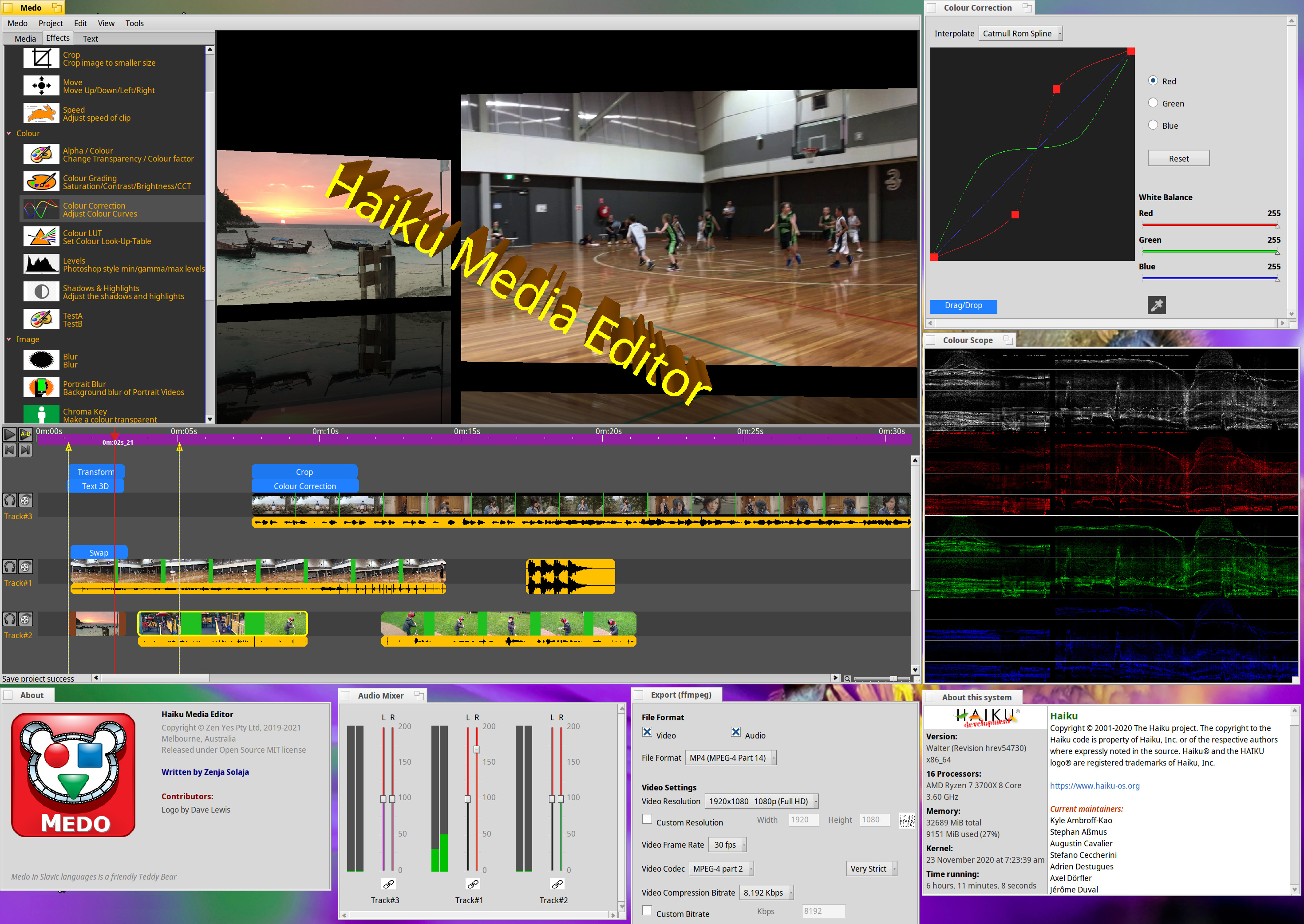
Haiku native apps, on the other hand, are smooth as ice. See this screenshot of Medo video editor where all windows are working in their own threads (https://raw.githubusercontent.com/smallstepforman/Medo/refs/...). On modern systems, this app is smooth as ice, which for a video editor is heresy. Disclaimer: I wrote the linked Haiku app.

Re: QNX is now free for anything non-commercial, plus there's an RPi image

#116

QNX and BeOS were the only operating systems I tried in the early '00s that could make old single-core mid-90s Pentiums feel excellent and snappy to use. Far, far better than any Windows version, or Linux. I assume it's mostly scheduler stuff and much better multimedia stacks, in both cases. I always hoped the operating systems of the future would feel more like that. Closest we've got is probably iOS and it cheats b…

iOS has very strict process/resource management because it wants to preserve both available RAM (for responsiveness) and your battery life. I wouldn't call it cheating (even in jest); it's a very deliberately and carefully designed feature of the OS.

Re: QNX is now free for anything non-commercial, plus there's an RPi image

#117
What I need to know is, does it come with Solitaire using the “Giants of Computing” card deck?

Because if it does, that is worth it right there.

We ran QNX for ASI statistical multiplexing in TV. I would always fire up a game while waiting for logs.

Re: QNX is now free for anything non-commercial, plus there's an RPi image

#118
Why would I use QNX for any project when RTOS Linux is mature? Why would I care? So you can rug-pull license changes?

Should I use it because it's cute? It's academically interesting? Sure, I've used QNX in the past for those reasons. The next time I pick a soc for a project, and its associated bsp, I'm not going to look for QNX. I'm either going to use whatever freertos distro they include or install the android build tools so i can push an apk to its wackity ass android fork.

I suppose if i was doing automotive or medical, the story would be different. But I know the space well enough to know that you have many competitors all nipping at your heels, and with the linux rtos changes, it's not going to get better.

This is not 2010. There are options. While QNX has languished behind obscure and annoying licensing requirements, literally dozens of companies have been developing alternatives. Some of them are quite big, and in some cases, have gone to space.

At this point, if you want QNX to be taken seriously, you're going to have to do better than "start opening the doors to QNX like things used to be".

I'll take it one step further - if it's not completely open source for commercial use, I have no interest in using it. I could be enticed to put up with an Epic-style license if the associated tooling and bsp support was worth my time. I have zero interest in paying a license to get started. Again - not 2010.

Your product has been commoditized and now it's a curiosity. The only way it gets enough active development and adoption is if its a community effort.
Re: QNX is now free for anything non-commercial, plus there's an RPi image

#119

Why would I use QNX for any project when RTOS Linux is mature? Why would I care? So you can rug-pull license changes? Should I use it because it's cute? It's academically interesting? Sure, I've used QNX in the past for those reasons. The next time I pick a soc for a project, and its associated bsp, I'm not going to look for QNX. I'm either going to use whatever freertos distro they include or install the android bui…

Amen
Post reply on HN