Live data from Hacker News

Averaging is a convenient fiction of neuroscience

thetransmitter.org

31–40 of 110 posts

Re: Averaging is a convenient fiction of neuroscience

#31
post #25
post #3

All models are convenient fictions. I heard a neuroscientist once describe averaging as a low-pass filter. People know it hides high-frequency dynamics. But unless you have a way to interpret the high-frequency signal, it looks an awful lot like noise.

> But unless you have a way to interpret the high-frequency signal, it looks an awful lot like noise. In other words, they're looking for their lost keys under the lamp-post because it's easier there. If there is a signal in the HF, it's not yet understood. This feels like "junk DNA" -which is I believe receiving more attention than the name suggests.

> they're looking for their lost keys under the lamp-post because it's easier there

This is a strange criticism. If you're looking for your keys in the dead of night, and there is a lamp post where they might be, you should start there.

The streelight effect criticises "only search[ing] for something where it is easiest to look" [1]. Not searching where it's easiest in all cases.

In this case, we know averaging destroys information. But we don't know to what significance. As the author says, "we now have the tools we need to find out if averaging is showing us something about the brain’s signals or is a misleading historical accident." That neither confirms nor damns the preceding research--it may be that averaging is perfectly fine, hides some of the truth that we can now uncover or is entirely misleading.
[1] https://en.wikipedia.org/wiki/Streetlight_effect

Re: Averaging is a convenient fiction of neuroscience

#32

As a computer scientist, I was blown away the first time my friend explained to me that his research focused on the timing of neuron spikes, not their magnitude. After talking about it for a while I realized that machine learning neural networks are much closer to simple early models of how neuron's work (averages and all), not how neuron's actually signal. Makes sense when you consider how the latest LLM models have…

Yes and no. An alternate perspective is that the output of each neuron in an artificial neural net is analogous to an F-I curve in a real neuron (spike frequency-input DC current curve). In this way, different neurons have different slopes and intercepts in their FI curves, just as a network of ANN neurons effectively have their activation functions tweaked after applying weights.

I usually only say this to other neuroscientists who have a background in electrophysiology. The analogy isn't perfect, and is unnecessary to understand what ANNs are doing, but the analogy still stands.

Re: Averaging is a convenient fiction of neuroscience

#33
post #18

Earlier quoted context omitted.

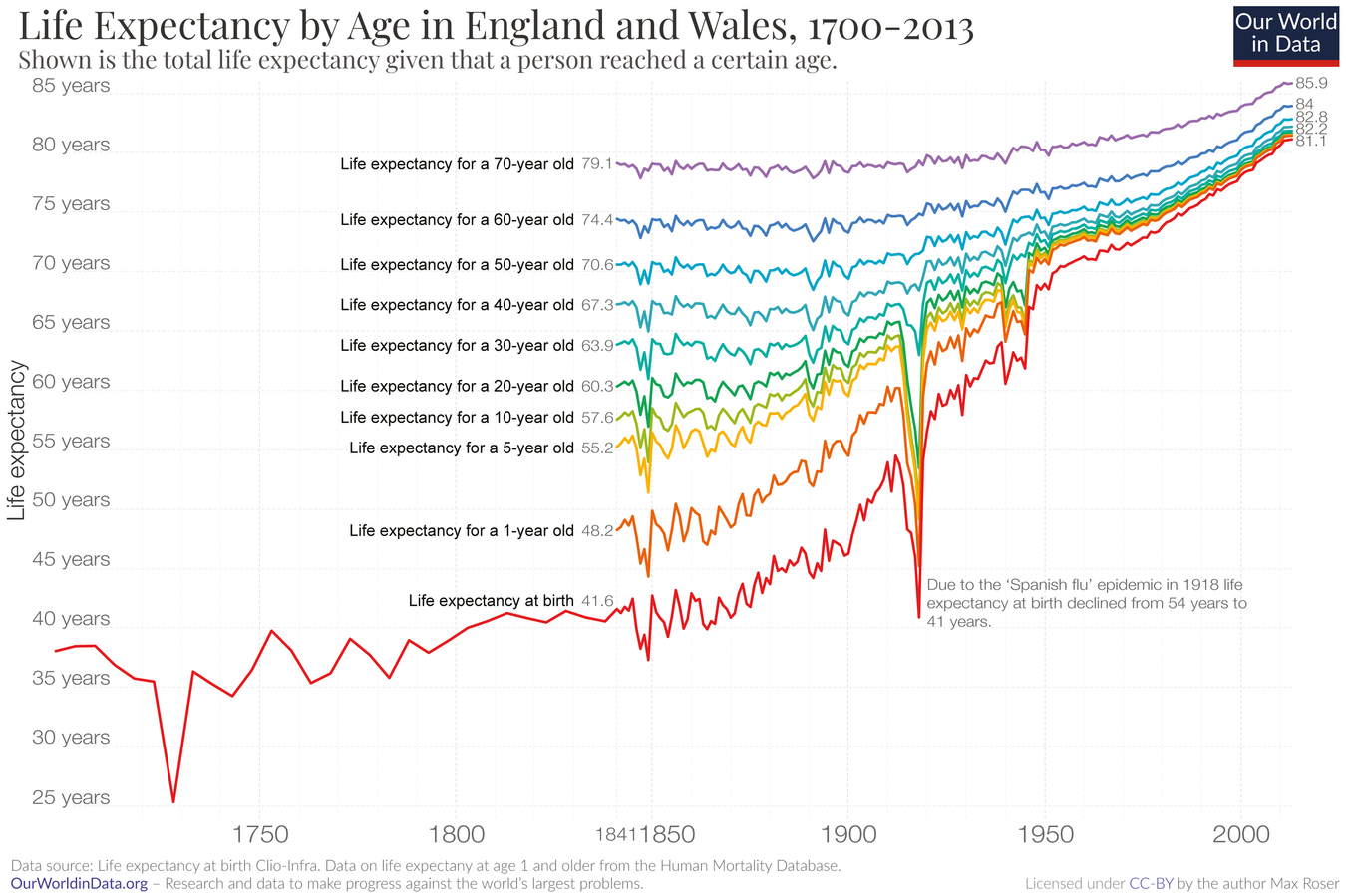
> In reality the modal life expectancy of adults (most common age of death other than 0) has been pretty stable in the 70s-80s range for most of human history- the low average was almost entirely due to infant mortality. This isn't true: https://ourworldindata.org/its-not-just-about-child-mortalit...

It mostly is. The biggest gains are in childhood. Aldo consider that you’re looking at figures for England and Wales, which isn’t necessarily representative. The largest contribution to improving life expectancy is measured by reductions in child mortality. The factors that drove those improvements (infection control, improved hygienic practices, food quality, regulation of food and drug purity, medicine) benefited e…

From the nice graph at: https://ourworldindata.org/images/published/Life-expectancy-...

In 1850 a 0 year old would expect to live to 41.6 years. A 5 year old would expect to live to 55.2.

If we waved a magic wand and let all infants survive past childhood with nothing else changed in 1850 life expectancy would still be 27 years lower than it is today. Or put another way you'd have the same life expectancy as someone in South Sudan or Somalia.

Re: Averaging is a convenient fiction of neuroscience

#34
post #33

Earlier quoted context omitted.

It mostly is. The biggest gains are in childhood. Aldo consider that you’re looking at figures for England and Wales, which isn’t necessarily representative. The largest contribution to improving life expectancy is measured by reductions in child mortality. The factors that drove those improvements (infection control, improved hygienic practices, food quality, regulation of food and drug purity, medicine) benefited e…

From the nice graph at: https://ourworldindata.org/images/published/Life-expectancy-... In 1850 a 0 year old would expect to live to 41.6 years. A 5 year old would expect to live to 55.2. If we waved a magic wand and let all infants survive past childhood with nothing else changed in 1850 life expectancy would still be 27 years lower than it is today. Or put another way you'd have the same life expectancy as someone…

Sounds like we mostly agree, save some pedantry.

Nobody waved a wand. The contaminated milk that killed infants killed adults too - alcohol and milk were alternatives to unsafe water. Public health, medicine and other factors improved things.

We don’t really have great stats from before the 19th century. Was 1850 a nadir in life expectancy? I’m not sure - but I suspect it varied by region and rural/urban conditions. 1750 NYC wasn’t as gross as 1850.

Re: Averaging is a convenient fiction of neuroscience

#35
post #7

I've become increasingly convinced that the idea of averaging is one of the biggest obstacles to understanding things... it contains the insidious trap of feeling/sounding "rigorous" and "quantitative" while making huge assumptions that are extremely inappropriate for most real world situations. Once I started noticing this I can't stop seeing this almost everywhere- almost every news article, scientific paper, etc.…

I was at the Denver museum’s mummy exhibit and disturbed to see that they said the lady died at 30, a “normal age for death in those times”. You would think a museum should know better.

https://aeon.co/ideas/think-everyone-died-young-in-ancient-s...

Re: Averaging is a convenient fiction of neuroscience

#36
post #7

I've become increasingly convinced that the idea of averaging is one of the biggest obstacles to understanding things... it contains the insidious trap of feeling/sounding "rigorous" and "quantitative" while making huge assumptions that are extremely inappropriate for most real world situations. Once I started noticing this I can't stop seeing this almost everywhere- almost every news article, scientific paper, etc.…

> In reality the modal life expectancy of adults (most common age of death other than 0) has been pretty stable in the 70s-80s range for most of human history-

I am pretty sure this is wrong. East Asian cultures celebrate 60th birthday as becoming very elderly, and if you live to the 70s it's almost as if you achieved Buddhahood.

Re: Averaging is a convenient fiction of neuroscience

#37
post #21

As a computer scientist, I was blown away the first time my friend explained to me that his research focused on the timing of neuron spikes, not their magnitude. After talking about it for a while I realized that machine learning neural networks are much closer to simple early models of how neuron's work (averages and all), not how neuron's actually signal. Makes sense when you consider how the latest LLM models have…

In many, perhaps most, signalling pathways, amplitude doesn't matter much (it does at log-scale). Given how well we control temperature and therefore rate of the reaction, it makes sense to use timing to fight off the noise.

Put another way, there is a reason why FM radio sounds much better than AM radio.

https://www.youtube.com/watch?v=AzvxefRDT84

Re: Averaging is a convenient fiction of neuroscience

#38
post #33

Earlier quoted context omitted.

From the nice graph at: https://ourworldindata.org/images/published/Life-expectancy-... In 1850 a 0 year old would expect to live to 41.6 years. A 5 year old would expect to live to 55.2. If we waved a magic wand and let all infants survive past childhood with nothing else changed in 1850 life expectancy would still be 27 years lower than it is today. Or put another way you'd have the same life expectancy as someone…

Sounds like we mostly agree, save some pedantry. Nobody waved a wand. The contaminated milk that killed infants killed adults too - alcohol and milk were alternatives to unsafe water. Public health, medicine and other factors improved things. We don’t really have great stats from before the 19th century. Was 1850 a nadir in life expectancy? I’m not sure - but I suspect it varied by region and rural/urban conditions.…

>Sounds like we mostly agree, save some pedantry.

If by pedantry you mean that I'm not ignoring the cause of 70% of the improvement in life expectancy in the last 200 years then sure.

Re: Averaging is a convenient fiction of neuroscience

#39

Great note Mark. I agree. Action potentials are noisy beasts but much may be hidden in spike time coding that is obscured by averaging. There is an even lower level problem that deserves more thought. What timebase do we use to average, or not. There is no handy oscillator or clock embedded in the cortex or thalamus that allows a neuron or module or us to declare “these events are synchronous and in phase”. Our notio…

> There is no handy oscillator or clock embedded in the cortex or thalamus that allows a neuron or module or us to declare “these events are synchronous and in phase”.

Brains waves drive synchronization of groups of neurons, lower frequencies broader, higher frequencies more localized.

Re: Averaging is a convenient fiction of neuroscience

#40
post #7

I've become increasingly convinced that the idea of averaging is one of the biggest obstacles to understanding things... it contains the insidious trap of feeling/sounding "rigorous" and "quantitative" while making huge assumptions that are extremely inappropriate for most real world situations. Once I started noticing this I can't stop seeing this almost everywhere- almost every news article, scientific paper, etc.…

Your beef appears to be with simple averages, not averaging per se.

The average for life expectancy is the mean of the Gompertz distribution [1]. Specifically, one that is "left skewed and with a flattened slope for ages under 50 years for men and 60 years for women," which proceeds to become "more right skewed and leptokurtic" as age increases [2].

So a simple average in the 55 domain it would overestimate it. Which is almost comically problematic when comparing ancient societies that had a median age below that level to modern ones above it.

> the modal life expectancy of adults (most common age of death other than 0) has been pretty stable in the 70s-80s range for most of human history

Not quite. 63 in 1900 to 83 in 2000 (in Sweden). Bigger differences when you go further back.

[1] https://en.wikipedia.org/wiki/Gompertz_distribution

[2] https://www.ncbi.nlm.nih.gov/pmc/articles/PMC2652977/

[3] https://www.ncbi.nlm.nih.gov/pmc/articles/PMC3000019/ Figure 1

Post reply on HN