Live data from Hacker News

Escaping from Anaconda's Stranglehold on macOS

paulromer.net

31–40 of 286 posts

Re: Escaping from Anaconda's Stranglehold on macOS

#31
post #17

Earlier quoted context omitted.

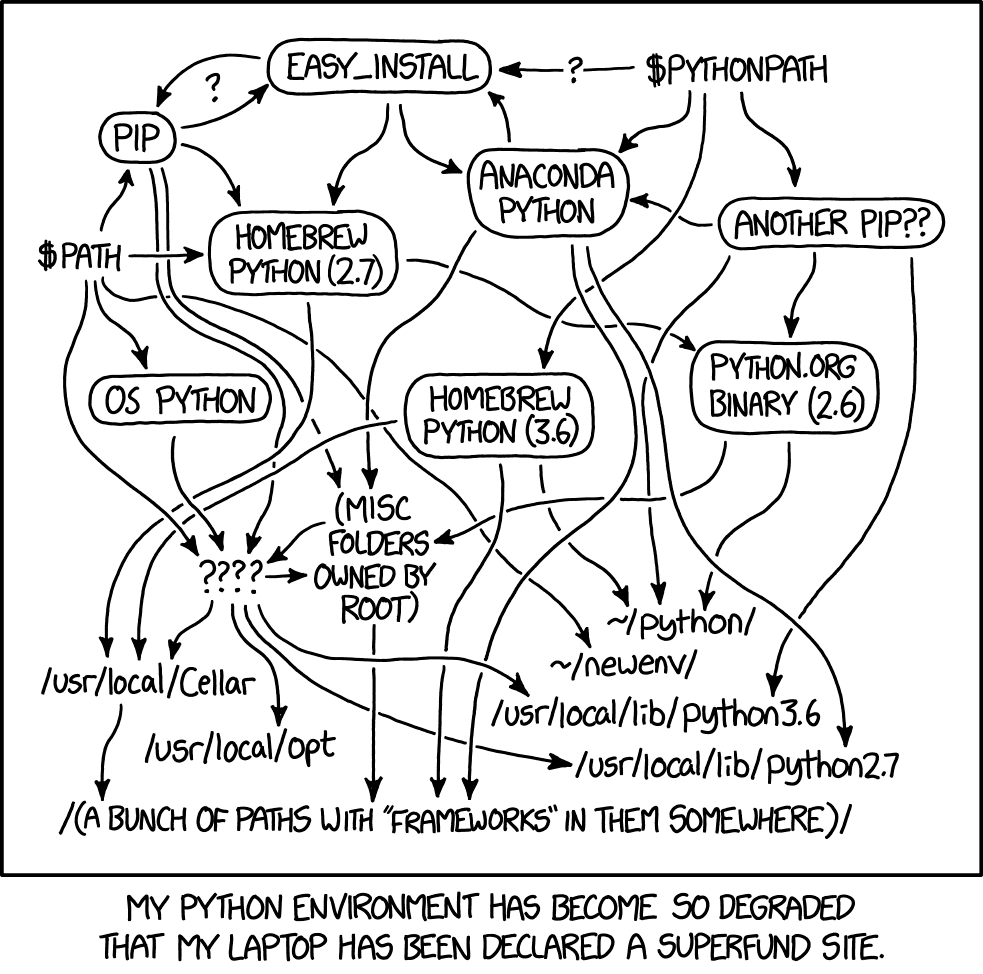
Whatever project solves Python dependency management deserves to get a Nobel in Economics for saving humanity billion of hours per year.

Usually I simply use pip and poetry. Haven't run into an issue in a long time. Privately I use Guix often, when it has the required packages. I find the dependency management mostly to be already solved. Perhaps I am not riding along the edge enough, to see things broken.

Poetry does a lot of good stuff: lock file, dev dependencies (and other customizable groups), easy to use virtual env, dependencies pulled directly from git.

I do not recommend pip in serious projects, as it lacks the above. Here's things that I've seen:

- add dependencies and not save them in the requirements file - forget to activate cenv and install packages globally - different package versions across deployments due to absence of lock file - main dependencies mixed with dev dependencies
Re: Escaping from Anaconda's Stranglehold on macOS

#32
post #28

This is insane lmao. Why not just edit out the line that added into your .zshrc (or by extension the .bashrc) instead of running through all these complicated GUI specific things just to basically rename the file so that ZSH doesn't load it when it runs a shell??? This is exactly why you should learn to use your tools properly, learn just a tiny tiny tiny bit of posix shell (which works for ALL posix shells sh, tcsh,…

While I agree in principle, this is a professor sharing as foolproof a method as he can find to get many students, whose existing knowledge, setup, and CLI avoidance he can't control, to the meat of the course experience he has designed for them.

Re: Escaping from Anaconda's Stranglehold on macOS

#35
This is really elegant. What a nice solution; single-step and reversible.

It’s also excellent documentation, written by someone who clearly knows their audience. It keeps all operations in GUI-land, which most users consider more safe. It avoids almost all technical explanations.

Folks responding with “Terminal is easier” are missing context. You’re not the audience. The fact that you can come up with seven solutions for this proves that :)

Re: Escaping from Anaconda's Stranglehold on macOS

#36

You can just keep Anaconda and just use it as a pyenv replacement, e.g.: conda create -n "myenv" python=3.8 conda activate myenv Then just use pip in your environment, if you don’t like conda packages. Not sure what the paragraph about being able to install multiple Python versions after getting rid of Anaconda is about.

That's installing another 3.8 rather than using the system one, isn't it?

Re: Escaping from Anaconda's Stranglehold on macOS

#37
My takeaway from this article is that Paul Romer doesn’t know how to use the environment feature in anaconda. If he has a problem with dependency resolution speed, ‘conda install mamba’ will solve that.

But really, for his use cases, he should be using Julia (for DSGE modeling) or else R for stats.

Still, I applaud his willingness to try new things, if more economists were like him, we might finally break the stranglehold of stata and matlab in econ.

Re: Escaping from Anaconda's Stranglehold on macOS

#38
post #18

I collaborate with people that use macOS while I use Linux. For reproducible environments, Nix has served us well. Despite the myth, it is not hard to use unless you need to package something complicated or messy. Then it may become hard. The advantage of Nix is total version reproducibility and declarativeness. It's quite reassuring to know things are exactly the same on all computers.

It’s not a myth, Nix is incredibly complicated to get into and is actively hostile towards its users with the abysmal DSL and documentation. Every company we’ve tried to introduce it in has failed to adopt it primarily due to its incredibly steep learning curve

Re: Escaping from Anaconda's Stranglehold on macOS

#39
post #38
post #18

I collaborate with people that use macOS while I use Linux. For reproducible environments, Nix has served us well. Despite the myth, it is not hard to use unless you need to package something complicated or messy. Then it may become hard. The advantage of Nix is total version reproducibility and declarativeness. It's quite reassuring to know things are exactly the same on all computers.

It’s not a myth, Nix is incredibly complicated to get into and is actively hostile towards its users with the abysmal DSL and documentation. Every company we’ve tried to introduce it in has failed to adopt it primarily due to its incredibly steep learning curve

It is quite complicated to understand or to set up, yes, but I agree that it is easy to use. We use it at work for our dev environments. Like two or three of us are able to actually add packages, adjust nix configs, etc. Everyone else just runs `direnv allow` and automatically gets everything they need to build and run out software.

Re: Escaping from Anaconda's Stranglehold on macOS

#40
post #9

Earlier quoted context omitted.

It sounds like they want to be able to restore it too. And the Terminal is harder to use than a graphical step by step guide.

This guide requires holding down arcane secret key combination, this is not remotely normal way to do anything, and prevents people from learning basic system commands every programmer needs to know. Also, “mv ~/.zsh ~/zsh-anaconda”.

His audience is not programmers.
Post reply on HN