Live data from Hacker News

Can solar costs keep shrinking?

unchartedterritories.tomaspueyo.com

271–280 of 632 posts

Re: Can solar costs keep shrinking?

#271
post #187
post #168

Earlier quoted context omitted.

'too cheap to meter' was always nonsense and is nonsense now. the only time you're getting unmetered energy is if you have so much distributed generation and storage that transmission is unprofitable to build except for unusual cases. for example, most people with a household solar system with storage have unmetered energy during the day the numbers you saw for solar in 01975 were wrong, based on at most five years o…

Hi Kragen, small world! At an individual scale, I think plan B is pretty much always a small tri-fuel generator. At a society scale, it's probably a natural gas turbine. If batteries continue to follow their own price curve down, storage may well be a viable answer to 95%+ dunkelflautes at some point in our lifetimes. I'm curious about the land use analysis and the embodied energy. Given the capacity factor inherent…

hey, nice to be in touch! i haven't done much lately with sip

not just in our lifetimes; within a decade

as for embodied energy, the energy payback time on solar panels has been on the order of a few months to a year or two for decades now; see https://iea-pvps.org/snapshot-reports/snapshot-2024/ for a comprehensive overview, http://www.mdpi.com/1996-1073/9/8/622/htm for a detailed analysis from 02016, or https://www.nrel.gov/docs/fy05osti/37322.pdf for an easily digestible but outdated explanation from 02004. you're right that it depends on capacity factor! according to https://www.spglobal.com/marketintelligence/en/news-insights... the capacity factor across the border from you in kentucky is better than 25%, which is about as good as you can expect anywhere, but in much of your area only 10–15%, so you might need to multiply those payback times by as much as 2. https://atb.nrel.gov/img/electricity/2021/p19/v1/solar-annua... provides more detailed ghi (global horizontal irradiance) data for the usa which makes it look like it ought to be more like 20%. i'd be very interested in actual numbers by us state
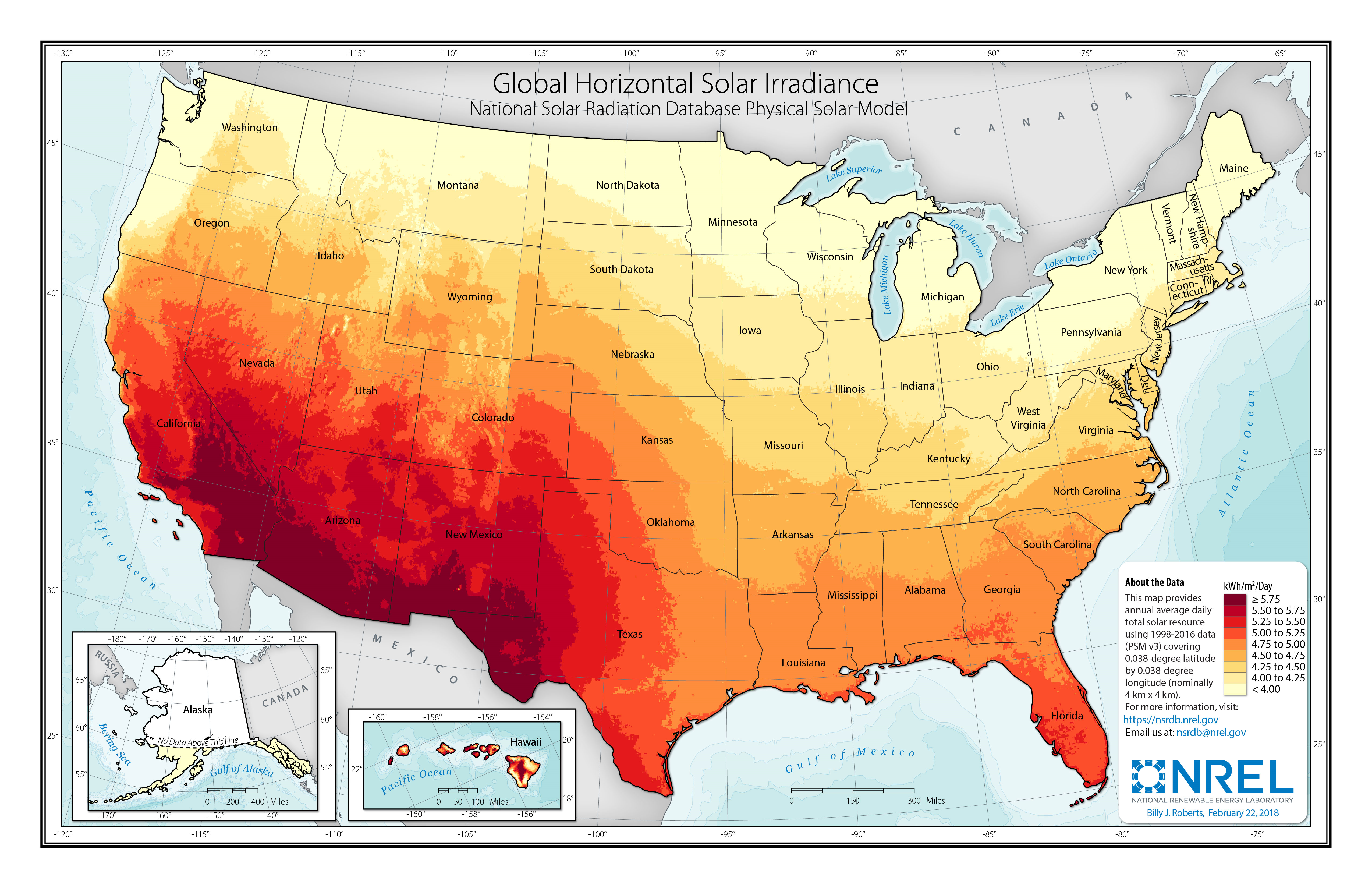
batteries use an insignificant amount of land, but probably overprovisioning of solar production is cheaper than batteries until you get into those 95th percentiles you're talking about. so probably we're talking about something like 10× the land use for solar panels that would be needed to meet demand on average? it depends a lot on how much demand flexibility there is; will dunkelflaute electrical grid demand be 20% of average grid demand, 2%, or 0.2%? that's a question that depends on things like what new designs people come up with for aluminum smelters and haber-bosch fertilizer plants, which is impossible to anticipate ahead of time

Re: Can solar costs keep shrinking?

#272

Earlier quoted context omitted.

Bahrain and UAE being big aluminum smelters is a bit surprising.

Exporting aluminum is basically exporting electricity, except aluminum is easy to ship, costs very little to store, and has an indefinite shelf life. For places with a lot of natural gas and no pipelines to export it, it’s often easier to export aluminum than liquified gas.

if you're burning it in aluminum-air fuel cells, it can be literally exporting electricity. right now that isn't a commercial-scale activity, but possibly it will become profitable in the coming years for places with a lot of solar power and no hvdc lines to export it

Re: Can solar costs keep shrinking?

#273
post #268

I spend four months of the year traveling in an RV. Two years ago, I budgeted over $6000 for my desired solar setup (at least 1200Ah of battery, at least 2400W of solar, plus various controllers and other components). It was expensive enough for me to hold off, and more importantly, I didn't have the space on my current RV for the solar panels. In just the two years since then, prices on batteries and panels have dro…

I think RVs that you can live/remote work in while traveling are interesting. (I'm speaking about large class A RVs like an apartment with washer/dryer etc...) But as solar becomes more prevalent, I don't see why they don't design RVs more around solar. It has only been recently that I've seen "all electric" type RVs. Before that, most RVs were hybrid propane/electric or diesel/electric, for example gas stoves, dual…

I do well in my tiny (20') RV for four months a year. It was a little cramped when I had a girlfriend with me, but still cozy. This is my third summer doing this. The first two summers, I wasn't working. This summer I'm working full-time remote (dev). It has its challenges. I plan to upgrade to a much larger 5th wheel trailer, likely in two years, with all the creature comforts you mention.

Part of the reason solar is still a fringe thing for RVs is due to the costs up till now. Another big reason has been solar panel energy density; there simply wasn't enough room on the roof for the thousands of watts you need to generate for true full-time off-grid living with all the creature comforts (most notably air conditioning). Affordable, compact DC-powered refrigerators are still new (but are becoming standard items). Battery cost used to be prohibitive, and battery weight is still a problem. The 1200Ah I'm targeting (at minimum) is going to weigh a few hundred pounds.

If you want a residential-sized fridge, washer/dryer, and air conditioning that you can use 24/7, you need more like 3200W of solar and 2400Ah of battery. The larger the RV, the more expensive it is to cool. RVs have crap insulation, and most RVs are used in hotter southern areas. True self-sufficient electric and solar with no behavioral/comfort sacrifice still requires a lot of space and costs a lot.

The market is headed toward more solar, but the kind of setup you're talking about (and that I'm building for myself) is still quite expensive. And it's a huge cost for people that don't typically need it; the vast majority of people full-timing in RVs are content to do so at a sardine-packed RV park with full hookups. The market isn't going to bear the cost of massive solar installations as standard equipment.

Re: Can solar costs keep shrinking?

#274
One thing that is often forgotten is the difference between the cost of electricity at the power plant, and the price of electricity in the power plug in the household. The difference is that the grid provides constant electricity at 60Hz 24/7.

Solar is much cheaper to produce, but there are many challenges to get a reliable grid. Big centralized power plant that have huge turbines with kinetic energy are much easier and cheaper to handle on the grid than a distributed intermittent production where you somehow need to convert to 60Hz and add storage that has quite some loss.

Re: Can solar costs keep shrinking?

#275

Earlier quoted context omitted.

Same - take lightbulbs for example. Thanks to LEDs, the amount of energy you need to generate X amount of light has reduced considerably, but we still have as much if not more lighting than ever. And it's not like our GDP is suffering due to a lack of sufficient lighting, at a certain point there's no gain to productivity gained from having another lightbulb. Same thing can be said about cars, CPUs etc.

It is a curious assertion for sure, but the next wave of AI will be throttled by a few factors: chip fab capacity, water supply to cool data centers, and electricity to power the chips/servers. Look at what is happening with xAI in Memphis where they are illegally running a dozen turbine generators to power their new AI data center since they can't get enough supply off the grid.

It may be throttled by energy supply and water supply at a desirable site, but not by country-level energy costs and water costs, which is all this blog post is looking at.

Re: Can solar costs keep shrinking?

#276
post #120

Earlier quoted context omitted.

Same - take lightbulbs for example. Thanks to LEDs, the amount of energy you need to generate X amount of light has reduced considerably, but we still have as much if not more lighting than ever. And it's not like our GDP is suffering due to a lack of sufficient lighting, at a certain point there's no gain to productivity gained from having another lightbulb. Same thing can be said about cars, CPUs etc.

Think it’s meant more as a broad generalization than something that is always true. Many physical things take pretty fixed amounts of energy. Eg heating a liter of water.

Even with water heating moving to a heat pump lets you do it using less input energy because you are taking heat from the environment

Re: Can solar costs keep shrinking?

#277
post #2

I'm having a hard time getting past the assumption in the article that energy use is tied directly to GDP per capita and that by not following the 7% growth of the Henry Adams Curve we're somehow below where we should/could be as a country. That embeds so many assumptions about the economy and where GDP comes from, the decoupling seems more likely to be from the transition from manufacturing and other energy heavy se…

You need energy to make things. Houses, roads, cars, food, many services. Basically without energy you are poor. Having energy is not enough, but it is necessary to be rich.

Having more things certainly is good for GDP. But I don't know about you, but I'm pretty saturated on things already, with a bunch of stuff that I've purchased and barely use.

Perhaps this comes down to a quality of life vs GDP per capita not being identical. While I could use more energy to consume more, I don't have a very strong desire to go much above my current level of consumption.

But outside of the wealthy there is still huge latent demand for energy and what comes with it.

Re: Can solar costs keep shrinking?

#278
post #158

Earlier quoted context omitted.

What is the point of citing theoretical values like LCOE when we have direct practical information on predicted profitability? Energy producers in Texas are are adding 8x as much solar capacity (24 GW) as natural gas capacity (3 GW) [1] over 2024-2025. Do you believe that the entire Texas power plant industry is deliberately choosing less profitable and capital inefficient generation? That could be the case, they may…

Is it a free market though? Or are solar, wind, etc being funded by the government? Or is gas being taxed in a way that solar is not (yet)?

Since fossil fuels are not being charged the full cost of their negative externalities, no it's not a free market.

Re: Can solar costs keep shrinking?

#279
post #187
post #168

Earlier quoted context omitted.

'too cheap to meter' was always nonsense and is nonsense now. the only time you're getting unmetered energy is if you have so much distributed generation and storage that transmission is unprofitable to build except for unusual cases. for example, most people with a household solar system with storage have unmetered energy during the day the numbers you saw for solar in 01975 were wrong, based on at most five years o…

Hi Kragen, small world! At an individual scale, I think plan B is pretty much always a small tri-fuel generator. At a society scale, it's probably a natural gas turbine. If batteries continue to follow their own price curve down, storage may well be a viable answer to 95%+ dunkelflautes at some point in our lifetimes. I'm curious about the land use analysis and the embodied energy. Given the capacity factor inherent…

The societal solution for Dunkelflauten remains using turbines, but the gas burned switches from fossil natural gas to green hydrogen.
Post reply on HN