Earlier quoted context omitted.
Native look&feel makes for a consistent UX across apps. Users learn one set of conventions and UI controls that uniformly applies to all applications. In addition, all applications benefit from enhancements made to the native UI toolkit and integration with the OS (input methods, file dialogs, keyboard navigation, automations, …). Moreover, web UIs tend to be less sophisticated and less power user friendly, due to HT…
I don't personally believe it's ever been true that users want the same UI styling across apps. When given the option to customize the colors or layout of an app, users will do that. People want their applications to follow common UI patterns, but applications should have some kind of personality to them, otherwise they just look like Microsoft or Apple products
Clojure Desktop UI Framework
71–80 of 139 posts
Re: Clojure Desktop UI Framework
#72Re: Clojure Desktop UI Framework
#73Re: Clojure Desktop UI Framework
#74The readme says it is aiming for a “web look”, with no intention to make it look — and, presumably, behave — native. As a user, that’s not what I expect and hope for from a desktop application.
Professional software (think Clip Studio Art, 3DS Max, Autodesk Fusion and alike) are almost exclusively disconnected from "native" looks, behavior and theming, which is perfectly fine, better than having a different experience depending on your OS. I feel like it's mostly consumers who ask for native look, and particular users on macOS, as almost all other professional-oriented software doesn't offer that. But yet i…
I don't even think native macOS UI is so great cross-plat programs should target it. It's full of its own weird conventions like a "New item" button being a tiny "+" at the bottom of the left sidebar, the last place I always look.
Safari is an example of UX that has stuck to hard macOS conventions and was always worse off for it. Not until recently did it begin relenting, and now it's bearable to use as a daily driver. Xcode is another classic example of hostile native macOS UX conventions. Finder.app is another.
I'd rather software ask "what's the UX that makes the most sense?" rather than "how can I make my UI look native?" On HN people seem to think by solving the latter, you solve the former. But that isn't the case.
Re: Clojure Desktop UI Framework
#75Earlier quoted context omitted.
At this point it feels like this argument is dead an buried. So many non-native apps on every platform, most platforms even have multiple official GUI toolkits/widget styles so even first party apps are inconsistent.
The most consistently-looking desktop I have runs under Linux. With a few settings and a right theme, all GTK2, GTK3, Qt, and Java apps look and feel pretty much the same, in a pleasant way. MacOS is a close second, with a few native apps that can't decide exactly what a checkbox or a button should look like. And Win10 on my wife's machine is a salad, reminding me of Linux desktop experience from 1998.
This is pretty funny, because if you just use Gnome apps + desktop environment, you have a consistent experience. But if you only use Microsoft/Windows GUIs, panels and applications, it nowhere near as consistent.
So even the Gnome team can build better UI and UX than Windows themselves can, pretty telling.
Re: Clojure Desktop UI Framework
#76Does anyone close to the project know when/if it will no longer be in "No docs, and everything changes every day" release status?
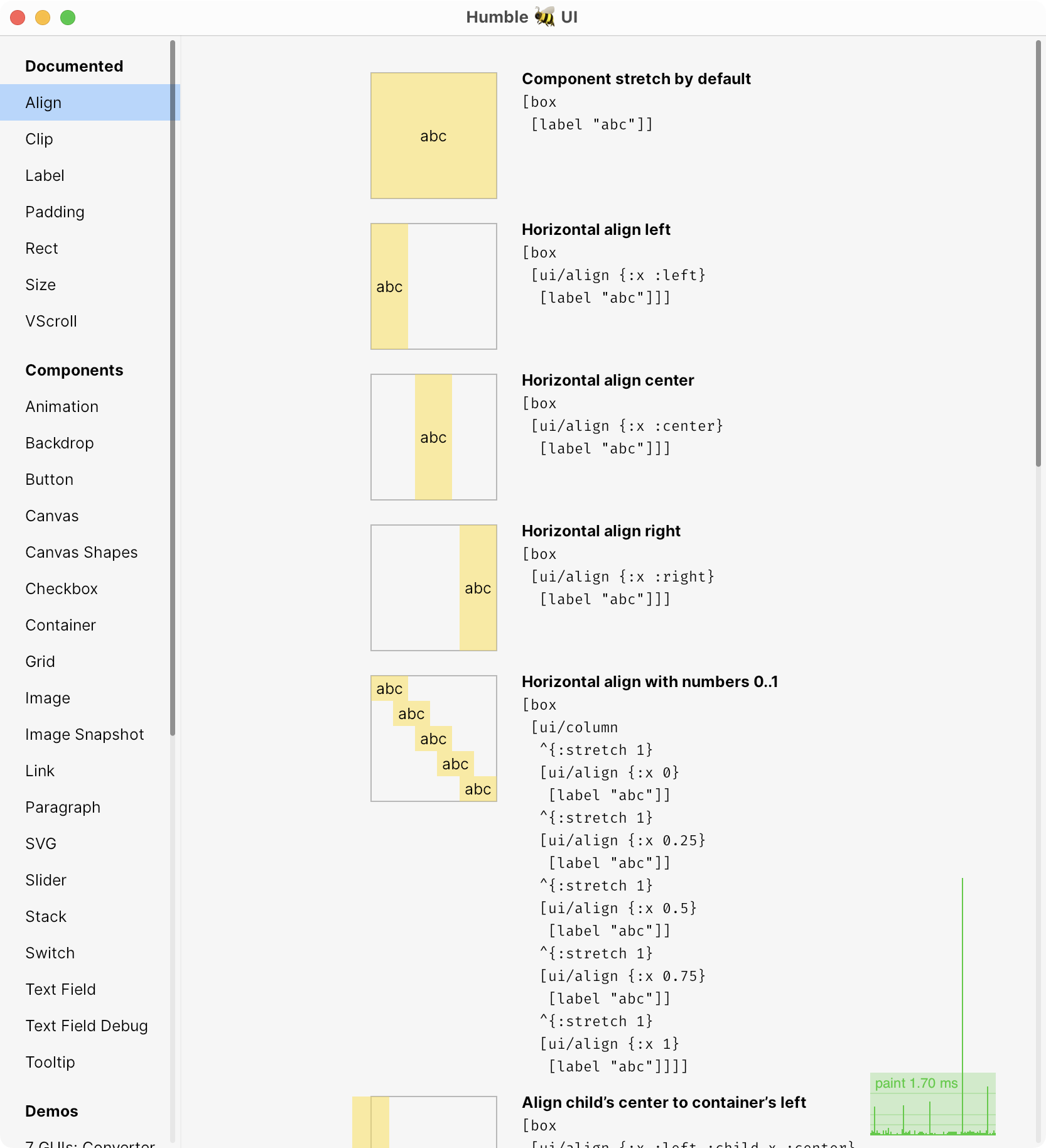
https://s.tonsky.me/share/Screenshot%202024-08-27%20at%2017....
Re: Clojure Desktop UI Framework
#77Question about native integration. Does the framework support documents on a native level? Can I define a file type that opens the app when double clicked, maintaining the windows and data, etc?
Re: Clojure Desktop UI Framework
#78I'm sure Clojure is a great language for some tasks... But, looking at the examples (picked the Wordle one since I know that game): https://github.com/HumbleUI/HumbleUI/blob/main/dev/examples/... I find it extremely hard to read. Even small snippets, say line 56 to 74 which define this "color", "merge-colors" and "colors"... then the "field" one lines 76 to 117 is even harder. is it more natural read for people famil…
I think it’s just a familiarity thing. Clojure is different from most languages in that it’s a lisp and it’s immutable-first functional. That gives it a bit of a learning curve compared to other languages, but I find other simpler languages quite dificulte to read until I’m familiar with them, too.
Re: Clojure Desktop UI Framework
#79where did the myth that people prefer apps that look native to the platform come from? There are two types of apps: 1. the ones that professionals use and 2. the ones that consumers use. for 1. they don't care if it looks native, as long as it works and is performant e.g. DAWs, Video Editing tools, Trading, etc. 2. likewise I don't think it matters that much. my guess is the myth came from OS makers.
When apps have native look and feel, they have consistent behaviour, affordances and accessibility: - buttons are labeled and placed correctly, and respond to expected input (including secondary focus and secondary action on MacOS, for example) - dropdowns/selects behave correctly, and respond to expected input (for example, you can type to select in MacOS dropdowns). - windows have OS-defined areas for drag/resize,…
Re: Clojure Desktop UI Framework
#80The readme says it is aiming for a “web look”, with no intention to make it look — and, presumably, behave — native. As a user, that’s not what I expect and hope for from a desktop application.