Live data from Hacker News

Mourning and moving on: rituals for leaving a career (2014)

franceshocutt.com

41–50 of 132 posts

Re: Mourning and moving on: rituals for leaving a career (2014)

#41
post #17

Earlier quoted context omitted.

Leaving academia is like this. It's very sticky and scary to leave. I remember how devastating it was for me. I think it's because there's a very strong sense of a missed dream, and that you can never return.

I feel the need to point out that it's not difficult for people whose identity is not centered around their jobs, since I see that disconnect in the comments. I found the author's take full of the pageantry that I often associate with people who make big deals out of fairly inconsequential things, but before I begrudge the author their take, I have to remember that my career is of relatively little importance to me.…

In the 19th century you had the same job for life. If you were a blacksmith you stayed a blacksmith and died a blacksmith in the village where you were born. Your surname was synonymous with your skill. Wheeler. Smith. Potter. Even in the mid 20th century people worked for the same company for life. The "corporate" (body) world meant something very different than today. The corporation took care of you. It paid for your health and holidays. If you were unhappy in work, it helped sort that out so you would stay. As late as the 1960s, and still for some people who work in government, and still a culture in Japan, you can get a "job for life".

"Career" means to move haphazardly. It replaced the more stable notions of "vocation" and "calling". Today you might spend a year in hospitality, a few years in sales, then do a diploma in programming, move to California, get into media design, and then open a juice bar on the beach... Everyone is at the mercy of ever swirling markets and the slings and arrows of outrageous fortune, layoffs and takeovers, new trends. Who here didn't "get into AI" in the last 2 years?

In a way that's a richer better life. It's more challenging. It is also shallower. There are less places to put down roots and grow anything worthwhile. People with active minds and a lust for life naturally outgrow scenes, groups and institutions. Moving on should be an exciting joy. What I see of America and UK now (at least here on HN) is that people are held in place by fear. We've regressed to 19th century ideas about work and life, minus the positive 'belonging'.

What I think people sometimes "grieve" is the sunk-cost spiritual investment in what they thought an institution represented. Or they found themselves in an career that is in decline. or in institutions that have decayed - and it's painful to move on. Those reasons may be emotionally noble; loyalty, fidelity to values etc. You can let go of values and of a dream. Or you can take them with you, by realising that they never belonged to any "institution" in the first place. They're yours.

Academia is definitely that place in 2024. The reality of academic life is the antithesis of human values we traditionally associate it with. If the institutions we inhabit are inflexible, ineffectual, and less than our ambitions then it's time to move on. The problem is not so much that people identify with what they "do", but where and with whom they do it. It's a strong and valuable kind of person who keeps their calling/purpose separate from their employment identity.
Re: Mourning and moving on: rituals for leaving a career (2014)

#42
post #26
post #16

Earlier quoted context omitted.

Not to highjack this topic, but she was recommended (like to many others of you no doubt) quite a bit in my Youtube feeds over the last few months; and the first few videos I watched seemed to be solid enough. Yet as I watched a few more, I couldn't shake the feeling that she's so out of left field that she's not just a 'quirky renegade' anymore, but rather a quack who dresses up her quackery with just enough 'real'…

>So my question is - just how serious should she (and others like her, who denounce 'mainstream' academia as much as those other fringe groups who go on and on about the corruption of 'mainstream' media) be taken? Anyone have an opinion on this? I know nothing about her but the video on her experience in academia is spot on. It's a pretty common experience among STEM academics. You will face the point where you have…

Can I ask what you mean with "pretty common"? Do you think more than half of all STEM graduate students had a similar experience as she did? Do you have actual data to support this?

I am asking this because HN neems to be so much more negative of academia than what I am seeing around me.

More generally I think it is worth stressing that any site like this can be a terrible echo chamber at times. Generally there are smart people here, but on some topics I suspect that the consensus could be completely misguided.

Re: Mourning and moving on: rituals for leaving a career (2014)

#44

Earlier quoted context omitted.

As an expert in at least some of the things Sabine makes videos about (string theory), Sabine is a contrarian who, if you are not otherwise an expert on what she is talking about, it would be best to avoid. Sabine, like many contrarians, takes advantage of the fact that there are smart and convincing criticisms of many mainstream ideas, and she does her best to rely on those criticisms. However like all contrarians s…

As another 'mainsteam' academic with relevant expertise I think this comment is spot on. I would like to add that Sabine's video on her academic experience was quite a tragic thing to watch. If her allegations are true then the behavior of her PhD supervisor was completely outrageous. She also did seem a bit too dreamy-eyed about academia. Sure you can criticize everything you want, but she never seemed to have under…

I certainly am not making any comments about her experiences for sure! Academia is difficult and full of terrible stories, and its not surprising that it causes many people to become exceedingly bitter and contrarian (Peter Woit is famously of the same ilk as another string theorist critic who fell out of academia like Sabine).

Unfortunately a chip (even a legitimately earned one) on ones shoulder about the bad parts of academia doesn't save you from being criticized for being crank-y.

Re: Mourning and moving on: rituals for leaving a career (2014)

#45
post #16

Reminds me of Sabine Hossenfelder's "My dream died, and now I'm here" https://www.youtube.com/watch?v=LKiBlGDfRU8

Not to highjack this topic, but she was recommended (like to many others of you no doubt) quite a bit in my Youtube feeds over the last few months; and the first few videos I watched seemed to be solid enough. Yet as I watched a few more, I couldn't shake the feeling that she's so out of left field that she's not just a 'quirky renegade' anymore, but rather a quack who dresses up her quackery with just enough 'real'…

I've seen similar reactions and I can't help but think she's intentionally communicating provocatively to make people engage their brains.

You shouldn't just "take her seriously", you should take what she says *critically*. Hear the information and opinions, then decide for yourself whether to accept them.

Re: Mourning and moving on: rituals for leaving a career (2014)

#47
post #16

Reminds me of Sabine Hossenfelder's "My dream died, and now I'm here" https://www.youtube.com/watch?v=LKiBlGDfRU8

Not to highjack this topic, but she was recommended (like to many others of you no doubt) quite a bit in my Youtube feeds over the last few months; and the first few videos I watched seemed to be solid enough. Yet as I watched a few more, I couldn't shake the feeling that she's so out of left field that she's not just a 'quirky renegade' anymore, but rather a quack who dresses up her quackery with just enough 'real'…

> just how serious should she... be taken?

Very seriously indeed if you value higher education and research.

Lot's of people do. Over a decade ago now, Ben Ginsberg wrote "Fall of the Faculty". Political scientists like Wendy Brown have picked apart not only the evidence, but done deep analytical work on the reasons for the disintegration of academia in the West. Even Peter Thiel (who I profoundly disagree with on almost everything) has given knock-down commentary that I find impossible to ignore on how academia went to seed, and is now unfit for teaching, learning and honest research.

From a personal perspective; I worked in universities for over 30 years. What we have now is unrecognisable from the institutions I started teaching at in the early 1990s. Almost all human values have been expunged and replaced by a puppet show of performative theatrics, led by MBA educated impostors and career administrators. It is fake to the core. I no longer recognise these places as universities. I've seen brilliant colleagues go crazy, retire early, turn to alcohol and drugs, commit suicide, or just wander off to live in the mountains and grow vegetables. I refuse to believe all those smart and dedicated people are/were "weak". Academia is a very toxic place and I would not advise any "smart and sensitive" person to go into that life if you value your health.

When you consider how much it costs a nation to educate someone to PhD level and then look at the churn and attrition, it's a massive bonfire of wealth.

I've written numerous pieces in the Times Higher on specific failings of universities, but one cannot halt a juggernaut of change with words alone. Now I am left only with curiosity at how higher education will change and what will come after.

My response has been to conduct and publish my own research independently outside the "academic system" and to start my own companies for teaching. By my standards, both are successful.

edit: grammar

Re: Mourning and moving on: rituals for leaving a career (2014)

#48
post #26

Earlier quoted context omitted.

>So my question is - just how serious should she (and others like her, who denounce 'mainstream' academia as much as those other fringe groups who go on and on about the corruption of 'mainstream' media) be taken? Anyone have an opinion on this? I know nothing about her but the video on her experience in academia is spot on. It's a pretty common experience among STEM academics. You will face the point where you have…

Can I ask what you mean with "pretty common"? Do you think more than half of all STEM graduate students had a similar experience as she did? Do you have actual data to support this? I am asking this because HN neems to be so much more negative of academia than what I am seeing around me. More generally I think it is worth stressing that any site like this can be a terrible echo chamber at times. Generally there are s…

> Do you think more than half of all STEM graduate students had a similar experience as she did? Do you have actual data to support this?

Yes, her entire description about her experience (safe for that weirdness with the textbook sweatshop) is relatable. I am not sure what you are looking for but STEM PhD attrition rates speak for themselves. Those do not include PhDs that decide to leave academia after retrieving their PhD. Not to mention the frequently discussed mental health crisis that consistently gets Nature articles.

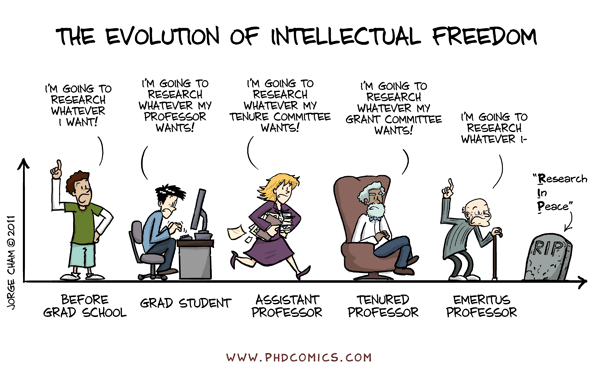
HN's negativity is comparable to the negativity I have seen with CS, Maths, and Physics PhDs and Postdocs in personal discussions. See also PhD comics: https://phdcomics.com/comics/archive/phd072011s.gif

If you are an idealist you will of course be worn down by the way many academic institutions are set up. There is a ton of writing on this, e.g., https://www-users.cse.umn.edu/~odlyzko/doc/decline.txt

Re: Mourning and moving on: rituals for leaving a career (2014)

#49
post #16

Earlier quoted context omitted.

Not to highjack this topic, but she was recommended (like to many others of you no doubt) quite a bit in my Youtube feeds over the last few months; and the first few videos I watched seemed to be solid enough. Yet as I watched a few more, I couldn't shake the feeling that she's so out of left field that she's not just a 'quirky renegade' anymore, but rather a quack who dresses up her quackery with just enough 'real'…

> just how serious should she... be taken? Very seriously indeed if you value higher education and research. Lot's of people do. Over a decade ago now, Ben Ginsberg wrote "Fall of the Faculty". Political scientists like Wendy Brown have picked apart not only the evidence, but done deep analytical work on the reasons for the disintegration of academia in the West. Even Peter Thiel (who I profoundly disagree with on al…

I think - no, I fear, fear is the right word - that there is much more than just academia disintegrating in the West.

> Almost all human values have been expunged and replaced by a puppet show of performative theatrics, led by MBA educated impostors and career administrators.

Not just academia.

This is the way the world ends

Not with a bang but a whimper.

Re: Mourning and moving on: rituals for leaving a career (2014)

#50
post #45
post #16

Earlier quoted context omitted.

Not to highjack this topic, but she was recommended (like to many others of you no doubt) quite a bit in my Youtube feeds over the last few months; and the first few videos I watched seemed to be solid enough. Yet as I watched a few more, I couldn't shake the feeling that she's so out of left field that she's not just a 'quirky renegade' anymore, but rather a quack who dresses up her quackery with just enough 'real'…

I've seen similar reactions and I can't help but think she's intentionally communicating provocatively to make people engage their brains. You shouldn't just "take her seriously", you should take what she says *critically*. Hear the information and opinions, then decide for yourself whether to accept them.

> Hear the information and opinions, then decide for yourself whether to accept them.

This sounds awfully similar to the “do your own research” defense that is often used as a cop-out disclaimer for quackery topics.

When someone presents themselves as an expert on a topic and invests a lot of time into making convincing videos about their beliefs, defending them with a “do your own research” feels like a tacit admission that they’re not actually the expert they present themselves as.

This feels somewhat like the high-brow intellectual equivalent of Joe Rogan making confident statements about COVID and then defending himself with “I’m just a comedian, do your own research”. You can’t have it both ways.

Post reply on HN