Live data from Hacker News

Why are Texas interchanges so tall?

practical.engineering

71–80 of 352 posts

Re: Why are Texas interchanges so tall?

#71
post #35

Does anyone know why the flyover ramps in a stacked interchange usually have such large vertical clearances? The vertical separation seems much larger than necessary to accommodate the tallest trucks allowed on the highway. EDIT: There are some more theories here: https://engineering.stackexchange.com/questions/4238/why-are... Obviously there may be many contributing factors, but I expect one is dominant. This one is…

It's because they let the same company design and build the interchange and own the concrete plant. "Design-build" project delivery. It is the same reason why the new HSR projects in California have ludicrous vertical and side clearance compared to other countries with better/cheaper HSR.

I don't follow, why they would increase their costs on purpose?
Re: Why are Texas interchanges so tall?

#72
post #34

Earlier quoted context omitted.

Assuming the 500k people all commute between 6am-9am and 3pm-8pm, that means this interchange moves 160k people per hour. That's 1½-2½ commuter rail lines or about 3-4 subway lines. Such interchanges are truly a monument to stupidity.

That's 500k vehicles not 500k people. While the plurality of vehicles could be single-occupant passenger vehicles, a good chunk of those vehicles are freight, multiple-occupant passenger vehicles, and some are even busses.

Being someone that has sat in a lot of traffic in Texas on these interchanges, the number of vehicles with more than one person is a rounding error.

There's a few trucks hauling freight, but they try to miss the cities during rush hour.

Re: Why are Texas interchanges so tall?

#73

Does anyone know why the flyover ramps in a stacked interchange usually have such large vertical clearances? The vertical separation seems much larger than necessary to accommodate the tallest trucks allowed on the highway. EDIT: There are some more theories here: https://engineering.stackexchange.com/questions/4238/why-are... Obviously there may be many contributing factors, but I expect one is dominant. This one is…

> The vertical separation seems much larger than necessary to accommodate the tallest trucks allowed on the highway.

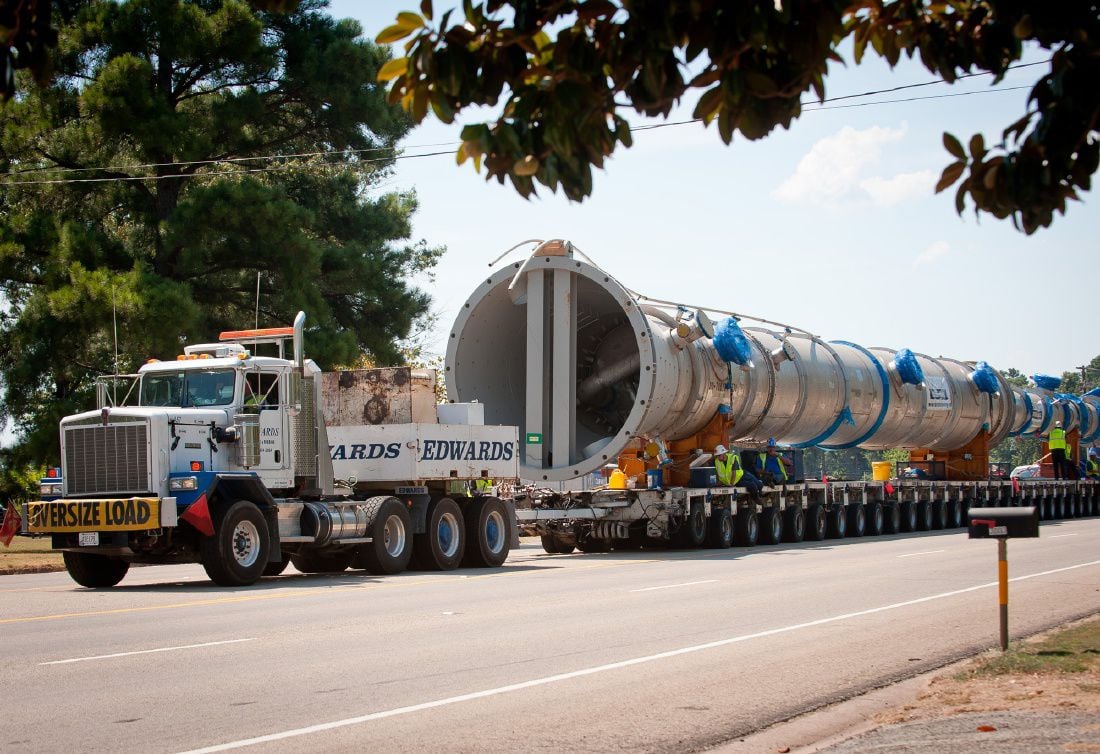
The vertical height of things we want to send down the highway are also sometimes larger than the tallest trucks on the highway.

https://bloximages.newyork1.vip.townnews.com/news-journal.co...

Re: Why are Texas interchanges so tall?

#75
post #35

Earlier quoted context omitted.

It's because they let the same company design and build the interchange and own the concrete plant. "Design-build" project delivery. It is the same reason why the new HSR projects in California have ludicrous vertical and side clearance compared to other countries with better/cheaper HSR.

I don't follow, why they would increase their costs on purpose?

No clue as to the validity of the above claim, but some contract types expose the customer to actual costs exclusively. e.g. T&M or cost-plus.

Re: Why are Texas interchanges so tall?

#76
As somebody who lived in Dallas and drove on the high five with some frequency, I had actually a lot of questions about the design of it. If somebody who understands this could explain I’d be happy.

For one, a lot of the overpasses had two lanes. But then they merged down to one right before you got on the highway…

What’s the point in having two lanes on the overpass that merge just before you get onto the highway? There was always slow traffic because of this.

If it was me, I would always make it so that you lose equal number of lanes To the outgoing overpasses as you will get in incoming overpasses to prevent inefficient lane changes. So if you have six lanes, you get 4 branch off, 2 for each direction on the other highway and keep 2. Then you get the four back from the intersection. No lane change.

But the way they have it, there’s so much merging it , which is harder to drive, and I’m not sure it’s more efficient.

Any thoughts?

Re: Why are Texas interchanges so tall?

#77

I only had a quick skim so far, but I did not feel like the article gave a firm enough rationale? I have seen scenarios in Texas when there is seemingly no other infrastructure or geography that could explain the over building.

It's addressed. The frontage roads by any reasonable measure seem like an objectively stupid idea that the state largely regrets building so much of, but they did it because it made it easier to acquire the adjacent land to build the highways. There may not be any infrastructure or geography that would have made building differently any harder, but the land had owners and Texas is probably abnormally deferential to p…

The frontage roads are great. If the freeway comes to a standstill you just cross over to the frontage road and continue. Doesn't matter if there's an exit or not. Everyone has giant 4x4 trucks so you can just exit where ever you want and hop on the frontage road. Eventually everyone does that and the frontage road gets clogged so timing is everything. Texas is interesting.

Re: Why are Texas interchanges so tall?

#78
post #76

As somebody who lived in Dallas and drove on the high five with some frequency, I had actually a lot of questions about the design of it. If somebody who understands this could explain I’d be happy. For one, a lot of the overpasses had two lanes. But then they merged down to one right before you got on the highway… What’s the point in having two lanes on the overpass that merge just before you get onto the highway? T…

There's a cities skylines YouTuber who agrees with you. He calls it lane math. "2 come off, 2 go on,..." I'm sure there's some reason the engineers do it irl, but it is funny that going with your approach does fix things in game.

Re: Why are Texas interchanges so tall?

#79

Earlier quoted context omitted.

Now THAT is some cool engineering I can get behind.

That sounds like tens of millions in extra infrastructure costs so as to save trucks a tiny amount of gas. It is Texas, so anything is possible.

Infrastructure maintenance is far cheaper in areas without regular freeze/thaw cycles (like most of Texas). I wouldn't be surprised if almost all road spending in southern states went straight to highways and ignored local roads though, as there are a ton of dirt roads unless you are in a city or on the highway.
Post reply on HN