Live data from Hacker News

Retina MacBook Pro Review: The Age of the High-Resolution PC

stevestreza.com

31–40 of 47 posts

Re: Retina MacBook Pro Review: The Age of the High-Resolution PC

#31

Earlier quoted context omitted.

The X-Box is a whitelabel product?

Depends how you define it. But, X-Box (the original) was a PIII + Nvidia + Other PC Hardware... none of it made by Microsoft. The 360 I give them more credit with, because they worked closer with partners and got off the WinTel brand... opting for PowerPC chips with ATI ... again, not manufacturing the hardware.

"again, not manufacturing the hardware" -- well, you noticed all Macs have nvidia or amd/ati GPUs and Intel processors, and are assembled by Foxconn?

"That's because Apple isn't a real hardware company, it's all white-labelled." I guess?
Re: Retina MacBook Pro Review: The Age of the High-Resolution PC

#32

Does anyone else think it weird that the first mainstream hi-res displays weren't pushed by Microsoft? Let me explain... Back when WPF was still called Avalon, Microsoft were pushing the technology as a solution for the soon-to-be-arriving high-dpi displays (which, we were assured, were right around the corner). As an example, see a contemporary blog post: http://blogs.msdn.com/b/marcelolr/archive/2004/12/03/274213..…

> Back when WPF was still called Avalon, Microsoft were pushing the technology as a solution for the soon-to-be-arriving high-dpi displays Although they were quieter about it, it has been quite clear that Apple was interested in resolution independence since at least 10.4, when such features started to show up. Remember that very few third-party Windows applications use WPF. Most first-party stuff, even, doesn't use…

It's a chicken-and-egg situation, agreed, It just seems really strange to me that they spent so much effort pushing and developing the software side, without putting any effort into the hardware, when the two clearly have to go hand-in-hand.

Microsoft had the software stack ready - imagine if they had released (via partners) high-dpi laptops and screens shortly afterwards? That actually might have made a Windows machine a compelling and desirable product, instead of just an expensive way to run a browser.

Re: Retina MacBook Pro Review: The Age of the High-Resolution PC

#33
post #31

Earlier quoted context omitted.

Depends how you define it. But, X-Box (the original) was a PIII + Nvidia + Other PC Hardware... none of it made by Microsoft. The 360 I give them more credit with, because they worked closer with partners and got off the WinTel brand... opting for PowerPC chips with ATI ... again, not manufacturing the hardware.

"again, not manufacturing the hardware" -- well, you noticed all Macs have nvidia or amd/ati GPUs and Intel processors, and are assembled by Foxconn? "That's because Apple isn't a real hardware company, it's all white-labelled." I guess?

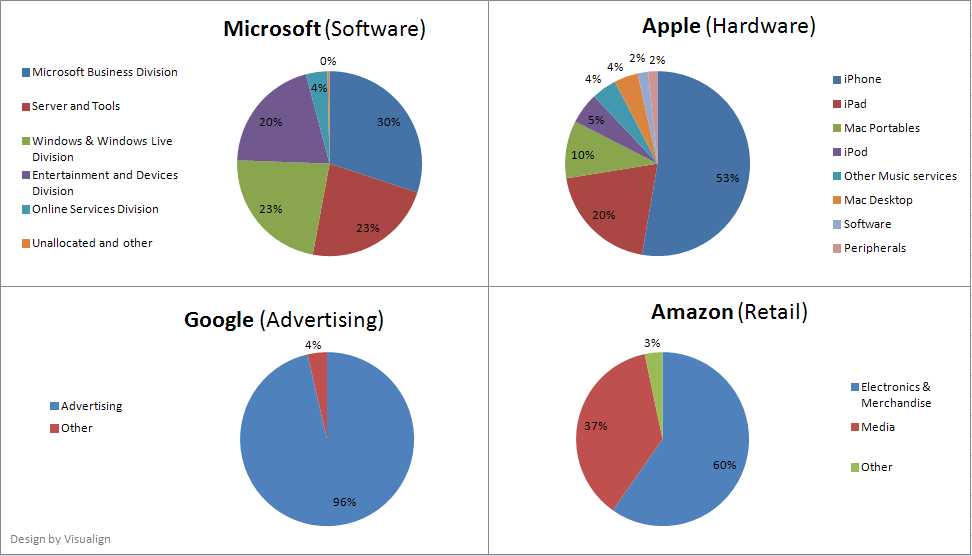
I define companies by WHAT MAKES THEM MONEY. I can't tell if people are pedantic or dense.

Apple makes money by selling hardware. Microsoft makes money by selling software. Google makes money by selling ads. Amazon makes money by selling goods.

Graphic for the insanely dense: http://visualign.files.wordpress.com/2012/02/applemicrosoftg...

Re: Retina MacBook Pro Review: The Age of the High-Resolution PC

#34

The intro/overview are a complete load of codswallop... Touting increases in DPI as game changing couldn't be farther from the truth. Nevermind the painting of apple as innovators.

One of my first thoughts after hearing the original iPhone announcement was "what a low resolution screen".

After all, the Nokia 770, released a couple of years before the iPhone, had an 800x480 screen.

Most full websites back then were usable on an 800 pixel screen. Because it had a low-res screen, the iPhone required mobile versions, which I thought would doom it due to the chicken and egg problem.

Remember, back then the iPhone didn't allow third party apps, the "blessed" way of adding capability to your iPhone was through web sites. Who would buy an iPhone if it didn't have any apps or mobile web sites? Who would mobile web sites if nobody bought an iPhone?

Apparently, I was wrong.

Re: Retina MacBook Pro Review: The Age of the High-Resolution PC

#35
Actually, it's the end of the high-resolution PC, since there's no point in adding more detail if your eyes are physically unable to detect the difference. Also, we're already able to buy 3D displays, so that's another 'old' technology too. Smart 3D TV's - old.

I imagine someone's going to be selling 3D contact lenses soon, so all surfaces will be 3D video devices. The next step is to make them intelligent...

Re: Retina MacBook Pro Review: The Age of the High-Resolution PC

#37
As someone who has pretty good eyesight (for the time being at least), I am pretty excited about the prospects of coding in the terminal with a super HD screen (I hate having to buy into Apple's marketing speak). Right now I struggle to have three 80 coloumn wide text files open in VIM on my Lenovo X201, and most other people have a real hard time reading the small font on my screen, while I have just gotten used to it. A super HD screen would mean vertical and horizontal lines of code for me without sacrificing the readability issues of going down in font size, assuming I can adapt to the smaller text.

Re: Retina MacBook Pro Review: The Age of the High-Resolution PC

#38

Earlier quoted context omitted.

Sorry, didn't really clarify what I meant by mainstream: easily available to purchase, by non-techie consumers, from a high-street shop.

Sony multiscan trinitrons weren't exotic - you could purchase them in any reasonable electronics store. I have several that go up to 2048x1536 @ 75hz. Viewsonic had monitors that did the same. While I look forward to higher resolution LCDs becoming a standard option, LCD's set us back resolution wise for quite a long time. LCD does have other advantages over CRT of course.

I had and loved a similar NEC CRT. But 2048x1536 on a 22" display is ~116ppi. Apple's non-retina laptops have been higher than that for years (with the MacBook Air being highest, at ~135ppi), and Sony, at least, has offered configurable 1080p displays in 13" laptops (~165ppi) for some time.

It was pretty nice a decade ago, when everyone was moving to LCD monitors that were vastly inferior in every measure beyond size or weight, but, at least in terms of ppi (and on consumer grade equipment), display technology eclipsed the CRT quite a while ago.

edit: I'd forgotten that CRTs were measured with the bezel included, so at 20" viewable, the display is 128ppi. So closer, but still pretty far behind.

Re: Retina MacBook Pro Review: The Age of the High-Resolution PC

#40
post #38

Earlier quoted context omitted.

Sony multiscan trinitrons weren't exotic - you could purchase them in any reasonable electronics store. I have several that go up to 2048x1536 @ 75hz. Viewsonic had monitors that did the same. While I look forward to higher resolution LCDs becoming a standard option, LCD's set us back resolution wise for quite a long time. LCD does have other advantages over CRT of course.

I had and loved a similar NEC CRT. But 2048x1536 on a 22" display is ~116ppi. Apple's non-retina laptops have been higher than that for years (with the MacBook Air being highest, at ~135ppi), and Sony, at least, has offered configurable 1080p displays in 13" laptops (~165ppi) for some time. It was pretty nice a decade ago, when everyone was moving to LCD monitors that were vastly inferior in every measure beyond size…

Viewsonic had a 19" display (with 18" viewable) that did 2048x1536. I think that was the smallest size that the 2048x1536 CRT's came in.
Post reply on HN