Live data from Hacker News

What I Learned Writing an Album in Just Intonation

osar.fr

11–20 of 99 posts

Re: What I Learned Writing an Album in Just Intonation

#11
This reminds me of when I stumpled into a music theory flame war by proposing the "scale": 1, 15/14, 15/13, ..., 15/8, 2. https://music.stackexchange.com/questions/66620/what-is-a-te...

This set of 8 nodes (can be transposed to whichever base frequency) has the lowest common denominator between any pair of nodes among all 8-node scales.

I thought that might make it a good choice for a just intonation scale (which can really be any subset of frequencies you build you music from), but it turned out a sensitive subject.

Re: What I Learned Writing an Album in Just Intonation

#12
post #6

“ This also has the reputation of being terribly impractical, which is always a selling point for me.” That was truly LOL. Thank you.

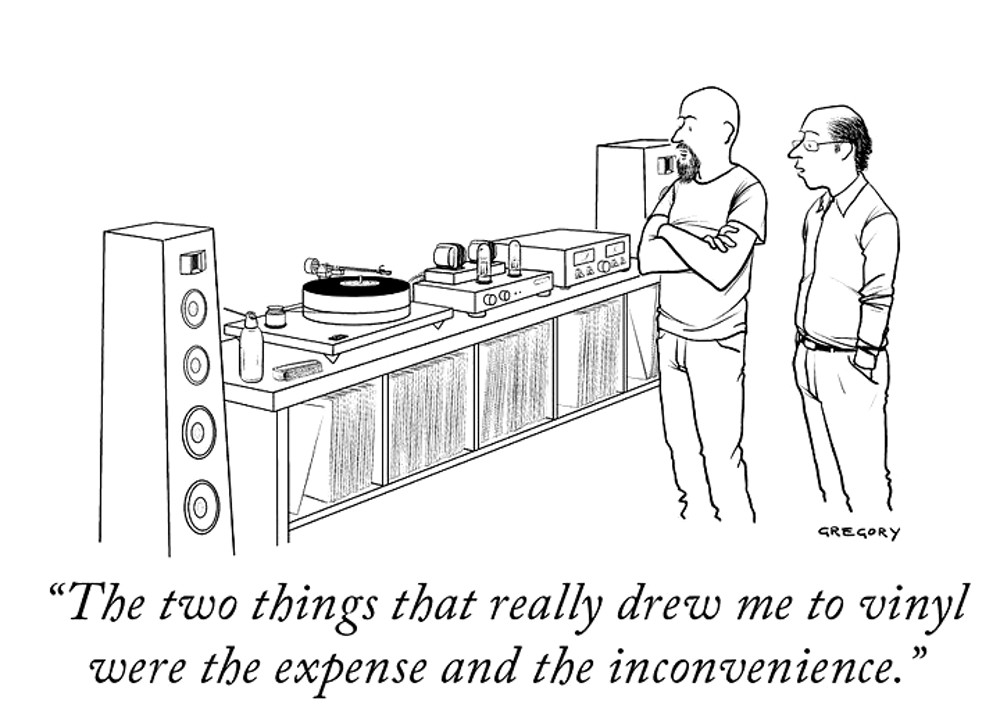
posting related vinyl record collection comic: https://www.ratherrarerecords.com/wp-content/uploads/AlexGre...

Re: What I Learned Writing an Album in Just Intonation

#13
post #9

Earlier quoted context omitted.

The interactive harmonic lattice, with the commas clickable and audible, is first rate and is the best interactive illustration of JI problems I have yet seen. It is not quite clear from the explanation, that since the "3" direction is also dividing by 2 implicitly, the note confusingly labeled "3" is really just 3/2 - the perfect fifth. Similarly, the note labeled "5" is actually what we hear as the 12TET major thir…

I'm now realizing this and I totally agree that hiding the octave transpositions might make things confusing. Maybe this could be clarified by having a first lattice where this adjustment is not made, and everyone can observe how frequencies rapidly become extremely low or high, maybe to the point of being inaudible. Then we can ask "how can this problem be solved?" and introduce the concept of pitch class lattices w…

To continue with an empty cup philosophy while still mentioning intervals, you can just posit "humans like how these 5- and 3-ratio intervals sound" and play chords using them to demonstrate. Then you don't need to handwave why this particular lattice was picked, and you can draw a comparison to 12TET's third and fifth.

Re: What I Learned Writing an Album in Just Intonation

#14
post #2

When I compose, I usually begin by sitting quietly and humming or singing out loud until I have a melody that I like. Because I was born and raised in the west, acoustically I'm naturally accustomed to a 12 tone equal temperament. Atonal music is more difficult for me to grok, and I kind of imagine that for you to be fluent and compose in these sort of microtonal scales you would need to be introduced to it at a youn…

I have no clue about this topic, but isn't Just Intonation what e.g. people sing when left to their own devices?

Re: What I Learned Writing an Album in Just Intonation

#15
post #3

I'd love to get some feedback on this, because I'm not sure I've hit the original goal of this article. For a long time, the topics of just intonation, harmonic lattices, and of their relationship with temperaments were difficult for me to understand, despite reading the theory on them. It's not until I applied the concepts that could say I understood them. I tried writing the "missing article" that would have given…

I would say that this is way too technical for me, however, I also only have the slightest hint of music theory knowledge to begin with. It seems to me like that isn't a problem though, because this is a very technical topic by nature. Unrelated to the writing, but I was kind of disappointed that when listening to the examples, I cannot for the life of me hear a difference between just intonation and equal temperamen…

Do you hear the differences when clicking the 275 vs the 277 in the third player? If so, you can try to focus on those frequencies and see if they stand out to you.

Re: What I Learned Writing an Album in Just Intonation

#16
post #3

I'd love to get some feedback on this, because I'm not sure I've hit the original goal of this article. For a long time, the topics of just intonation, harmonic lattices, and of their relationship with temperaments were difficult for me to understand, despite reading the theory on them. It's not until I applied the concepts that could say I understood them. I tried writing the "missing article" that would have given…

I think you could make the piece more interesting to the casual reader by grounding the subject in its history. It's been suggested by the book below that the dominance of equal temperament in western music is a relatively recent innovation, something like 120 years old, and is perhaps a consequence of the industrial revolution and the demand for mass manufacture of musical instruments having uniform qualities it produced.

Further reading: How Equal Temperament Ruined Harmony (and Why You Should Care), by Ross W. Duffin (2008).

My layman's takeaway from the book: Equal Temperament is a compromise tuning that allows a piano to access all major and minor modes, at the cost of the keys on the outer ring of the circle of fifths to be somewhat out of tune. An ET "C Major" "sounds best", and the further you move away from it in either direction, the worse the key sounds. Also, the fact that Beethoven and Mozart were aiming for just intonation and/or meantone in productions of their works seems to be sort of an inside secret among music maestros, with rigid adherence to equal temperament slyly pushed on competing rookies to keep them trapped in the lower ranks by virtue of their resulting weaker performances. But the subject is highly contentious in western music for sure.
Re: What I Learned Writing an Album in Just Intonation

#17
Haven't read it fully (to be honest this topic is new to me), but it's funny that as I read this article, I also happen to listen to a microtonal music: Flying Microtonal Banana by King Gizzard & The Lizard Wizard.

Both the name of the album and the name of the band sounds funny, trust me when I say this: It's one of the best microtonal album out there. They really mixed the sound element of turkish(?) music into the album. Highly recommended!

Re: What I Learned Writing an Album in Just Intonation

#18
post #3

I'd love to get some feedback on this, because I'm not sure I've hit the original goal of this article. For a long time, the topics of just intonation, harmonic lattices, and of their relationship with temperaments were difficult for me to understand, despite reading the theory on them. It's not until I applied the concepts that could say I understood them. I tried writing the "missing article" that would have given…

I think you could make the piece more interesting to the casual reader by grounding the subject in its history. It's been suggested by the book below that the dominance of equal temperament in western music is a relatively recent innovation, something like 120 years old, and is perhaps a consequence of the industrial revolution and the demand for mass manufacture of musical instruments having uniform qualities it pro…

I disagree. I really liked that this post focused on the subject matter, rather than the history. History can be interesting in itself, but I find that when trying to actually learn something it is just a layer of distraction. Maybe “casual“ reader would find it interesting to read about the history. But more technically inclined readers might then just bounce off the piece because they would have to weigh through history in order to get to the part which they actually found interesting.

Re: What I Learned Writing an Album in Just Intonation

#19
post #10

What a marvelous article about intonation and temperament. It is one of those expositions that approach perfection in conveying the subject matter. I am no music theorist but rather an engineer with an appreciation for all things wave- or signal-oriented. I will want to read it multiple times to savor the explanations. The author's album based on just intonation is linked in the article ("A Walk Through The Ambient G…

To save people a few clicks, there's a wonderful visualisation of the generated music at https://ambient.garden/

Re: What I Learned Writing an Album in Just Intonation

#20
post #2

When I compose, I usually begin by sitting quietly and humming or singing out loud until I have a melody that I like. Because I was born and raised in the west, acoustically I'm naturally accustomed to a 12 tone equal temperament. Atonal music is more difficult for me to grok, and I kind of imagine that for you to be fluent and compose in these sort of microtonal scales you would need to be introduced to it at a youn…

I have no clue about this topic, but isn't Just Intonation what e.g. people sing when left to their own devices?

Yes
Post reply on HN