Lawsuit between origami enthusiasts unfolds
1–10 of 42 posts
Re: Lawsuit between origami enthusiasts unfolds
#2While the article has parallels in software copyright, I +1'd this post because it has the best title ever.
Re: Lawsuit between origami enthusiasts unfolds
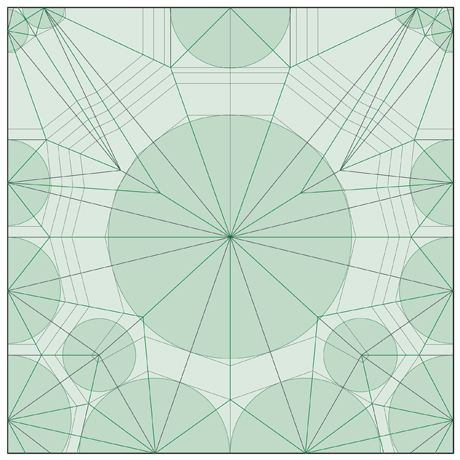
#3Not strictly between origami artists, though; between an origami artist (Lang) and a painter. She painted his crease patterns, well-recognizable, with one or two changes that my eye parses as annoyingly illegal.
If you're not into origami, you may think a crease pattern is just an unintended byproduct -- what you happen to get when you unfold a model. This isn't the case, as the article explains. These things are carefully designed, and are the heart of the engineering process. Models in books or on display sometimes come with diagrams of the pattern. Receiving a model as a gift, one may very well unfold it flat to look at the crease pattern and see how it was done.
So I guess this is sort of like finding a pretty geometric pattern in someone's source code (that they put there!), and painting it.
I think it's too much of a shortcut to just take his crease patterns without attribution. She's an artist; she can learn the art and make her own. It's not as though it's a unique insight on her part that the useful patterns are beautiful in an abstract, geometric way. We (origami enthusiasts) all think they are. The paintings are beautiful and intriguing, but the art that makes them so isn't hers; it's Lang's.
I'm all for remixing and free information, but . . . I think at a minimum, attribution would be polite.
Re: Lawsuit between origami enthusiasts unfolds
#4The posted article doesn't have examples of the copied art, but this page does:
http://www.langorigami.com/copyright/sarah_morris_copyright_...
It's not a matter of similarity, or independent creation - The painter Sarah Morris directly copied the original artist's work, removed the lines and colored in the voids.
Since there's no question that copying took place, the case will hinge on whether the copying was "fair use" - that's where the issue of whether the copying was "transformative" comes in.
Re: Lawsuit between origami enthusiasts unfolds
#5Robert Lang's work is jaw dropping - Here is his TED talk
http://www.ted.com/talks/robert_lang_folds_way_new_origami.h...
Re: Lawsuit between origami enthusiasts unfolds
#6For reference, Robert Lang is not just some origami guy who happens to use computers; he's one of the foremost origami-math guys [0] and one of the pioneers in computer-designed origami.
In his books, he typically has both detailed step-by-step instructions for each model, as well as an "overview" image that shows where all of the creases will end up on the original sheet of paper (seen in image 3 and 7 at the top of the article, as well as example [1]); it's paintings of some of these overview images that are in question. He seems to treat both those overview images and the final products as art, not mere "instructions", in prior interviews (they are actually quite useless as instructions.)
This will be a critical point in the case: do the crease overview images count as art? If so, Lang has a certain amount of say-so in how they are used.
[0] he authored the proof of completeness of the Huzita-Hatori axioms: http://en.wikipedia.org/wiki/Huzita%E2%80%93Hatori_axioms [1] http://cabinetmagazine.org/issues/17/Scorpion.jpg
Re: Lawsuit between origami enthusiasts unfolds
#7Reminds me of Andy Warhol's use of soup cans, except the subject of the art is itself an "art".
Re: Lawsuit between origami enthusiasts unfolds
#8Robert Lang's work is jaw dropping - Here is his TED talk http://www.ted.com/talks/robert_lang_folds_way_new_origami.h...
Just... wow! I had no idea origami had progressed that far. The animals are so life-like, it's a bit creepy. All the practical applications of the folding principals are very interesting.
Re: Lawsuit between origami enthusiasts unfolds
#9The posted article doesn't have examples of the copied art, but this page does: http://www.langorigami.com/copyright/sarah_morris_copyright_... It's not a matter of similarity, or independent creation - The painter Sarah Morris directly copied the original artist's work, removed the lines and colored in the voids. Since there's no question that copying took place, the case will hinge on whether the copying was "fair…
It's especially interesting given that Lang has exhibited his crease patterns - though not as standalone images, judging from what he shows; he's very aware that it's a precursor to a model.
Morris is copying his crease patterns and treating them as an end in themselves; the way she turns them into abstract color fields is very different from what Lang has done with them. Although on the other hand I will quite happily bag on people like Shepard Fairey (the Obey Giant dude) for tracing images without attribution.
I dunno, I've got some of Lang's books in my library, he is amazing and I totally respect him as an artist, but I think that Morris is doing something interesting here too. Citing her sources would help a lot though.
Re: Lawsuit between origami enthusiasts unfolds
#10She should have mentioned his name as source material. I don't think royalties or anything were in order, but his name should've been there as a matter of courtesy.