What finally got this to stick for me was abandoning all notion of structure and organization (and formal concepts like “logging” and “journaling”) and optimizing fully for capture over retrieval, then relying on search tools and proximity for the latter. I have the OneNote icon in the notification area configured to create a new quick note and use it liberally. Occasionally I look through all the pages, especially t…
Use a work journal
41–50 of 305 posts
Re: Use a work journal
#42Earlier quoted context omitted.
Woops, thanks for letting me know, should be fixed in a few minutes. That's the one: https://fev.al/img/2024/focus.png
I'm getting the below instead of an image ![/img/2024/focus.png]
Re: Use a work journal
#43Re: Use a work journal
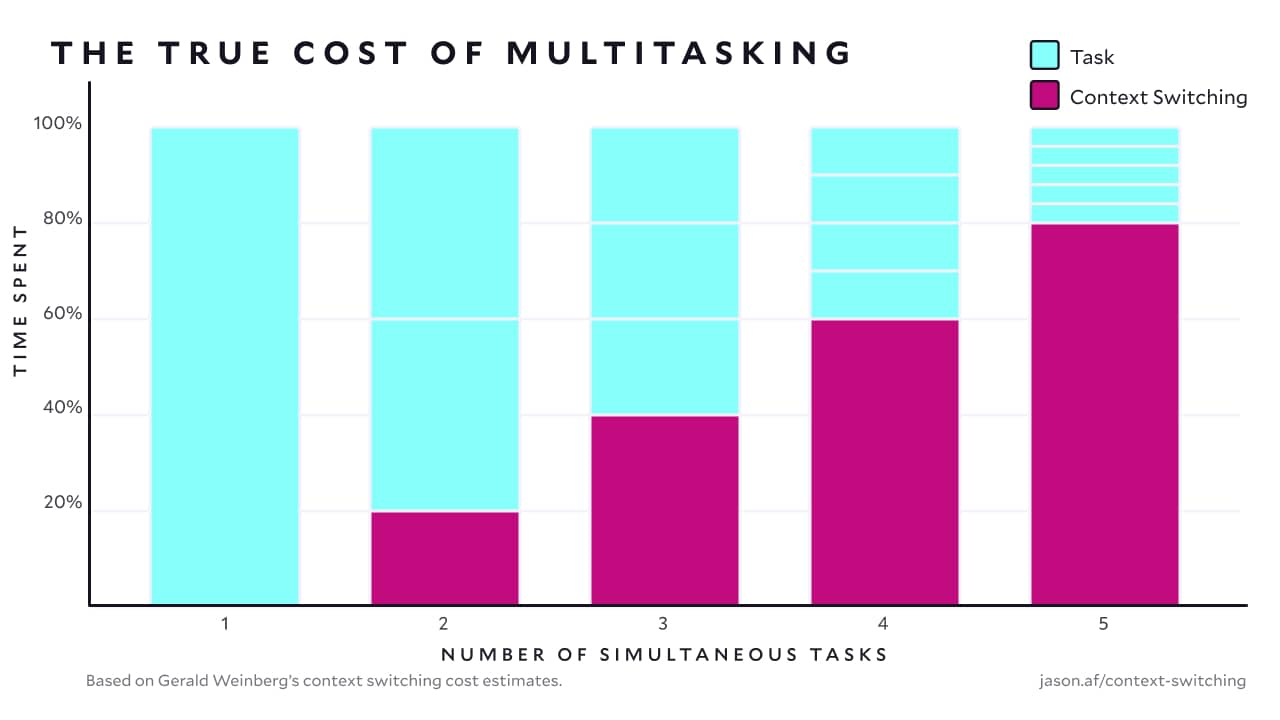
#44Reminds me a lot of Cal Newport's ideas re: Slow Productivity. He talks a lot about how Context shifts are death for knowledge work and that a lot of offices operate via a "hyper active hive mind" that doesn't allow or value deep work.
If meetings were eliminated (or just consolidated into a single planning week), and I cloud just do deep work, I think I could work 2 days per month and be more productive than I am currently working 40+ hours per week.
I always want to send my management graphs like this to show them why having 10 projects running at a time is a bad idea...
https://res.cloudinary.com/jlengstorf/image/upload/f_auto,q_...
...but I know it will be received poorly.
The image in the article (here, since the link was broken: https://fev.al/img/2024/focus.png) is something I've sent to a boss in the past. He didn't get it.
Re: Use a work journal
#45To those who keep doing this for a longer period: Any tips would be appreciated.
Re: Use a work journal
#46The benefit of journaling is not just reentry, but that you begin to solidify the mental model into a concrete branching of possibilities that is tightly coupled to the specific problem. Your work becomes traversal and mutation of this tree. Several benefits accrue: you begin to see gaps in the tree, and can fill them in. You begin to have confidence in your mental model, recovering the time you used to spend going o…
Re: Use a work journal
#47I use GitHub Issues threads for this and it works amazingly well. Any task I'm working on has a GitHub issue - in a public repo for my open source work, or a private repo for other tasks (including personal research). As I figure things out, I add comments. These might have copy pasted fragments of code, links to things I found useful, quoted chunks of text, screenshots or references to other issues. I often end up w…
I use it for everything and not only work journal, this creates a small problem.Since I dump both future references and worklogs, and I have ~50 channels, it's very easy to not get back to things and only get back to it when needed(which is the idea mentioned by OP). It seems like a feature than a bug at first but after capture, one round of review after some time interval really helps. It took a while but slowly seeing the benefits.
For that I plan to write some bot to re-organize the worklogs and the reference/other things dump to my own email at the end of the week and then I can create something like https://simonwillison.net/tags/weeknotes/ for myself(private) to go though at the end of the week. I think it would be perfect for me.
Re: Use a work journal
#48The benefit of journaling is not just reentry, but that you begin to solidify the mental model into a concrete branching of possibilities that is tightly coupled to the specific problem. Your work becomes traversal and mutation of this tree. Several benefits accrue: you begin to see gaps in the tree, and can fill them in. You begin to have confidence in your mental model, recovering the time you used to spend going o…
To add to your "this is wrong": These others may have themselves solved the problems we are now trying to solve, likely even using a journal. They no longer need a journal since they know how to navigate it, and it appears as superior to us.
Re: Use a work journal
#49To me the hardest part of journaling (or Pomodoro, or whatever work-related methodology/hack) is to stick with it. I have a work journal. I abandoned it and came back, then abandoned it and came back again. It's an endless back-and-forth. To those who keep doing this for a longer period: Any tips would be appreciated.
What really worked for me is to make it a primary tool of work. Rather than sometimes writing what I did today, whenever I work on something somewhat involved, I immediately write my approach about it ("I need to do X so I started Y").
Re: Use a work journal
#50Reminds me a lot of Cal Newport's ideas re: Slow Productivity. He talks a lot about how Context shifts are death for knowledge work and that a lot of offices operate via a "hyper active hive mind" that doesn't allow or value deep work.
I don't care how long a thing takes, and I don't retrospectively analyse the time. The point is that I can only have one timer running: and that's the thing that I'm supposed to be doing.
If I notice I'm doing something else, it serves to bring me back to the task.
And at the end of the day, I do look through the list and see how often the thing I was doing changed. I try to keep that to a minimum, because every change is a context switch.
I've only been doing this for about a week, I'm still working on it, but so far it's been more helpful than not.