Live data from Hacker News

Qualcomm's Oryon core: A long time in the making

chipsandcheese.com

141–150 of 182 posts

Re: Qualcomm's Oryon core: A long time in the making

#141
post #7

Earlier quoted context omitted.

Hasn't each gen been like 20-30% performance? Isn't that better than what AMD and Intel have managed?

I've been tracking the performance increase via GeekBench for M1, M2, M3 and now M4 and they are good incremental and consistent improvements: https://docs.google.com/spreadsheets/d/1i5dBe_rsiNaQATH-D-Pj...

Thank You for the Google Spreadsheets. I did my comparison on my Apple Numbers, dont know why it never occurred to me I could do it on Google Spreadsheets and shared it out on the web.

For M1 - M3 the IPC improvement were minimal. Absolute performance came from Node and Clock Speed improvement. And for M4, most of the single core improvement actually came from floating point improvements. If we look into each test results and in terms of Integer I remember last time I checked it was less than 5%. In total, M1 to M4 has less than 10% of IPC improvement in terms of integer performance.

This is not to say I am disappointed or surprised like all others. A lot of the CPU improvement went from A12 to M1 / A14 which was barely showcased by Apple developer toolkit during ARM transition. The ultra wide design which Apple were perfecting for many years before it reached M1, has reached a plateau.

I am now wondering if there could be some other Integer IPC improvement, but judging from M4 we will likely have to wait until 2026 before we see anything new in terms of CPU uArch design.
Re: Qualcomm's Oryon core: A long time in the making

#142
post #138

Earlier quoted context omitted.

These statements are orthogonal though i.e. 2300->3800 is still less than 20% per generation (17% per if you use the exact single core numbers for the M1 vs M4 iPad). That might be meaningful for your workload but it also means 20-30 percent per generation is quite a bit off.

I am sorry I have to say this out loud. But seriously? We expect 20% per generation ? When the word generation used to mean 2 years in CPU terms because that was what Moore's law or Intel's tick tock dictate. Even ignoring the word generation, For the past 20 years how many times did we see a successful uArch bringing 20% IPC improvement over the current leading IPC? Where did that 20-30% per gen coming from. The wor…

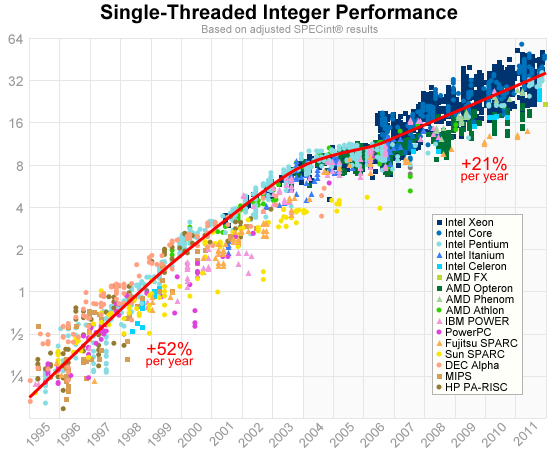
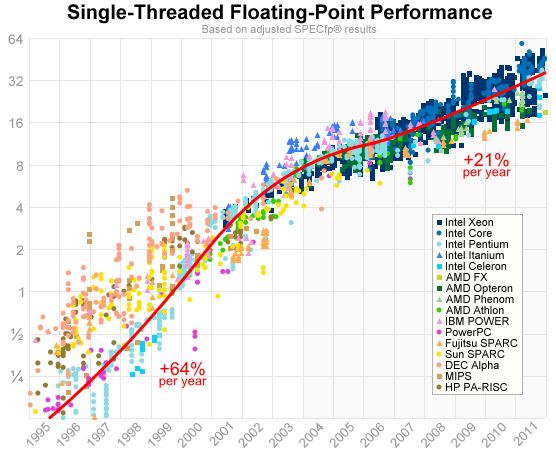
On the contrary, _not_ expecting at least 20% per year (more for generations farther apart) is actually only a recent take for CPUs [1][2] which formed in what I like to call "the great stagnation" of the mid 2010s where AMD bombed, ARM was still a low performance mobile play, and Intel didn't have any stiff competition. After that things have started to pick up a little again now that there is innovation on said fronts [3]

I remember there was even a period Moore's law was commonly conflated with "a doubling in performance every 2 years" (implies people being used to an increase of at least 41% per year) instead of a doubling in transistor count. Because Intel's tick-tock model started ~5 years prior to the great stagnation people commonly claimed it's the end of Moore's law and that's why we have tick-tock's now. Of course these days it's common knowledge that Moore's law (the actual transistor count version) has been holding steady all these years still and that the performance lull wasn't related to hitting and innate technical scaling barriers.

Marketing departments are definitely going to be marketing departments but they aren't the origin of the idea CPUs can have more than minor increments in performance each year.

[1] https://preshing.com/images/integer-perf.png

[2] https://preshing.com/images/float-point-perf.png

[3] https://i.imgur.com/HlGbJE9.png (note this chart is linear not log)

Re: Qualcomm's Oryon core: A long time in the making

#143
post #136

Earlier quoted context omitted.

> Or AMD / Intel could just make more power efficient x86 core? What would they gain by switching to ARM? I mixed some thoughts in rewrites. I hope Nvidia releases laptop/desktop SoC. AMD is getting better at x86 mobile, Steamdeck is pretty decent. I hope they keep getting better. I'd like to see high-end integrated GPU on a SoC from AMD for laptops/desktops. That doesn't exist yet. It requires a discrete GPU and the…

There is a different between design and developing a CPU Core like Oryon Core here, and Nvidia shipping ARM SoC which the CPU design itself that is from ARM, likely Cortex-X5.

I don’t care who designs the CPU. I just would love to see a Nvidia SoC that targets laptops and desktops that has a high end GPU built in.

Does that require them to design a custom CPU and not use an ARM design? I don’t know. I also don’t really care. Either way is fine!

Re: Qualcomm's Oryon core: A long time in the making

#144
post #129
post #128

Earlier quoted context omitted.

Well yeah... I was saying that they improved power consumption massively compared to Apple since 2020. Which is true. 10th gen was horrible and now they have almost caught up with the M series.

According to Wikipedia the lastest meteor lakes have a peak draw of 57w. My entire Mac Studio draws 38w.

Apple gives 115 W as the peak draw of the lowest power Mac Studio model (10 core M1 Max) https://support.apple.com/en-us/10202) and 295 W for the highest power (M2 Ultra 24 Core).

I believe 38 W is what you see under your personal "full utilization workload" but it's just that's not comparable to "peak workload" numbers. To be honest the peak numbers are relatively useless anyways, you'll never hit them unless you go do something akin to running purpose written CPU and a GPU benchmark at the same time, specifically designed to utilize all of the hardware capabilities at once rather than do something useful with them. The idle and typical wattage numbers are much more useful and much lower.

Also keep in mind some CPU models (even of the same family) are pushed to e.g. double the wattage for a 25% multicore gain or the like. It doesn't mean the CPU family is complete shit for power efficiency it just means there was a market for a SKU which wasn't very concerned with power consumption.

All that said the M* line is definitely still better efficiency/Watt but I concur with qwytw the difference between Intel and Apple now vs 4 years ago is massively improved and the gap isn't as anywhere near as big as you've been listing.

Re: Qualcomm's Oryon core: A long time in the making

#145
post #129

Earlier quoted context omitted.

According to Wikipedia the lastest meteor lakes have a peak draw of 57w. My entire Mac Studio draws 38w.

Apple gives 115 W as the peak draw of the lowest power Mac Studio model (10 core M1 Max) https://support.apple.com/en-us/10202 ) and 295 W for the highest power (M2 Ultra 24 Core). I believe 38 W is what you see under your personal "full utilization workload" but it's just that's not comparable to "peak workload" numbers. To be honest the peak numbers are relatively useless anyways, you'll never hit them unless you g…

[deleted]

Re: Qualcomm's Oryon core: A long time in the making

#146
post #139

Earlier quoted context omitted.

Do note that the M4 is built on TSMC's 3nm process while the 9950X is built on the relatively older 4nm process. This has been the case for the earlier Apple ARM processors too, as Apple made deals with TSMC to get priority access to the newer processes. In the end as a user you get a slighly faster machine, but that doesn't mean that's all thanks to the CPU architecture. Apple's also has lower memory latencies by vi…

> Do note that the M4 is built on TSMC's 3nm process while the 9950X is built on the relatively older 4nm process. That helps (perhaps a lot, hard to say), but note that moving your design from 4 nm to 3 nm pitch isn’t as simple as recompiling your Verilog. So this is still a significant engineering achievement. Apple is chasing a different design point from the desktop folks: low power and optimized more for single…

Upgradability of RAM isn't the issue, it's the price of getting access to that RAM. On PC you get it for cheap, you just pay for the RAM modules. On Apple, you get it for arm and a leg, as you don't pay for the modules, but for the privilege to use their higher end model with enough RAM.

Re: Qualcomm's Oryon core: A long time in the making

#147
post #31

Earlier quoted context omitted.

>The M4 is the highest single core CPU in the world and it’s in a ridiculously thin tablet That's kind of the problem. The world's most powerful CPU is put in the world's most expensive and thinnest Netflix machine lol. Was the previous "thicker" M3 iPad holding anyone back? All that power and I can't use it to compile the Linux kernel, I can't use it to play the latest Steam/GOG games, or run CAD simulations, becaus…

It's not just a benchmark flex. I have been using Linux since 1992, for many or most of those years on both desktop and server. I am currently more productive while on an Apple Silicon Mac. I would venture to guess that for most people, they would be more productive on a Mac or an iPad versus Linux. Pedantry: To my knowledge, there was no M3 iPad.

> I would venture to guess that for most people, they would be more productive on a Mac or an iPad versus Linux.

Why is that? Because of different UI? Guessing, since you're comparing hardware(Mac/iPad) with operating systems (Linux distributions)...

Re: Qualcomm's Oryon core: A long time in the making

#148
post #54
post #51

Earlier quoted context omitted.

Out of interest, I assume this was an arm64 build of Linux? Which hypervisor or VM software did you use?

Arm64 Ubuntu 22.04 LTS. VMWare Fusion (now free beer) and Podman. Still running the beta of Fusion which I have literally had zero issues with. I have not benchmarked podman. https://blogs.vmware.com/teamfusion/2024/05/fusion-pro-now-a... https://podman-desktop.io/docs/installation/macos-install

Was your VM running arm64 Linux on both Apple and AMD? On AMD cpu, performance of arm64 VM is expected to be poor, because it is a different architecture and "emulation" has to happen. Or do you actually compare to VM running amd64 Linux on the AMD processor?

Re: Qualcomm's Oryon core: A long time in the making

#149

Earlier quoted context omitted.

I'll attempt the best interpretation of the comment. Installing Linux would allow for general purpose use of the device (in a freedom sense). This increases the "utility" of the device and lowers the bar for extending its functionality.

You can run iSH on the device for Linux (somewhat limited). It’s on the App Store https://github.com/ish-app/ish

Can you get real root that way?

Re: Qualcomm's Oryon core: A long time in the making

#150
post #26

Earlier quoted context omitted.

That’s a very narrow definition of “useful” and one I’d say is rather focused on yourself? Why is Linux the arbiter of what is “useful”? Why would it still be a benchmark flex if it was on macOS, an Os where millions of people do professional work everyday? And why is the iPad just a “Netflix machine” when tons of people use the iPad for professional creative use cases as well?

> And why is the iPad just a “Netflix machine” when tons of people use the iPad for professional creative use cases as well? For my family, the iPhone and other Apple devices are the ultimate productivity machines. The App Store, fantastic. Why? Because they are (rightly) terrified of installing apps on Windows. Or any “computer.” They’ve been burned too many times, warned too many times. Unless it’s Microsoft Office…

Do you really think actual people ask for and want "ultimate productivity machines"? Btw this term reveals a true kool-aid drinker. I always wanted a machine that is reliable, supported by the software I want to use, and fast enough, and affordable. I never cared for "ultimate productivity" or winning in some bench. I accept that you do; that is something e.g. managers may talk or care about. But most of them do not seem to agree with you that Apple is the ultimate best, because most workers using computers are still on windows machines.
Post reply on HN